
With Christopher Nolan‘s Oppenheimer around the corner, we look to films about innovation as the theme for July’s Retrospective Roundtable. Read below for our thoughts on a number of films where innovation is a prominent theme. These films weigh the role innovation plays within our lives and our future. We explore both fiction and non-fiction in this retrospective as well as a broad variety of subjects and settings.
The Man in the White Suit (1951)
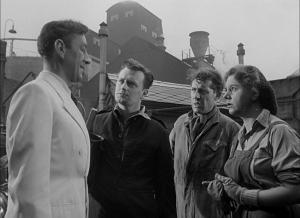 Sometimes there is an invention so miraculous, so revolutionary, that the world is changed immediately. This is what Birnley Mills wants to avoid when word spreads that a researcher, Sidney Stratton (Alec Guinness) at the Mills has invented a fabric that never gets dirty. If Stratton’s invention were to be introduced to the public, then the textile industry would swiftly go belly-up, producing enough clothing with this fabric to saturate the market then find themselves with almost zero demand thereafter. Stratton’s invention is met with derision from both the labor unions and mill owner – he must be stopped.
Alexander Mackendrick’s The Man in the White Suit is a light, comic affair that illustrates how inventions are defined by the era they are produced. Whether or not an invention is disruptive is dependent on its impact on the means of production, distribution, or utilization of other products. The boldest of inventions can irrevocably change an industry – look to the release of the first iPhone – and there are stakeholders who can stand to benefit or be harmed by a new invention. The Man in the White Suit shows the latter, their disbelief in Stratton’s invention fueling outright panic. – Alex Sitaras
Hysteria (2011)
 It is no surprise that there was little understanding of or interest in mental illness in women in England during the late 1800s. “Hysteria” was a blanket term for such conditions, which could have ranged from sexual discontent to something far more serious, and a popular treatment seemed to be genital stimulation. Dr. Mortimer Granville (Hugh Dancy) gains popularity as he is particularly adept at providing such stimulation with his hands. He is forced to quit after he develops a cramp in his hand, which leads him to modifying a friend’s invention of an electric feather duster into what would become the first vibrator. Or at least that is the story that Hysteria tells. In reality, the real Dr. Granville had developed his device to help with muscle pain in men and had specifically argued against using his device to treat hysteria.
Hysteria is a fanciful historical romance that happens to feature a fascinating piece of medical history. Much of the film is dedicated to Granville’s romancing of his boss’ older daughter Charlotte Dalrymple (Maggie Gyllenhaal), who works with the poor and otherwise disenfranchised in a settlement house. The film has a lot of fun at winking to its audience about how the mysterious medical condition of hysteria is really no mystery at all as women of all ages come to seek Dr. Granville’s services. Both Dancy and Gyllenhaal are charming in their story of two well-intentioned souls butting heads but then eventually falling in love. There are hints of a much better film that actually explores the history of hysteria and sexuality especially in how it crossed class and race lines, but this film is not concerned with that. It is primarily a frothy romantic comedy with a sheen of period drama that could possibly lead to a further exploration of a complex and fascinating topic. – Eugene Kang
Side by Side (documentary) (2012)
 Most moviegoers won’t know the difference between a movie shot using film or by digital cameras. To an extent, we take the images that appear on the silver screen for granted – after all, we are typically shown what occurs in front of the camera and not behind it – all the while it remains a matter of contention amongst filmmakers. Side by Side explores the history of digital filmmaking, highlighting key films shot digitally, and muses on the future of filmmaking and the role film will hold.
It is almost impossible to believe that in 1999, there were only four digital projectors within the United States available to screen The Phantom Menace. Flash forward to today, almost all worldwide theater screens have been converted to digital. Side by Side gathers a number of prominent directors and cinematographers to discuss this transformation and how the process of filmmaking has changed through the use of digital cameras. Some – Steven Soderbergh, Anthony Dod Mantle and others – extol the virtues of digital filmmaking while some, most notably Christopher Nolan, are critical (and in Nolan’s case, dismissive).
What Side by Side excels in is informing that the innovations of digital filmmaking have a far more profound impact than merely being a technology upgrade. The transition to digital filmmaking has resulted in different ways of working for film cast and crew. When shooting on film, the footage has to be developed overnight and isn’t immediately available to be seen. Only the cinematographer had clear insight into how the ‘dailies’ would turn out, whereas with digital, the ‘immediatelies’ are instantly available for observation and feedback from the director and actors. Therefore, the cadence of shooting a film can be impacted through this immediate feedback loop. Additionally, innovation in digital filmmaking have opened up a world of editing possibilities but this lends itself to the possibility of over-editing. Whether film or digital remains one’s preference, one cannot deny that the onset of digital filmmaking has made the possibility of making television and movies accessible to just about anyone. Look to films like Paranormal Activity, shows like It’s Always Sunny in Philadelphia, and the burst in video content produced for YouTube and TikTok. – Alex Sitaras
BlackBerry (2023)
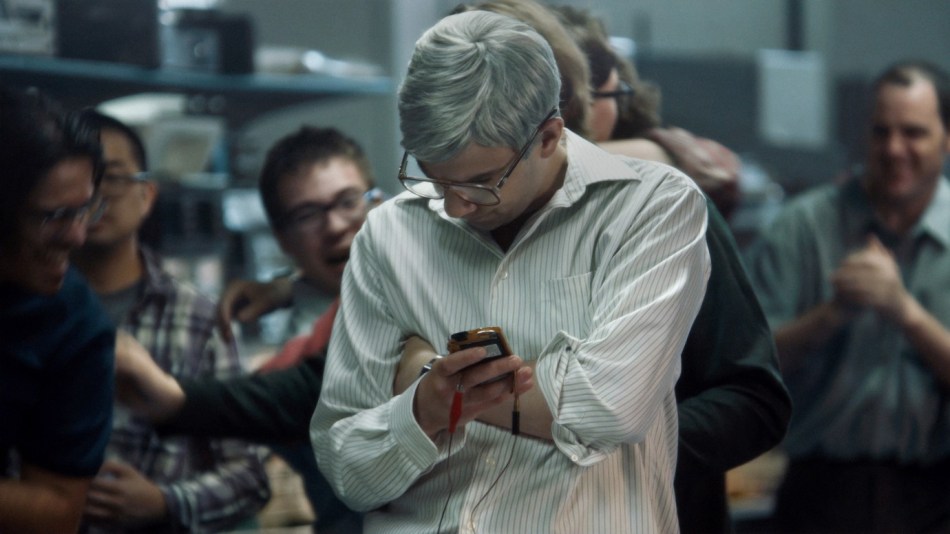
 Director Matt Johnson has managed to make a name for himself in the indie film world with both The Dirties and Operation Avalanche, some of the better takes on the found footage genre in recent years. BlackBerry has those same sensibilities in its telling of the invention of the revolutionary precursor to the smartphone. Though the characters and the story are worthy of something along the lines of The Wolf of Wall Street with its epic story of greed, BlackBerry is an intimate story of personalities clashing. Glenn Howerton plays Jim Balsillie, the brash businessman who is instrumental in taking the device invented by Mike Lazaridis (Jay Baruchel) while working at the company Research in Motion (RIM), which he co-founded with Doug Fregin (Matt Johnson). Much of the early film is Balsillie basically bullying Mike and Doug into getting their act together and pushing them into making what would become the BlackBerry. RIM starts out as a modest company with a few socially awkward scientists and engineers living out the fantasy of playing video games, eating junk food and having movie nights with a little bit of actual work sprinkled in. When BlackBerry really takes off, Johnson makes an interesting choice to make even the new RIM headquarters merely an extension of that same space, with the same movie nights and generally relaxed atmosphere.
The characters remain remarkably consistent despite the dramatic challenges they are faced with, and that will be to their detriment. On the business side is Balsillie and his interminable greed whose cutthroat attitude is constantly at odds with the more relaxed Doug and the neurotic Mike. BlackBerry is definitely concerned with the dangers of venture capitalism left unchecked, but it is also grounded in a seemingly modest but actually intense battle of wills. Mike turns out to be as stubborn as Balsillie is in his insistence that he knows everything there is to know about the cell phone market. It is this insistence, which makes him ignore the threat of the iPhone. With two leads unwilling to compromise when it was needed most, the fall of BlackBerry seems inevitable even if you were unaware of its history. – Eugene Kang
Discover more from Cineccentric
Subscribe to get the latest posts sent to your email.
 Cineccentric
0 comments on “Films About Innovation”