
The summer heat has brought us to a number of bold, challenging, and controversial titles this month (and one coming-of-age story!). Read below for our thoughts on a number of captivating titles we’ve been watching this summer:
Greed (1924)
Films such as Greed and Metropolis are soon approaching their 100th anniversary. These titans of cinema have stood the test of time and will linger in the minds of those either revisiting or watching for the first time. When watching these classics, it never fails to amaze me how nonwithholding these early films penetrated into the human condition. Greed’s story is immensely tragic, weighty in its discourse on envy, free will, and, of course, greed.
 The film centers on the marriage of Dr. John McTeague (Gibson Gowland) and Trina Sieppe (ZaSu Pitts). The two are introduced by Marcus Schouler (Jean Hersholt), McTeague’s friend and Trina’s fiancée. McTeague quickly becomes infatuated with Trina that Schouler calls off his engagement and approves of his friend’s courtship with her. While Schouler is with Trina, she buys a lottery ticket and discovers it is a winning ticket after Trina agrees to marry McTeague. Schouler is embittered at the outcome and that the winnings could have been shared with him had Schouler not granted McTeague permission to pursue Trina. Nonetheless, McTeague and Trina’s lives are unchanged by the winning ticket – Trina refuses to spend the money. Her refusal ignites a hatred that festers within their marriage until it can’t be contained any more.
To me, films like Greed are striking in their subject matter. Even though art has never resisted the uncomfortable, to tell stories with the ambition and tragedy of this one so early in the development of the art form is truly special. Greed’s influence helped steer the direction of cinema’s development with contemporary directors of its time – Sergei Eisenstein, Jean Renoir, Ernst Lubitsch – offering high praise to the film while the film’s novel cinematographic techniques and imagery would later be seen in films such as Citizen Kane and Rashomon. – Alex Sitaras
Anatomy of Hell (2004)
Based on her 2001 novel Pornocratie, Catherine Breillat‘s Anatomy of Hell is another sexually explicit exploration of gender dynamics and female desire from the controversial French filmmaker. A sequel to her 1999 film, Romance, Breillat approaches her subjects with a theoretician’s gaze, letting an ennui-stricken woman (Amira Casar) discourse with a gay man (Rocco Siffredi) while locked away in her remote estate. The two meet when he comes across the woman attempting to take her own life in the bathroom of a gay club — “Because I’m a woman,” goes her reasoning — and after he takes her to pharmacy to literally get her stitched up, she thanks him by performing oral sex on him during their late-night stroll. After, she offers him good money to spend four nights at her remote estate where they will confront the ugliest aspects of their sexuality together.
 It’s hard to say whether or not Anatomy of Hell is a “good” film and there’s probably an argument to be made that it transcends the good–bad dichotomy. What it definitely is, however, is provocative, refreshingly antagonistic towards the more lecherous elements of its exploitation-hungry audience, and intriguingly contradictory, veering so far into sexual explicitness that it somehow wraps around to being anti-porn again. Though frequently characterized as pornographic and erotic, there is little here to get anyone in the mood for love. Unless you’re the kind of person who becomes aroused by the sexual possibilities presented by a garden rake and the human anus, you’re unlikely to be enticed by what you see. But what Breillat’s transgressive drama lacks in straightforward eroticism, it at least somewhat makes up for in sheer dedication to intellectual inquiry. – Fred Barrett
Texas Chainsaw Massacre (2022)
Texas Chainsaw Massacre (2022) obviously can’t touch the stone-cold classic status of Tobe Hooper‘s 1974 The Texas Chain Saw Massacre — how many films can? — but looking back more than a year later, it’s difficult to make sense of the vitriol it was met with. Dropping the “The” from the title à la Sean Parker in The Social Network, David Blue Garcia‘s sequel to the grisly horror milestone is wonderfully mean-spirited as it pits a group of ostensibly progressive influencers against regressive rural folk. Since it eschews cheap virtue signaling (a gross term, to be sure, but fitting in this context), obviously the social media machine had to do its best to deride it as terrible and politically suspect, with even critics joining in, branding the film “disrespectful,” “conservative,” and even “racist”. Of course, Texas Chainsaw Massacre is neither conservative nor racist, but a surprisingly incisive look at how American social spheres interact.
 Garcia’s film also easily out-gores Hooper’s surprisingly restrained shocker, with creatively gruesome kills and an incredibly, ridiculously bloody sequence set on a party bus. Even the few jokes land in their own eye-rolling way and in spite of media naysayers, it is more capable of traversing the political terrain it ventures into, getting its licks in with both gun-toting rednecks and liberal gentrifiers without resorting to trite bothsidesism. All of this makes it easy to imagine that this reviled entry into the TCM franchise will be reclaimed somewhere down the line — the nasty, hilarious ending alone deserves it. – Fred Barrett
Are You There God? It’s Me, Margaret. (2023)
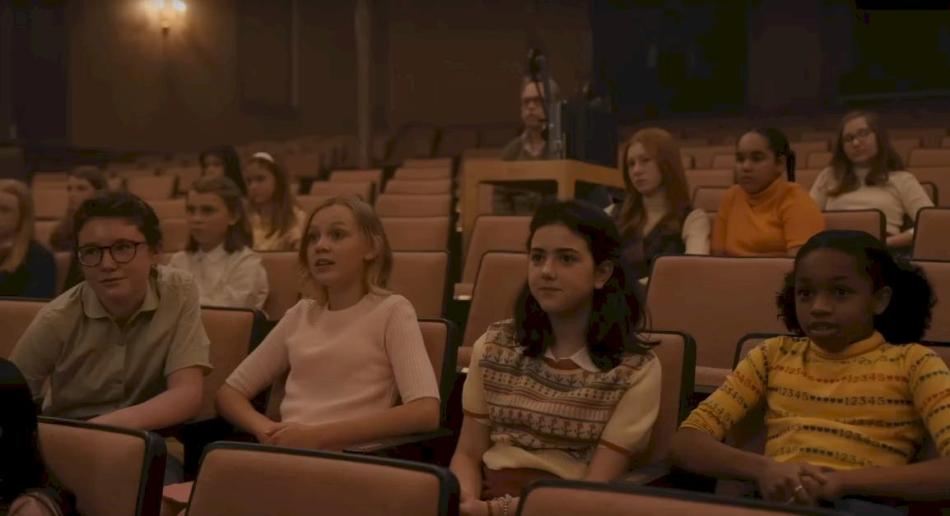
 Are You There God? It’s Me Margaret represented a watershed moment back when it was published in 1970. Books that spoke frankly about female reproductive systems and the changes it goes through during puberty simply didn’t seem to exist before the publication of Judy Blume’s book. Not to mention the frank talk of religion as personal choice rather than an institution one is forced to participate in. It is alarming that this lovingly written and detailed account of a young girl’s life still ends up on lists of banned books even today. The film adaptation, directed by Kelly Fremon Craig, does not forget that this is a book about one girl and her unique experiences. The film gets the period (pun unintended) details right, but this is still very much about Margaret (Abby Forston Ryder) and her life. Small moments such as Margaret’s anger over having to move and her conflicted feelings over religion are given space to breathe. One could easily imagine the studio notes to juice this story with more obviously dramatic storylines or tropes. There are also attempts to give more dimension to some of the characters, especially Margaret’s mother (Rachel McAdams). Her mother’s storyline serves to underline the invisible pressures that women are forced to undergo, such as having an uneven balance of parental responsibility. This may be the best decision Craig makes since it makes Margaret’s story less insular and puts her in the context of not just the culture at the time but in environment of the people around her. Margaret may be about as perfect a literary adaptation as one could achieve, and the fact that it’s of such a widely beloved book just makes the accomplishment even more impressive.
Discover more from Cineccentric
Subscribe to get the latest posts sent to your email.
 Cineccentric
0 comments on “What We’re Watching – August 2023”