
Werner Herzog is one of the most recognizable voices in cinema. His films are notable for their obsessive characters, eccentricities (both in terms of characters and plot), and beautiful imagery. Writing the greater majority of his films himself, Herzog directs films that are thought-provoking and never fail to leave an impression. He has directed films across seven decades and is one of the few directors equally accomplished in both fiction and non-fiction filmmaking. Read our thoughts below on a number of our Herzog favorites:
Heart of Glass (1976)
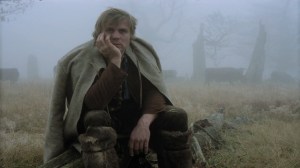 Without exaggeration Heart of Glass has some of the most beautiful landscapes put to camera. Shot mostly in Bavaria by frequent Herzog cinematographer Jörg Schmidt-Reitwein, Heart of Glass is set in the 18th century and revolves around the circumstances that occur when the master glass blower at a glassblowing factory dies. The town is sent into disarray as a seer prophesies disaster and efforts to find the recipe of the elusive ruby glass become increasingly desperate.
Like many Herzog films, Heart of Glass is concerned with the theme of obsession. Unlike a number of his films however, the story within Heart of Glass is so intrinsic to its small town that the film is allowed to be minimalist and small events are granted a larger-than-life impact. The film’s rural setting with deep browns and greens and haze, smoke, and fog is entrancing – not to mention that the bulk of the cast performed while under hypnosis – and all contributes to an aesthetic of otherworldliness. Heart of Glass is not the most accessible Herzog film, but it is one of his most memorable for those willing to entertain this peculiar story. – Alex Sitaras
Nosferatu the Vampyre (1979)
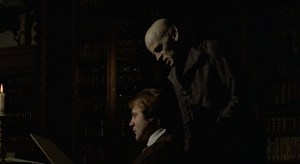 Nosferatu the Vampyre and F. W. Murnau‘s original 1922 silent film will likely draw rejuvenated attention with Robert Eggers‘s take on the story due for release next year. Both films people recognise for their visuals in very different ways. The 1922 film is a defining work of German Expressionism while Werner Herzog’s Nosferatu has a more naturalistic look of production design that embodies the time and place the original novel by Bram Stoker is set. Both films are great at creating an unsettling atmosphere, with Herzog’s film having one advantage. The use of sound or its minimalist approach, even when Johnathan Harker (Bruno Ganz) wanders around Count Dracula’s castle, draws the audience in with only the sound of Harker’s slow-moving footsteps.
The colour-grading highlights the cold and bleak world in which the characters live. Herzog wanted to emphasise Count Dracula’s loneliness, and even though Klaus Kinski has a very similar appearance to Max Schreck as Count Orlok in the 1922 film, the audience is not constantly weary of the character but also has sympathy for him being so isolated. However, the industry remembers Nosferatu the Vampyre for its achievements in production and design, and this is all the more remarkable with the financial restrictions on the film industry in West Germany and shooting with a crew of just sixteen people. – Ian Floodgate
Fitzcarraldo (1982)
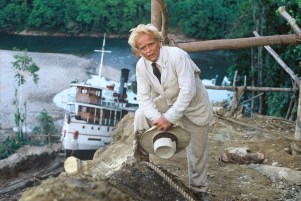 Around the time Francis Ford Coppola’s Apocalypse Now was released in theaters, Werner Herzog was in the Amazon rainforest shooting Fitzcarraldo. Herzog’s film is inspired by the story of rubber baron Carlos Fitzcarrald who disassembled a steamboat and transported it across the Isthmus of Fitzcarrald to get from one river to another. Herzog, evidently not believing this was cinematic enough in itself, decided rather than disassemble the steamboat, to instead move it across whole through a system of pulleys. And the motivation for his character Brian Sweeney Fitzgerald (Klaus Kinski)? To build an opera house in Iquitos and bring Italian opera to Peru. For art.
Of course, as we get to know Fitzgerald and his wife more, we see that greed is a significant proponent as well. He will need a considerable amount of good circumstances to go his way if he is to extract rubber from the rubber trees in the Amazon and transport it through indigenous lands. His journey quickly strays from its course as his crew abandons him once they encounter an indigenous tribe. Luckily, however, the tribe is willing to help Fitzgerald seemingly without question. But things take a turn when Fitzgerald is reckless and one of the tribesmen is killed.
When one reads more about the troubled production of this film, it becomes clear that Herzog had overextended his reach in terms of practical filmmaking, leaving a bittersweet impression when considering the place of this film within his filmography and classic cinema. No doubt, Fitzcarraldo is an impressive film, though the jubilance of the final scene conveys not just joy, but also irony and tragedy. – Alex Sitaras
Cobra Verde (1987)
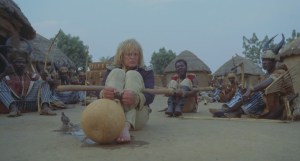 Werner Herzog’s famous collaboration with tempestuous actor Klaus Kinski would come to an end with Cobra Verde, in which Kinski plays Brazilian rancher Francisco Manoel da Silva as a morally reprehensible quixotic figure. He is a violent and ill-tempered man who impregnates the three daughters of his employer and for this offense, is shipped off to West Africa to start slave trade again in West Africa. It is a brilliant satire of colonialism and its perpetrators.
All throughout the film, it seems the odds are stacked against da Silva to even make it out of the most basic situations alive. Yet somehow he pulls himself up through almost sheer vim and vinegar. Herzog laces his film with moments of absurdity and surrealism, such as a priest giving communion to a goat or a bony, spectral figure in the background as da Silva struggles with pulling a boat into the water. It is in capturing these small moments that Herzog distinguishes himself. Herzog has spoken of the ecstatic truth and how certain artistic liberties can get to the truth better than a straightforward depiction can. This discussion has mostly been directed at his documentaries where Herzog would take many liberties with the truth such as long, wildly subjective monologues over footage he has shot or making his subjects do things that they never actually did. Yet, this idea of ecstatic truth is also present in his fictional narrative films. The way that he frames these small moments and non sequiturs give this film more dimension than a simple biopic would have. And of course, Klaus Kinski can command any scene merely with the right glare. Herzog chose to work with Kinski six times for a reason, not because he was a masochist. Between the two of them, Cobra Verde becomes a rancid picaresque epic that eviscerates colonialism. – Eugene Kang
The Fire Within: Requiem for Katia and Maurice Krafft (2022)
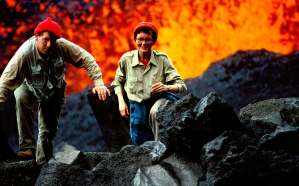 Werner Herzog is one the most prolific filmmakers, and whether his films are narrative or documentary, each project he makes is with passion for the story and the filmmaking. The Fire Within is a prime example of this and is one of Herzog’s most recent films.
The film is a tribute to the French volcanologists Katia and Maurice Krafft. Herzog recognises that without Krafft’s passion for volcanology and capturing still and moving images of eruptions so closely, we might not have some of the most impressive natural images ever seen. Herzog claims that Maurice Karfft, in particular, is one the greatest filmmakers and uses only footage filmed by the Kraffts. The film shows the Kraffts getting unbelievably close to the lava flows to capture some of the most amazing images. The colours are beautifully edited with modern-day technology to accentuate the original footage. As with many of Herzog’s documentaries he also acts as a narrator, and I think this helps engage the audience not only because his dulcet tone is easy on the ears, but also since you can also hear his passion for what he is narrating.
Discover more from Cineccentric
Subscribe to get the latest posts sent to your email.
 Cineccentric
0 comments on “The Films of Werner Herzog”