
Just over a decade ago, Pablo Larraín’s breakout film No was released in which he told the story of the political campaign that led to Chile voting no to another eight years of Augusto Pinochet as dictator. In El Conde, Larraín has returned to his native Chile and his condemnation of the dictatorship and war crimes of Pinochet. But, with a spin to it.
 Larraín’s film portrays Pinochet (Jaime Vadell) as a 250 year old vampire whose tyranny goes back hundreds of years before his dictatorship in Chile. In his youth, Pinochet was present during the reign of Louis XVI and was an admirer of the throne. He witnessed the French Revolution and the execution of Marie Antoinette firsthand, and resolved to fight revolutionaires around the world. Not before collecting a few macabre artifacts, however.
His travels led him to Chile, a land without a king, where he saw potential for himself to become a political leader. Pinochet organized a coup against President Allende, a Marxist, and became dictator. He ruled Chile for almost twenty years and was known for his brutal persecution of his critics, executing thousands and arresting and torturing tens of thousands. He famously never faced justice for his crimes and Larraín tongue-in-cheek portrays Pinochet as faking his death for this reason.
In the present day, Pinochet lives in his country estate and has lost the desire to live. In his view, he is regarded as a cruel and corrupt man and not favorably as an influential Chilean leader. He is cared for by Fyodor (Alfredo Castro) who admires Pinochet’s discretions, himself a Russian vampire who sought revenge on the Bolsheviks and leftists for the Russian Revolution. When ‘mysterious’ murders make headlines, Pinochet’s children visit their father. Learning that he wishes to die, they make it clear they are interested in inheritance. They’re a vapid miserable bunch and the power struggle that unfolds plays out as an idiotic rendition of Ran, and I mean that as a compliment. Pinochet’s children are greedy and have benefited greatly from their father’s corruption. Now, they want to ensure that will still be the case and Larraín is more than happy to portray Pinochet and his family as fickle and foolish.
 An accountant, Carmen (Paula Luchsinger), is brought in to interview the family and organize their finances. She is a nun, however, and has an agenda of her own knowing that Pinochet is an unholy vampire. Yet, Carmen seemingly relishes in hearing the Pinochet family tell stories of executions and corruption. Is this to earn the family’s trust or is she just as despicable? Luchsinger is captivating in her role, cinematographer Edward Lachman often showing her in close-up where her expressions are impossible to overlook. Compared to those in the home, she exudes youthfulness (Pinochet certainly notices) and has a strong presence in each scene she is in.
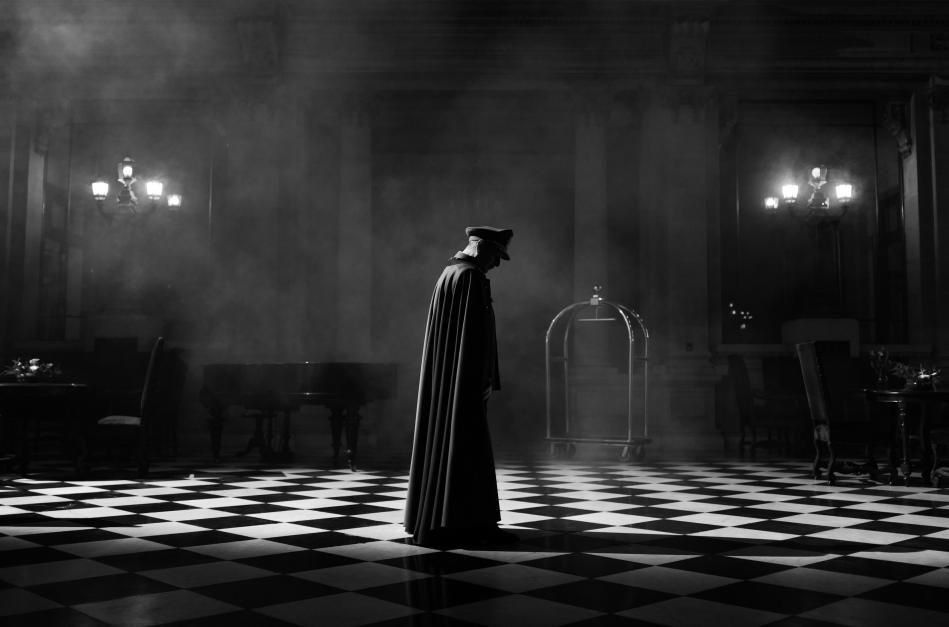
El Conde is a clever piece of revisionist history, condemning Pinochet for never having to face justice for his crimes. Larraín is biting in his criticisms and critical of corrupt institutions of which there are many here. Once there is an inkling that Pinochet wishes to die, he is swarmed by those wishing to have a piece of the pie. Pinochet’s portrayal as a vampire is fitting to Larraín’s view of Pinochet. Just as vampires are irreverent towards human hearts (there’s a number of scenes involving blenders that make me thankful this film is in black-and-white), Pinochet was equally irreverent for the lives of his detractors. Larraín supplements his vampire story with a voiceover that tells this story as if it were a fairytale and with images of Pinochet flying over Chile in military uniform with a billowing cape. As a satire, El Conde will appeal to those who enjoy the darkly comic, and for those who are pessimists they’ll find something they agree with as El Conde comes to its sinister end.
Discover more from Cineccentric
Subscribe to get the latest posts sent to your email.
 Cineccentric
0 comments on “El Conde ★★★”