
With the announcement at the end of October that director Hou Hsiao-hsien had retired due to dementia, we knew we had to commemorate his filmmaking in this month’s Retrospective Roundtable. Hou was one of the leading directors of the New Taiwanese Cinema movement characteristic of realist drama and is remembered for his impassioned dramas and portrayals of contemporary life in Taiwan. Continue reading for some of our thoughts on our favorite films from Hou.
Daughter of the Nile (1987)
 Family is a significant theme that pervades through a number of Hou Hsiao-hsien’s films. Typically, families within his films are experiencing a struggle brought upon or influenced by cultural factors. Daughter of the Nile, released in 1987 at the center of New Taiwanese Cinema, portrays a family that is drifting apart. Lin Hsiao-yang (Lin Yang) is the de facto ‘parent’ in her family, her mother deceased and her father works out of town. Hsiao-yang works at a Kentucky Fried Chicken and attends night school while taking care of her sister. She also attempts to reign in her brother who participates in gang activities. Hsiao-yang’s friends have also gradually drifted away from her, some immigrating West in hopes of a better future.
The influence of the West can’t be missed in Daughter of the Nile, one scene showing a Marlboro poster and a cattle skull hanging on the wall. This Western imagery has been adopted by Hsiao-yang’s generation and enhances the sense of disorientation felt by Hsiao-yang when contrasted with Asian design and aesthetic. Hsiao-yang yearns to find her place in life and her struggles are echoed in that of Taiwan, a country with its own identity experiencing a cultural shift at the time. Though Daughter of the Nile was not distributed to the United States, Hsiao-hsien would later return to explore similar themes in Millennium Mambo after concluding his acclaimed Taiwan Trilogy. – Alex Sitaras
A City of Sadness (1989)
 A City of Sadness is an ambitious historical epic surrounding the circumstances of the “White Terror” in Taiwan. This was a period of martial law and repression of Taiwanese citizens by the Kuomintang government (KMT) who had taken over rule of Taiwan. The “White Terror” began following the February 28 incident of 1947 which resulted in thousands of Taiwanese massacred by the KMT. A City of Sadness, aptly titled, is the first film that portrays these events. Hou shows the life of the Lin family during this time and films on location in Jiufen, a declining gold mining town largely isolated from its surroundings. Filming there evokes the aesthetic of the period and of rural life.
Inspired by the success of star power in Hong Kong cinema, Hou Hsiao-hsien cast Tony Leung in A City of Sadness for the role of Lin Wen-ching. Given that Leung does not speak Taiwanese or Japanese, Wen-ching is deaf and mute. Wen-ching converses with his family via pen and paper and his quietness and ability to find joy in small moments is a contrast to the turbulence of the period and emphasizes the tragedy surrounding him. As his family is pulled apart over the course of its runtime, A City of Sadness never strays from its somber tone and ultimately became a formative film, both in Hou’s filmography and as a centerpiece of New Taiwanese Cinema. – Alex Sitaras
Three Times (2005)
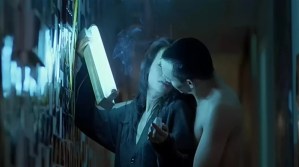 Some films invite you to live in them. They are not about the narrative per se, though they are not necessarily lacking in that area, but rather about the mood they evoke. Three Times is one of these films that invites its audience into the rich emotional experience between the two lovers (Shu Qi and Chang Chen), playing three different couples in three different eras.
As its title would imply, the film is split into three stories. The first in 1966, the second in 1911, and the third in 2005 (then the modern time). Three Times was meant to be an omnibus film with each segment directed by a different director. That idea fell through when funding could not be raised, and Hou took the reins himself. Consider the first story which takes place in 1966. Chang Chen basically plays phone tag without the phone to reunite with Shu Qi’s character whom he met at a pool hall once. Sped up a little and laden with more dialogue, it becomes a screwball comedy of errors. Instead, Hou Hsiao-Hsien places us as the bystander patiently waiting our turn at the pool table as we watch May (Shu Qi) play a game of pool. His camera pans languidly barely catching up with May’s movements, which are not quick by any means. Slowing down the pace forces us to observe and settles our expectations for the rest of the film.
Hou’s second story, set in 1911, is almost completely silent in homage to silent cinema yet is by far the most “talkative”. It stars as a story between a young man and a courtesan, and before we know it, they seem like a loving married couple, with the way that Shu’s character patiently attends to Chang’s, putting on his jacket, carefully arranging his queue. He speaks of the literary salons and political rallies that he attends. She inquires after his family and mentions that one of the courtesans has good prospects to become a concubine of a wealthy family. As talkative as this segment is, the dialogue is the least interesting thing about it. The real story is in the looks and the body language of both actors. They clearly long for each other and are beyond comfortable in their presence. Yet their circumstances make it impossible for them to be with each other. An insistent and very modern piano score almost overwhelms this particular narrative, which seems to work at a right angle to the actual images that unfold on screen. In fact, the times that break away from the silent film format are musical, since music is so much more better at conveying pure emotion.
In the modern day narrative, Shu Qi’s character is in a relationship with another young woman, yet Chang Chen’s character is slowly drawing her away from her relationship. Her partner is acutely aware of Shu’s emotional distance, yet we never see them have an honest discussion of what is happening. One potentially major revelation happens at a noisy nightclub, while the other is a note left on a computer screen. In an inverse of the first narrative, it is the more active person who plays phone tag with the drifter, who can barely muster up the energy to pretend that she is interested in confronting these issues. Here, communication is empty of both emotion and meaning, perhaps a commentary on modern society, perhaps only restricted to these two.
Motifs such as the use of music and the importance of how Hou places the audience within each story manifest in fascinating ways, and unlike most motifs, are used to point out differences in storytelling and society rather than connect them. In fact, it is up to the viewer to interpret each story since Hou steers his audience away from easy readings of his film (multiverses, reincarnation, etc.) and asks us simply to consider if the characters are truly communicating with each other. And your answer to this question will say more about you than about the film. – Eugene Kang
The Assassin (2015)
 There is a curious tension to The Assassin, Hou Hsiao-hsien’s most recent and, in light of his recently announced retirement, final film. The conventions of the wuxia genre, with its high-octane action and balletically choreographed fight scenes, dissolve amidst the glacial pace of Hou’s drama, the stillness of his compositions. The director teases out some excellent moments where the action ruptures the gorgeous serenity he so expertly conjures — the results are appropriately jarring even without any of the cheap-thrill violence that contemporary art-inflected genre exercises so often make use of.
The film plays somewhat like a highbrow twist on Zhang Yimou‘s more populist period cinema but such comparisons can be reductive, especially since Hou’s reflections on desire echo the work of Nagisa Ōshima — In the Realm of the Senses and Merry Christmas, Mr. Lawrence in particular — just as much, if not more so. As is common for wuxia, there is a lot of political intrigue and power games which keep desire unexpressed, only allowing it to find release through deadly swordsmanship, mirroring the erotically charged violence and desperate gestures that run through Ōshima’s most famous films.
It’s an act of mercy — a failure in the eyes of the powerful — on the part of the eponymous assassin (played by an excellent Shu Qi) that actually sets the narrative in motion, an aberration in the system of control that brings with it personal stakes when she is ordered to kill her cousin as punishment for her lapse in judgment. The ensuing tale is deliberately opaque (and the terrifically understated performances do their best to keep character motivations concealed) but also perplexing in its complex minimalism — just another fascinating contradiction in a film (and a filmography) full of them. – Fred Barrett
Discover more from Cineccentric
Subscribe to get the latest posts sent to your email.
 Cineccentric
0 comments on “The Films of Hou Hsiao-hsien”