
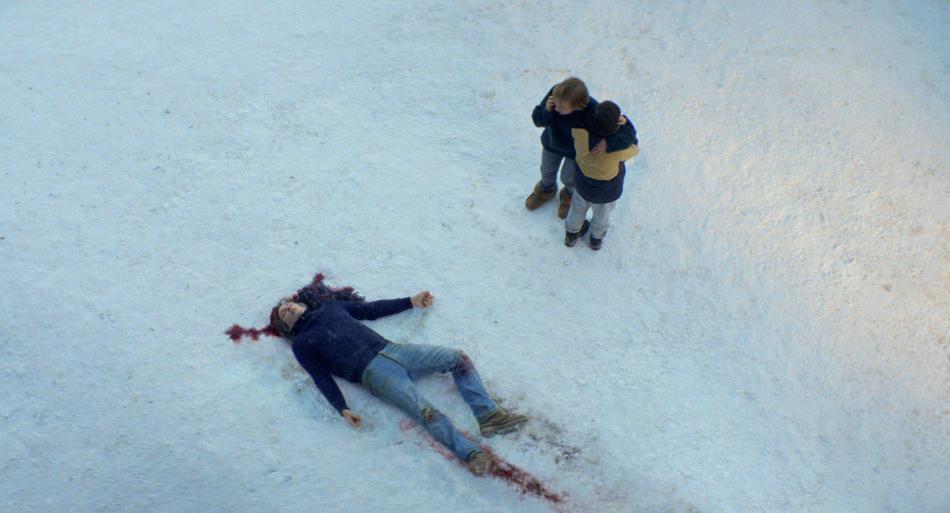
In most criminal trials, there is a verdict. A clear decision. Yes, the defendant is innocent. No, the defendant is guilty. But what’s to be done when there’s not decisive evidence for or against the defendant? This is the situation that Sandra (Sandra Hüller) finds herself in. Her husband Samuel (Samuel Theis) has fallen from their house and is found dead by their eleven-year-old son after returning from a walk.
 When an autopsy is performed, it is discovered that Samuel had sustained a head wound prior to his body hitting the ground. This finding suggests that Samuel could have been murdered, and with Sandra the only person at home she is indicted and goes to trial for the death of Samuel. To defend her innocence, Sandra and her old friend, a lawyer, have to assert that Samuel committed suicide. At first Sandra is skeptical that Samuel committed suicide, but she recalls to her lawyer that Samuel had attempted to overdose on aspirin months before his death. If she did not murder Samuel, then Samuel must have committed suicide. She has to believe this, if nothing else to argue her innocence.
With her case going to trial, personal details of Sandra’s life and marriage are discussed in a public setting and her trial becomes a meticulous exploration of the circumstances around Samuel’s death. We find out that the months leading up to Samuel’s death have been fraught with emotional hardship for both Sandra and Samuel. Their son, Daniel (Milo Machado-Graner), at the age of four was hit by a motorcycle while waiting for Samuel to pick him up from school. Samuel blames himself for Daniel’s injury and ever since, Samuel has been in a depressive slump causing tension between himself and Sandra. Now homeschooling Daniel, Samuel is unfulfilled with his career as a writer, an occupation shared by Sandra. He sees Sandra achieve success with her novels, one of them inspired by an idea Samuel had that he said she could use, whereas he struggles to write. These stressors build up to a fight the couple has a day before Samuel’s death. Samuel had recorded their fight, often recording him and his wife in everyday life as a possible source of inspiration for his writing.
The recording is listened to in the courtroom and Anatomy of a Fall shows the fight unfold up until its final moments. This is an uncomfortable scene – we’re shown something that otherwise would be a private moment. The prosecutor argues that the fight presents a motive for Sandra to murder Samuel while the defendant has to argue that the recording illustrates a man at wit’s end who could conceivably kill himself the day following.
Present at Sandra’s trial is her son. He hears the recording of his parents’ fight. He hears the accusations against his mother. Daniel is an active participant in Sandra’s trial, offering testimony of his perspective of his parent’s relationship. Daniel is portrayed as wise beyond his years, exhibiting an unusual maturity for an eleven-year-old. Despite this, it is impossible for Daniel not to be hurt by what he hears at the trial and, like ourselves, Daniel doesn’t know how Samuel died. Through his participation in the trial, he has to come to terms with his father’s death and determine whether he believes his father was murdered or committed suicide. It is almost unbearable to watch Daniel have to decide.
With half of Anatomy of a Fall occurring in the courtroom, director Justine Triet conveys that it is seemingly ludicrous to pursue a factual explanation for an incident caused by emotion. A fruitless discussion on blood spatter pattern and a crash dummy simulation show on one hand how probabilistic Sandra’s trial is and on the other how inane the pursuit of justice can appear at times. An exceptionally compelling prosecutor even attempts to argue that life imitates art through referencing a violent passage in one of Sandra’s novels – a crafty reversal of a theme Triet explores in her prior film Sibyl. Ultimately, the objective of the law is to come to a common truth but in Anatomy of a Fall, Triet shows that ‘truth’ can be very subjective when there is an absence of information to support it.
In the gray area between innocence and guilt, a jury can be swayed to one side or the other through persuasive testimony or an inquisitive line of questioning. Anatomy of a Fall deftly navigates this gray area, asking audiences to come to their own conclusions while also warning that the decisions and judgments we make carry an emotional weight of their own. In all, the film represents a definitive progression in Justine Triet’s career as a filmmaker while examining subject matter familiar to the director.
Discover more from Cineccentric
Subscribe to get the latest posts sent to your email.
 Cineccentric
0 comments on “Anatomy of a Fall ★★★½”