

“Life is like a hen house ladder. Shitty and short.”
-Paul Hunham
The Holdovers never turns a blind eye to the struggles of life. It is centered on three characters who have endured different and challenging journeys in life. Drawing the undesirable “holdover” assignment, professor Paul Hunham (Paul Giamatti) is tasked with watching Angus Tully (Dominic Sessa) and, initially, four other boys over the Christmas break. Angus’ mother refused to come pick him up and his father is no longer in the picture, leaving him with no choice but to stay on campus against his will. Paul, a curmudgeon of a man may be unhappy with the assignment, but he intends to make the most of this week, running a tight ship with his holdovers. With them is the grieving cook Mary Lamb (Da’Vine Joy Randolph), who lost her only son Curtis in the Vietnam War just a few months prior. This is set to be a challenging and emotional Christmas, one that may fit into how “shitty and short” life can be, but also how beautiful and loving it can be.
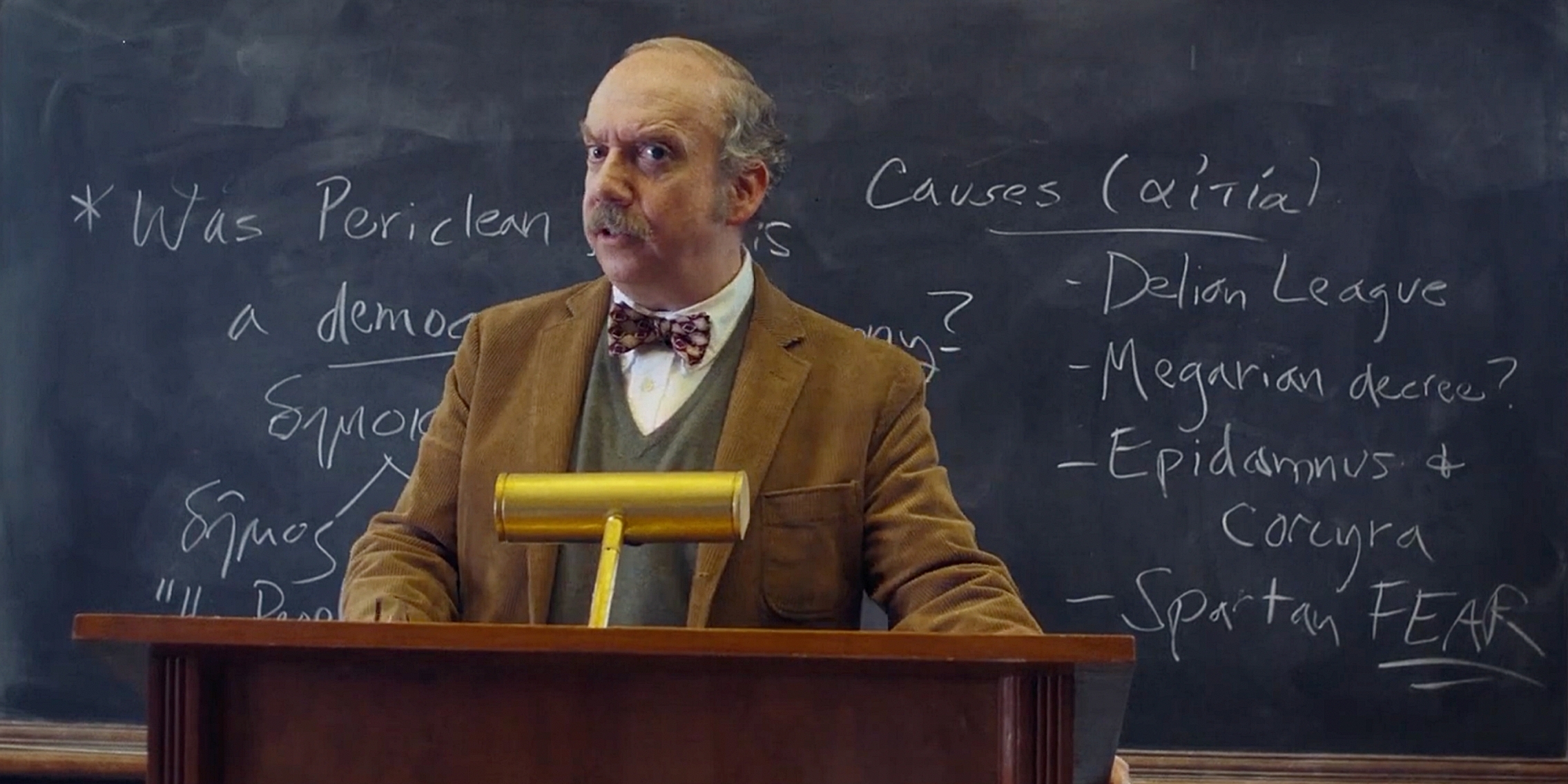
Where director Alexander Payne’s film soars is in how it peels back these characters to show the emotional cores that they often try to hide. Paul is a man with great passion for ancient civilizations and considerable personal insecurity that has driven him further within himself and against the world. He is a demanding and feared professor – with echoes of John Houseman in The Paper Chase – who revels in making his class difficult, losing his once-held optimism for changing lives over the years. Angus, an angsty young man with a smart mind but considerable emotional trauma that has left him often unruly and impetuous. Mary, a marginalized and hard working woman looked down upon in this world, both as a Black woman working in a White-dominated 1970 world and a working-class person serving upper-class young men at the esteemed Barton Academy. Her loss is emblematic of the lack of opportunity afforded to minorities because of systemic financial inequality, while her grief is often cruelly regarded by the unfeeling rich kids she deals with on a daily basis. None of them show this emotional core and repressed feeling initially, maintaining tougher exteriors as they confront a world that has dealt them rough hands. Yet, together, they find beauty in being with one another. Whether watching The Newlywed Game, driving to Boston, or just gathering around a table with a home cooked meal and a makeshift Christmas tree, life and The Holdovers offers great feeling in the “small” moments. It is a celebration of life’s simple pleasures amidst hardship, the symbolic warmth of a fire against the cold chill outdoors. None of these characters experience quintessentially idyllic holiday seasons, yet the feeling of warmth and love permeates all the same. Payne captures the powerful emotional resonance of these unconventional bonds.
The small moments come to define The Holdovers with the film taking on this natural flow and feeling that makes it all the more intimate, heartfelt, and poignant. The cast is crucial to this with Paul Giamatti nailing the old curmudgeon of a professor who has more heart than he is ever willing to let on. Giamatti captures the subtlety of this man so well, though never better than a scene with co-worker Lydia Crane (Carrie Preston). Hitting it off with her at a Christmas party, coming to believe there is something romantic to it, and then watching her get up to kiss her presumed-boyfriend – all shown in an over-the-shoulder shot with Giamatti in close-up – is terrific. The feeling of resignation, of reflective inevitability that of course he was misreading her intentions, nobody could be interested in him now, all written on Giamatti’s face with all of the requisite emotion. This is a man who may profess to crave isolation, but this holiday break reveals the lonely heart at his core. Dominic Sessa’s breakout performance as the hurt Angus, strikes great comedic chemistry with Giamatti in this odd couple pairing. His biting line delivery and comedic moments show the sharp wit of Angus, while Sessa finds great emotional depth in the more revealing moments for Angus. As with many men, he often does not come out and say how he feels, rather he layers it into his actions and facial expressions with Sessa nailing the emotional gravity of these moments. Watching this character with his guard down is especially revealing, namely a touching moment with a young holdover boy Ye-Joon Park (Jim Kaplan), who just had a bad dream, or the quiet fear he has in the film’s final act, sitting quietly holding hands with Mary who has come to comfort him. Da’Vine Joy Randolph often steals the show, offering a glimpse into the life of a grieving mother who carries her boy with her wherever she goes. His military jacket in her closet. His baby stuff in a box she carries with her. His spirit in her own. Everybody says they understand, but nobody can. Randolph embodies it all, a powerful and deeply felt experience given great gravity and depth with The Holdovers shining a light on an often overlooked figure of school life.

Crucial to the film’s success is its mise en scène. Payne shot on location, using no sets for the film while he and DP Eigil Bryld painstakingly re-created a film-like appearance. Grain and imperfections can be found, especially in the opening credits – which, as with the trailer, also mimic 1970s style credits, both with vintage-styled logos and credit lines for items such as “Color by Harbor”. Payne and Bryld use this 1970s cinematic language throughout. It is most notable in a scene of Paul trying to track down a missing Angus, racing through the halls and bursting out the front doors, calling out for him. As he does, the camera dramatically zooms out, almost following the yell. En vogue in the late 1960s and early 1970s, this zoom is an immediate touchstone of that era that, together with the other aforementioned details, successfully evokes the look and feeling of a 1970s film. The campus itself is quintessential of the era – with the snowbound and New England setting, Arthur Hiller‘s Love Story feels a clear influence – while Payne layers in various references and lived-in cultural notes to bring authenticity to life in 1970 for these characters. The Vietnam War and the lingering threat of being sent to war – and realistic grief for those lost – is one of the more crucial elements, whether in Mary’s story or in Angus’ fear of being expelled and sent to military school. The cultural divide with some, such as holdover Jason Smith (Michael Provost), noting their parents’ disgust with their long hairstyles and discussions of youthful rebellious behavior – though not outwardly a student rebellion film, echoes of Getting Straight and R.P.M. can be felt in The Holdovers’ approach to 1960/70s campus life – adds to the film’s thematic depth, aiming to not only match 1970 in tone but also in tenor.
The Holdovers is a very funny, tender, and heartfelt film that effectively captures its era, its characters, and the warmth of its holiday setting. It drops the audience right in 1970, allowing us to experience the world of these characters not only through their experiences and viewpoints, but also in the feelings and surroundings that define their daily life. Paul Giamatti, Dominic Sessa, and Da’Vine Joy Randolph, deliver terrific performances while the work of DP Eigil Bryld and Alexander Payne’s direction add to the film’s strengths. The Holdovers feels destined to become a staple of the holiday season, offering a warm celebration of life’s small, joyful moments amidst considerable hardship and the powerful experiences that can be found in the company of others.
Discover more from Cineccentric
Subscribe to get the latest posts sent to your email.
 Cineccentric
0 comments on “The Holdovers ★★★★”