

Ridley Scott’s long career has demonstrated considerable range, whether in terms of genre, style, or reception. One constant from his career, however, has been an affinity for historical drama. His career started there with The Duellists – in a sense, Napoleon is a return to those roots with both being set in France during the Napoleonic wars – and returned with films such as 1492: Conquest of Paradise, Gladiator, Kingdom of Heaven, Exodus: Gods and Kings, and The Last Duel. In Napoleon, Scott demonstrates his familiarity with the spectacle and often lurid nature of the historical genre. For Scott, facts and truth matter little in the pursuit of telling an epic tale, which may put-off those more familiar with the reality of Napoleon Bonaparte’s (Joaquin Phoenix) rise to being Emperor of France and his numerous military campaigns that preceded and followed. For those willing to go along, Napoleon can be thrilling and awe-inspiring in scale and pageantry during the battle scenes, but it lacks much of the connective thread to make its non-battle scenes as enthralling.
Scott is ambitious and far-reaching in his grasp, though a shortened runtime – the theatrical version runs 157 minutes, while Scott has worked on a director’s cut that runs 250 minutes – necessitates economy in its explanation and detail. This often occurs to a fault, maintaining a frenzied pace to fit in the entire period from the Revolution, Reign of Terror, Napoleon’s rise and years of rule, to his years in exile. As a result, the film renders the period into background noise to Napoleon’s war exploits, rarely exploring events beyond a surface-level. Even his relationship with Empress Josephine (Vanessa Kirby) is thin, more focused on the fight for a child and demonstrating Napoleon’s obsessive love for France than on the love that they share. His eventual marriage to Marie Louise of Austria, by contrast, delivers that child but is given two brief scenes that render her a forgettable character. Scenes crucial to Napoleon’s campaigns feel undercooked as well, cutting away any background details that could illuminate the history beyond bloodshed. It merely gives enough to state where the action is and who Napoleon is fighting with just brief glimpses at some of the political goings on in Europe. As a result, these dramatic elements are too brief to make an impact, feeling like brief vignettes set alongside a highlight reel of war scenes.
Where Napoleon excels dramatically is in deconstructing the myth of its protagonist. The film shows him to be an egotistical and impetuous man. Prone to outbursts and easily manipulated, his cunning in the battlefield is in stark contrast to his incompetence in daily life. His advisors feel fit to openly question his declarations while sharing judgmental smirks amongst themselves as he goofily stands on a crate to be face-to-face with an Egyptian mummy or makes a fool of himself in front of the Pope. Writer David Scarpa‘s script is wryly funny in those scenes, while unabashedly hysterical in others such as an argument at the dinner table over Josephine’s inability to become pregnant in which Napoleon boasts about his destiny and concludes, “Destiny has led me to this lamb chop.” A proclamation that, “You think you’re so great because you have boats,” said to a British ambassador speaks to Napoleon’s hilarity and its protagonist’s ill-fitting nature of political life. In his personal life, it is no better as he is a known cuckold, who returns from Egypt to find himself the public joke of France due to Josephine’s publicized affairs. In sex scenes, he just awkwardly stands and growls at Josephine to initiate before she opts to just let him jackhammer away for a few moments before going about her day. Compared to the tender scene of her wrapped up with that lover, Napoleon looks impotent and foolish.
This portrayal is elevated by Phoenix’s performance. He captures the feeling that Napoleon is little more than a child wearing adult clothing. His personal life finds him entirely under Josephine’s influence – and Kirby’s toxic, sensual energy here is tremendous, striking good, purposefully imbalanced chemistry with Phoenix’s sheepish Napoleon – while politically, he is a mere distraction who everybody would rather have at war than at home, where the adults are busy governing. While further depth would help – and, per Scott, one of the features of expanded cut is more emphasis on Empress Josephine, who is left woefully underdeveloped outside of her relationship with Napoleon – the larger aim of examining Napoleon the man is somewhat successful. Phoenix’s often awkward and stilted delivery counteracts the stoic and confident appearance in battle to reveal more of Napoleon’s nature in life. One can see in Phoenix’s expressive face a searching for words in more awkward, intimate moments compared to words and gestures seemingly just flying out of him like an ill-disciplined child when his emotions overtake him. It may lack overall detail, but Phoenix draws out a fascinating portrayal of Napoleon the man and leader.

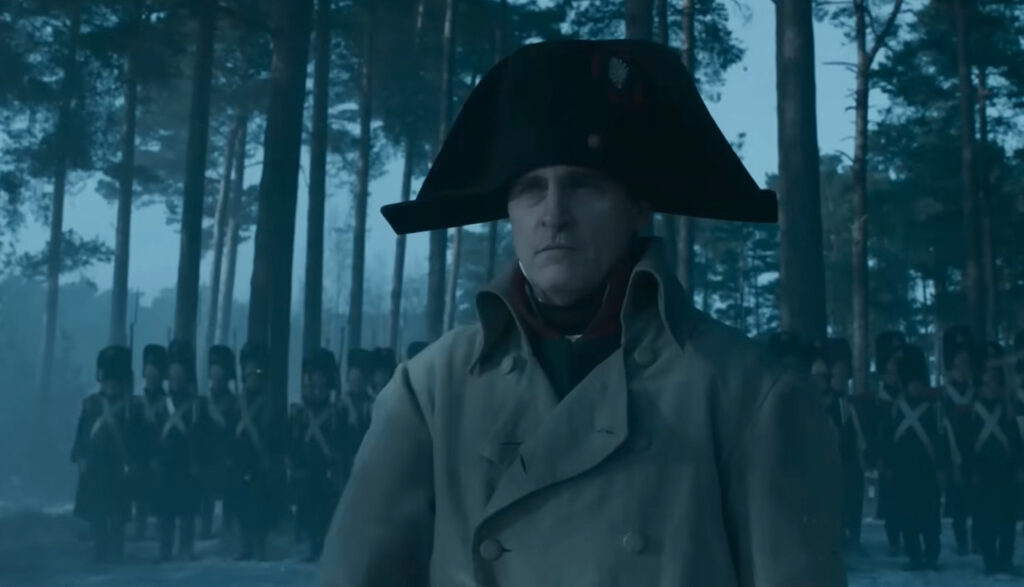
Napoleon’s greatest success, as with its protagonist, is in war. The early scenes at Toulon, repelling a British invasion in the night with an ingenious assault on their holdings and nearby Naval fleet set the tone for the film. By contrast, his putting down a loyalist insurrection via shooting cannons at civilians may deliver results (the insurrection is over), but reveals him as little more than a heartless brute, only capable of handling issues through extreme violence. The battle at Austerlitz in 1805 is a highlight of the war scenes, balancing focus on the mechanisms of war and on the bloody carnage created. Standing off to the side, Napoleon relies on some spotters who relay messages, informing of when they have been spotted and where the combined Austrian-Russian forces are gathering. He watches as they descend, luring them right where he wants them, launching assaults on their flanks once they take the bait of attacking the French encampment. Using a mixture of long shots from the sidelines of the battle, to close-ups on the artillery, and shots on the battlefield and from beneath the ice as bodies crash through the surface, it is an enthralling and hauntingly beautiful sequence that highlights his mastery of war. His cold, inexpressive face shows an indifference to the anguish he causes – a final count at the end of the film credits his campaigns with costing over 3,000,000 lives – while his cunning leaves one awe-struck at how he sees the battlefield. The same can be said for Waterloo, albeit in reverse, showing this once-great general outfoxed by Arthur Wellesley (Rupert Everett), driven by hubris to fight a battle he cannot win. It was the hubris that earned him his reputation and it is the hubris that finishes him in the end, proving that even in battle, he was always his worst enemy. The incredible choreography, stellar effects, and expansive long shots from DP Dariusz Wolski bring to life Waterloo as well as all of the battles, which elevate Napoleon above its flaws.
Napoleon is a lavish production that wears its large budget in every frame. Gorgeous and detailed production design and costumes bring it to life. The muted, cold look of France and the incredible scale and detail in the battles are wonderfully photographed by DP Dariusz Wolski, capturing the haunting beauty and brutality that dominated Napoleon’s life in war. A terrific performance from Joaquin Phoenix and strong supporting work from Vanessa Kirby serve as the emotional foundation of the film, but in this area, Napoleon falters. It excels in undressing its Emperor and highlighting the incompetent foolishness of this historical figure, but its lack of depth and rushed pacing leave it feeling hollow in comparison to the detailed brilliance of the battle scenes. In this regard, the film would benefit from the longer cut, as this present version struggles to balance its action and drama to equally satisfying results.
Discover more from Cineccentric
Subscribe to get the latest posts sent to your email.
 Cineccentric
0 comments on “Napoleon ★★★”