
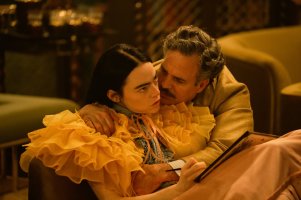
Bella Baxter (Emma Stone) is original. After committing suicide, she was brought back to life by Dr. Godwin Baxter (Willem Dafoe) using the brain of a child. She has no memories of her life prior to her death and awareness of her circumstances is kept from her. Bella has a childlike enthusiasm and curiosity about the world around her though she is a child in a woman’s body. She has no understanding of manners or of “polite society” and is quite the spectacle when introduced to others. Unfortunately, she also represents a danger to herself when following her impulses since she has the self-control and discipline of a child – in other words, barely apparent.
 After bringing her to life, Dr. Godwin Baxter acts as her guardian. She is not allowed outside for her safety, and her perspective on life is crafted by him absent of other influences. With scars on his face and the necessity to be attached to a mechanical apparatus in order to digest food, Dr. Godwin Baxter – or as Bella knows him, God – is a scientist in every sense of the word. Brought up by a scientist himself, God has been experimented on by his father, bears the scars, and shares his father’s fascination with the human body. God is meticulous in his experiments and research and we see a number of his fascinating creations: a duck with a dog’s body, a French bulldog with the body of a chicken, a duck with a goat’s body… God is far ahead of his peers in the Victorian era Poor Things is set. Willem Dafoe is aptly suited to play this role with his gaunt face that can come across as scary, but with a gentle and calming disposition that contrasts with Bella’s larger than life persona.
God teaches Bella, cares for her, and reads her bedtime stories as if she were his daughter. Her name in her past life was not Bella Baxter; God gives Bella a new first name and his last name. They form an atypical, yet loving, family. God introduces one of his students, Max McCandles (Ramy Youssef), to her and prompts him to record notes on her behavior. Monitor the experiment. The academic McCandles is fascinated by Bella and God broaches the topic of a marriage to Bella to McCandles. To ensure from his perspective that Bella is safe and cared for, God enlists a lawyer, Duncan Wedderburn (Mark Ruffalo), to draw up a marriage contract. Wedderburn notices the contract he is requested to create is so stringent that it compels him to meet the woman who is to be bound by the contract. Wedderburn meeting Bella is the catalyst of an adventure that takes her abroad to far away lands such as Lisbon, Alexandria, and Paris.
Bella is a stranger to each of these places and the people she meets, and her experiences are formative to her mental and personal development. In the beginning of the film, Bella does not wonder why she doesn’t know things other adults do, but she gradually turns introspective as she meets a variety of people with different worldviews. Her childlike innocence is chipped away at as she comes to discover the world can be dangerous. An adaptation of the Alasdair Gray novel, Poor Things also bears the strong influence of Voltaire’s Candide.
 Bella is quick to discover her sexual urges and befuddled when she is discouraged from speaking on the matter with others. With having a child’s mind (and impulse control) in a woman’s body, you can imagine the trouble Bella gets into, sexually and otherwise. Poor Things spends a great deal of time on Bella’s sexual experiences even though the film’s greater source of entertainment is Bella’s shortcomings in “polite society”. When Wedderburn pulls Bella aside at a lavish dinner and instructs her to only say “delighted”, “how marvelous”, and “how did they make the pastry so crisp”, it only takes her a matter of seconds to remark “how marvelous” to a woman sharing with Wedderburn that her father is unlikely to make it to the end of the year.
Collaborating again with The Favourite screenwriter Tony McNamara, cinematographer Robbie Ryan, Emma Stone, and editor Yorgos Mavropsaridis, Poor Things is unmistakingly a Yorgos Lanthimos film. Wide angle cinematography, fisheye lens, and pinhole cameras are in abundant use, so much so that it becomes a little silly when we see a column bend as the camera pans horizontally. Other than acting as a visual signature for Lanthimos’ work, these cinematographic choices are a bit haphazard and come across as disorienting rather than meaningful. Commendable within Poor Things however, is the film’s steampunk aesthetic. Steampunk imagery contributes to the fairytale journey Bella undertakes and allows us to share the same appreciation of visual splendor that Bella does with fresh eyes.
As Bella learns about the world around her, there are no shortage of people who take advantage of Bella’s naivete. To learn a lifetime of concepts such as philosophy, physiology, money, violence, and sexuality in such a short time is bewildering to Bella and Emma Stone is captivating as she portrays a woman who has to piece together her understanding of the world around her and most notably, her place within it. Up until her adventures, all of Bella’s choices were made for her, and even as she travels Wedderburn attempts to coerce Bella into conforming to his vision of her and her role as a Victorian woman. As Bella learns she must assert her agency, Poor Things builds up to crucial moments where Bella must use her newfound knowledge and wisdom to make the right choices for her life.
Discover more from Cineccentric
Subscribe to get the latest posts sent to your email.
 Cineccentric
0 comments on “Poor Things ★★½”