
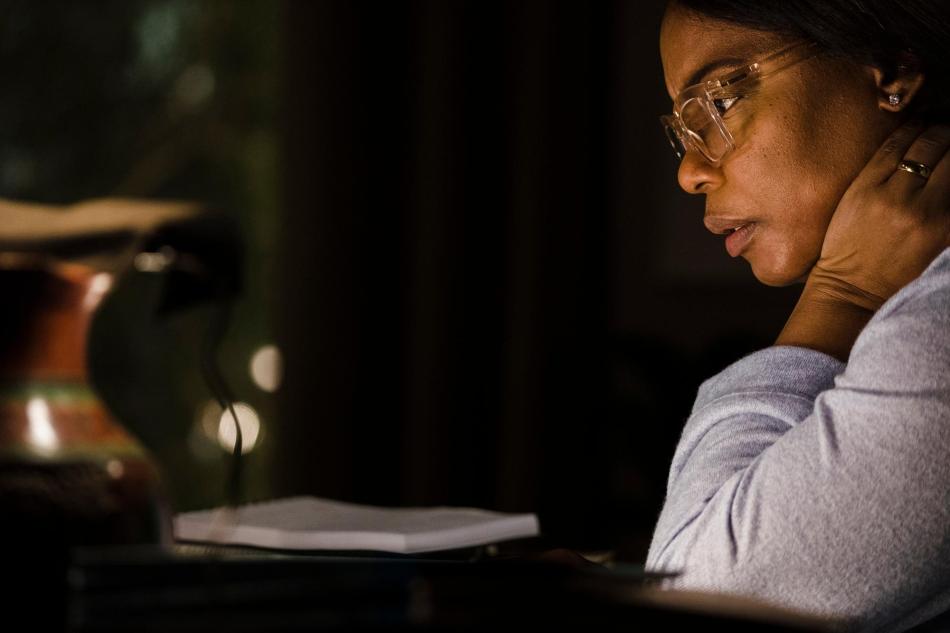
In 2020, Isabel Wilkerson (Aunjanue Ellis) published her second book Caste: The Origins of Our Discontents. The nonfiction book received critical acclaim and instantly became a bestseller. In Wilkerson’s book, she compares racism in the United States to the caste systems of India and Nazi Germany. She argues that while the outcomes and appearances of each are different, there are key similarities between these atrocities. Wilkerson presents the concept of caste as the common denominator.
 Ava DuVernay’s Origin is the adaptation of Wilkerson’s book. DuVernay portrays Wilkerson’s life as well as her creative process in coming up with the ideas that led to her book. Origin opens with Trayvon Martin’s murder. The 911 call placed by George Zimmerman to the police is shared with Wilkerson. Martin’s murder lingers on her mind as she wonders what could have possessed a Latino man to deputize himself in an all-white neighborhood to kill a Black teenager. Recurring incidences of violence against Black Americans leads Wilkerson to realize that racism is too narrow a lens for explaining this violence and the broader history of exploitation of Blacks in America.
As Toni Morrison stated, it can’t be racism that explains why White families would let Black servants and slaves nurture and care for their children. Morrison believed that White people knew that Black people were not inferior. To degrade them and present them as lesser than their White counterparts required myths to be magnified, laws to be codified, and to make distinctions between White and Black systemic and propagated across families and culture.
Wilkerson, a Black woman, even sees this in her marriage to Brett Kelly Hamilton (Jon Bernthal), a White man. Wilkerson observed that her family would wonder why Wilkerson would marry a White man, and upon Brett’s death, her family would try to play matchmaker and introduce her to Black men. Here, she sees that her family has categorized or classified marriage to a White man as less preferable for Wilkerson than marriage to a Black man. This categorization of people is a reinforcement of the caste system.
As it turns out, marriage becomes one of the common threads that Wilkerson observes between the history of Blacks in America, Dalits in India, and Jews in Nazi Germany. In each, marriage was outlawed between the ‘superior’ people and Blacks, Dalits, and Jews, respectively. Wilkerson professes that racism is an insidious means to propagate the caste system. Racists attempt to categorize people by their race to impose a hierarchy. But this presents something troubling to Wilkerson – the Dalits and Jews were not part of a different race than those perpetrating the injustices against them.
Wilkerson’s research for her book leads her to travel to Germany and India. She speaks with friends, academics, and intellectuals on her theory of caste. Over dinner in Germany, she is part of a discussion with friends and academics comparing the Holocaust in Germany to slavery in America. Many have reservations about making this comparison, but wouldn’t you think it quite damning that Nazi lawyers looked to Jim Crow laws and segregation as sources of inspiration for their laws to oppress Jews?
Wilkerson’s discussions during her travels help to form the connective tissue that leads to the writing of her book. Her research also leads her to the story of Allison Davis and his groundbreaking 1941 book Deep South: A Social Anthropological Study of Caste and Class, and Davis’ story along with August Landmessar’s are shown through historical flashbacks. DuVernay uses these flashback scenes to introduce tension and drama, as well as to make history and lived experience more tangible.
 Non-fiction books are typically adapted as documentaries, making Caste: The Origins of Our Discontents an exception. Even so, Origin bears similarities with documentaries in its prevalence of extracts from speeches, lectures, and books. To distinguish from a documentary, DuVernay highlights formative moments in Wilkerson’s life to make Wilkerson’s story and insights more personal, and perhaps more relatable to those with countering viewpoints. With portraying historical figures in addition to Wilkerson, Origin is ambitious in scope. Given its subject matter, the film is didactic in tone, but DuVernay interpolates enough of Wilkerson’s story to maintain a steady pace. It’s clear she and Aunjanue Ellis hold a reverence for Isabel Wilkerson and her life’s work.
Origin finds a home within DuVernay’s filmography as the film shines light to prejudice and continues DuVernay’s push to keep social justice and human rights as part of our collective consciousness. We would do well to remember Origin’s observation that public opinion is swayed by simplifications in how groups of people and races are portrayed. We would do well to remember who benefits from projecting a view or policy that reinforces a caste system. In what will likely be a tumultuous election year for American politics and a tense time for international politics, Isabel Wilkerson’s story is shared at an apt time through Origin.
Discover more from Cineccentric
Subscribe to get the latest posts sent to your email.
 Cineccentric
0 comments on “Origin ★★★”