
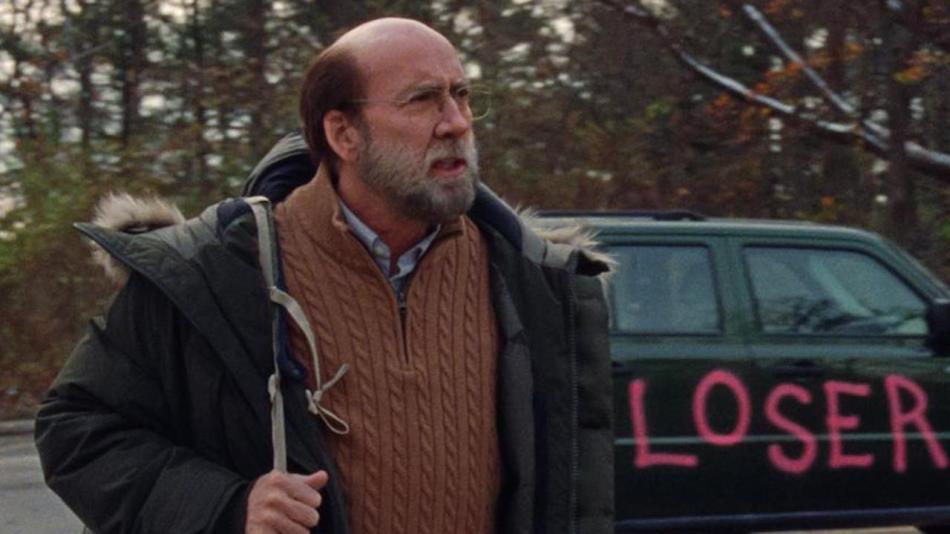
Careful what you wish for, because you just might get it and more. That is what befalls college professor Paul Matthews (Nicolas Cage). He is a stunted middle-aged man, a man with grand professional ambition who is now a tenured professor and unsatisfied. He speaks of writing a book, but has yet to tackle the sitting down and writing part. Instead, he harasses old colleagues who he accuses of stealing his terminology for their latest research, demanding he receive “recognition” for his contribution. Paul, despite these shortcomings, has the prototypical American Dream. He has a steady job. He has a very nice home with a wife, Janet (Julianne Nicholson) and two kids, Sophie (Lily Bird) and Hannah (Jessica Clement). As luck would have it, his desperation to be recognized comes to fruition, albeit via a surreal communal subconscious event in which he appears as a weird bystander in the dreams of thousands of people who have never met him.
/cdn.vox-cdn.com/uploads/chorus_image/image/72882051/DS_02737.0.jpg)
From how old acquaintances speak of Paul, it is clear that little has changed. He is a bit strange, shy, and stiff. He is described as “unexceptional” and he truly is, a milquetoast man with a large bald spot, bland wardrobe, and a huge coat that he is rarely not wearing. Few want to be around him, but he has long sought to be a pillar of the biologist community and to rub elbows with those he admires most – namely Richard (Dylan Baker), a colleague who holds “famous” dinner parties every month that Paul is never invited to – but has been unable to achieve that status. Instead, he spends his days lecturing about why zebras have stripes to uninterested college students. When the dreams start to happen and he achieves viral star status, he is thrilled at being the “cool dad” (in his judgment, as his daughters have friends asking about him). He revels in the attention from an ex-girlfriend and a young 20-something assistant at a PR firm, the former coming right in front of his wife. His narcissistic impulse is being fed in a self-destructive arc that allows him to achieve the popularity his awkward personality never allowed him. He is known and lauded after – feigning disinterest in both – but grows frustrated in his newfound fame, desiring to be known for his biology work rather than the dream appearances. He even takes it as a strange insult that his dream version never does anything, typically just walking by during the dream as a cold bystander. He wants to be known for more than dreams and he wants to be active in the dreams. Both wishes will also be granted, but again with more infamous and violent results than he expected. Rather than being a celebrated pillar of society and academia, he will become a social pariah, more feared than respected.
Writer/director Kristoffer Borgli builds “careful what you wish for” messaging into every plot development with Dream Scenario finding Paul unsatisfied at basically every point in his life. He gets what he wants in most cases, just in a way that is more revelatory of his base desires than in what he said he wanted. For Paul, his desire to be recognized for his “work” was not about genuine professional success, but about wanting to take a shortcut to professional respect without putting in the actual work. Instead of working, he resorts to whining or trying to accuse old colleagues of stealing his work. Even his dream of being a revered biologist was less about biology than it was about status and influence. The dreams provide him what he truly wanted, empty fame, just in a horrifying way that costs him everything he had that meant something, but did not value because he was so focused on what he did not have. In time, his wife starts to see him differently, while even watching his daughter’s school play together becomes an impossible ordeal. The final scene summarizes the film’s more emotional angle about the cost of dreams gone wrong very poignantly, taking that which he once had and turning it all into a dream, wishing that could be reality again after his ride on the pop culture wave took more than it gave.
In regards to pop culture, Borgli centers Dream Scenario’s thematic foundation on examining the impact of “trending” on an individual. Not only does it cost Paul his entire livelihood, but he experiences the ebb-and-flow of what 15 minutes of fame truly means. In this case, it is all imagined as his weird dream version goes from bystander to aggressor, but it nonetheless mimics the rise of an internet celebrity only for unseemly elements in their past to be revealed leading to the end of their brief fame. On the rise, everything he does is appealing. People want to be around him and find him interesting. They have a parasocial relationship with him that imposes personality traits upon him that he does not have. In the downfall, everything he does confirms the newly formed negative public opinion. Any attempt to maintain his status or audience via embarrassing public apologies or other ploys only compounds this downturn. An accident at school even makes the nightmares of his violent tendencies come true in a way that is impossible to shake. He has lost control of his image, becoming beholden to not only what his dream version does but to what people perceive him to be like. This may be great when Molly (Dylan Gelula) wants to have sex with him, but as she experiences first-hand, the dream and reality do not always line up and when that dream goes sour, Paul is left to reckon with becoming a real life “Freddy Kreuger”, then to watch himself turn into yet-another forgotten internet phenomenon. Borgli adds in an array of ideas about capitalism, modern social media, and the exploitation and commodification of the event by public relations firms, influencers, and tech entrepreneurs (one portrayed by Nicholas Braun even creates a very David Cronenberg-esque contraption that blends reality and imagination a la eXistenZ), that add to the thematic depth of the film.

How ambitious Dream Scenario is holds it back from being an even stronger film as Borgli adds on so many ideas that threads end up getting lost. Its third act, as such, ends up feeling unfulfilling even if the film’s final scene lands on an emotional gut punch. Until then, this strangely frightening and funny film proves to be a fascinating and greatly enjoyable experience. Shooting the dream and reality sequences in the same fashion adds a magical realism quality to the film, while emphasizing the way in which the dreams and reality come to influence perceptions/actions in one another. Nicolas Cage has rarely been better as this weird professor who has an off-putting aura from the start and a befuddling way of moving through life that Cage captures so believably. Julianne Nicholson as his wife, Janet Matthews, is terrific. She expresses much of the pain and confusion that the family feels, all while Paul spends his initial time with the fame feeling awe-struck and overjoyed. Michael Cera, who appears as a public relations firm owner, and Dylan Baker, as Paul’s wealthy colleague, impress in the supporting cast, bringing great believability to their respective roles. Cera’s scene, in particular, is a comedic highlight.
Kristoffer Borgli takes all of this emotion and acting power, blending it with genuinely unnerving dream sequences, increasingly alarming reality scenes, and a wealth of thematic ideas to make Dream Scenario into a thoroughly uncomfortable and exhilaratingly original experience. This is a story of an unexceptional middle-aged man who suddenly appears in the dreams of countless people, only to find himself famous and under a spotlight that he could never endure. It is a film that not only critiques the pop culture apparatus and the commodification of every communal experience for corporate gain, but also one that shows that sometimes, one can be so lost in dreaming of a different reality that they can lose what they already have. By the time it is realized, it is already lost with one left to not dream of the future, but to instead dream of times gone-by, longing to be back in times they did not cherish.
Discover more from Cineccentric
Subscribe to get the latest posts sent to your email.
 Cineccentric
0 comments on “Dream Scenario ★★★”