
In an increasingly virtual world, fine art can be challenging to relate to. There’s a difference between learning about art in school or online and actually seeing it in person. Not to mention, there’s only a certain population that visits art museums, with many non-attendees’ only exposure to art through headlines of record-breaking auction sales. Once sold at auction, most art is locked away in storage, never to be seen again. If you’re lucky, a piece is displayed in a museum, necessitating travel to Spain if one wishes to experience Picasso‘s Guernica or to Norway to see Edvard Munch’s The Scream. In this sense, an interest in art is truly unlike any other hobby.
 Though you might be aware of the size of a piece of art, seeing it in person can be an entirely eye-opening experience. Many visitors of The Louvre find the Mona Lisa to be quite small while those who see a painting from Anselm Kiefer can almost feel the painting given its mixed media and physical presence that lifts off the canvas and towards the viewer. Kiefer’s painting is typically supplemented by application of lead, shellac, straw and more that give his paintings a three-dimensional effect and uniqueness. As such, Anselm Kiefer’s artwork is naturally suited to be the subject of Wim Wenders’ latest 3D documentary.
Anselm shows us the artist at work and introduces us to his workspace, a large warehouse that stores a number of his pieces and has large open area to allow for space for Kiefer to create his paintings. Kiefer traverses through his studio with a bicycle, an almost humorous sight to see the artist bicycling with large paintings on both sides, but honestly practical given the size of his studio. We see Kiefer use a forklift to paint the top of his large pieces and even use a blowtorch to burn straw applied to canvas. Kiefer’s work is forged through fire, quite literally, and it is impressive to see the materials and teamwork required to create his large paintings.
Periods of Kiefer’s childhood and adolescence are shown through portrayals of Kiefer by Anton Wenders, Wenders’ great-nephew, and Daniel Kiefer, Anselm’s son. Formative experiences and moments in Kiefer’s career are shown through these portrayals, and Wenders often films Kiefer himself in staged scenes, such as when Kiefer reads from a book of Paul Celan poetry. As such, Kiefer himself is acting in Anselm and there’s an artificiality that is felt. Excerpts shown from historical interviews offer the most authentic look at Kiefer, though Kiefer is known for being enigmatic and his interview responses leave much open to question.
What is clear in Anselm however are the sources of Kiefer’s inspiration. Born in Germany in 1945, Kiefer was raised within a city that had been heavily bombed in World War II. Ruins and collapsed buildings were a familiar sight for Kiefer, and the devastation that occurred during World War II has a strong influence on his work. Kiefer muses on the work of Jewish poet Paul Celan and Nazi philosopher Martin Heidegger, who had actually met following the war. Kiefer’s early work revolves around themes related to Germany’s heritage and its place in a post-World War II world amidst the horrors it inflicted. Kiefer muses “you can’t just paint a landscape when tanks have driven through it” and his beige, dark and brown-toned paintings reflect this.
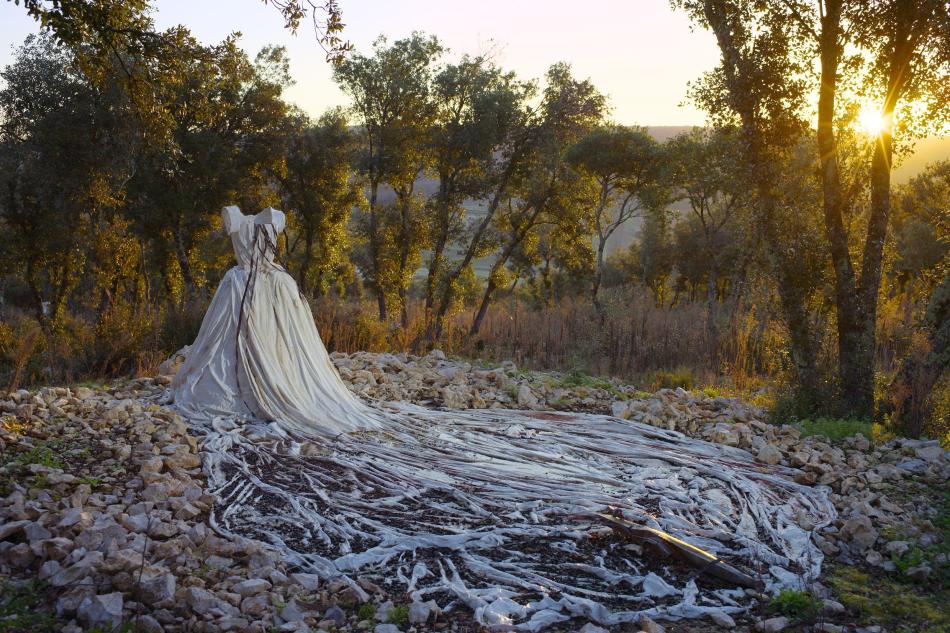
Privy to the German landscapes and fractured cityscapes following World War II, Kiefer believes that there is no such thing as permeance. History has shown that there is no city or country that will exist forever. The fact that Kiefer’s paintings are typically mixed media and will be difficult to preserve illustrates his comfort with knowing his artwork isn’t immortal, and will eventually be worn away and diminished. This is also reflected in Kiefer’s art studio in Barjac where he created sculptures and has since left the studio to a caretaker to oversee. The fate of Kiefer’s Barjac studio and its sculptures will be dependent on whether a preservation effort occurs. Kiefer possesses no illusions about his mortality. Anselm shows him to be stoic and introspective, very aware that mortality is an inescapable part of the human condition. Kiefer creates art as his means of musing on universal themes and, as his career progresses, also on myths and contemporary events.
Wenders’ slow camera pans and musing on universal themes that inspire Kiefer through voiceover is reminiscent of Alexander Sokurov’s filmmaking and perspective on the past. Much about Kiefer remains a mystery even after seeing Anselm, particularly regarding Kiefer’s Occupations photograph series and miscellaneous controversial artistic choices. In emphasizing Kiefer’s sources of inspiration, Anselm shows us relatively little about the artist himself, not to mention that most scenes including the artist are staged scenes. Anselm does not contribute anything novel to the critical discourse around Kiefer’s artwork, so Kiefer enthusiasts might take away less from the film than those new to his work. And with Anselm‘s 90 minute runtime, there isn’t ample time to explore Kiefer’s inspirations beyond a surface level.
 My first exposure to Anselm Kiefer’s paintings was at The Modern Art Museum of Fort Worth. His painting Aschenblume was on display and I remember being struck by the painting’s size. At 25 feet long, Aschenblume consumed the entire wall it was displayed on, and although the work uses one-point perspective to draw your eyes into the bottom center of the painting, I found myself walking from right to left and looking at portions of the painting close-up and raising my head to be able to see the top of the painting. Seeing Aschenblume is the only memory I have of that day more than ten years ago, and I committed to memory the name “Anselm Kiefer” for me to look up his work later that day. The use of physical matter – in the case of Aschenblume, clay, ash, and a dried sunflower – in Kiefer’s paintings elicits a response from the museumgoer even if you do not have a personal connection to the imagery. Kiefer’s paintings have a physical presence that invites you to interact with them, much as I did walking from one end of the frame to the other. Wim Wenders’ Anselm suffers challenges in bringing the great painter’s work to life, and is much too stoic to fill audiences with a feeling of reverence one should feel when watching a documentary that celebrates an artist and their work.
Discover more from Cineccentric
Subscribe to get the latest posts sent to your email.
 Cineccentric
0 comments on “Anselm (documentary) ★★”