
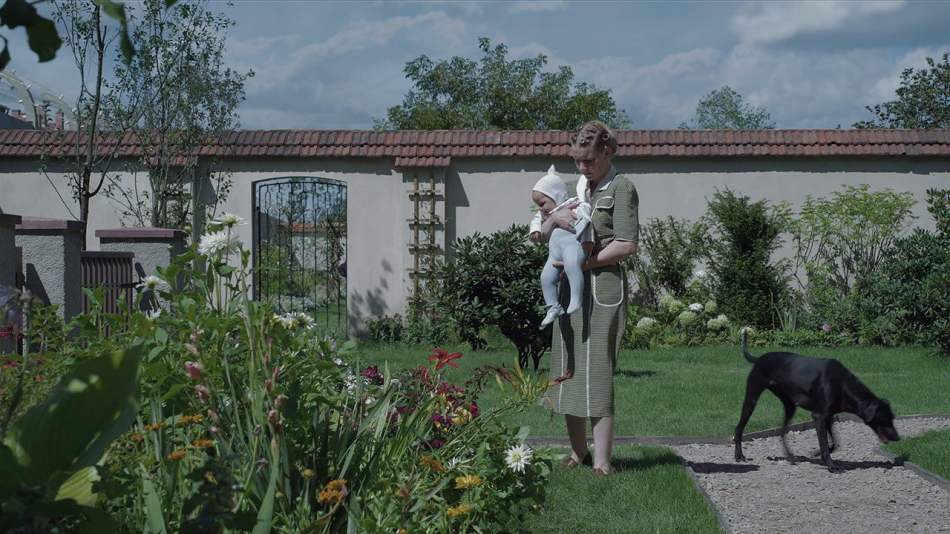
Known for his films Birth and Under the Skin, Jonathan Glazer has a reputation for directing eccentric films. While his filmography thus far has focused on films that hold little resemblance to realism, The Zone of Interest is a change in pace for the English auteur. Set during World War II, The Zone of Interest depicts the family life of Rudolf and Hedwig Höss. Rudolf Höss (Christian Friedel) is a Nazi Commandant stationed at Auschwitz. Him and his family have spent the last few years of their life sharing a wall with the concentration camp. Rudolf and Hedwig have five children, and Hedwig (Sandra Hüller) has worked to make their spacious backyard a beautiful place for her children to play and family to gather. Aware of her husband’s occupation and role in the Holocaust, Hedwig and Rudolf seldom discuss his work. They do the best they can to ignore the atrocities occurring nearby.
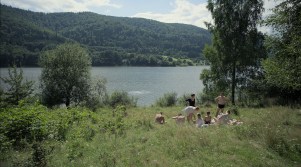 Glazer does not portray violence against Jews in The Zone of Interest, but the presence of this violence is abundantly clear through sounds of gunshots and torture heard even within the Höss household. Despite living in such close proximity to Auschwitz, the Höss family resembles a normal family in appearance. We’re introduced to the family when they share a picnic and play in the river, but the denial can only go so far. In a later scene, Rudolf discovers ash in the river and rushes to remove his children from playing in the water. Rudolf and Hedwig are not shown to acknowledge the concentration camp to their children, and the most striking aspect of the film is this normalization of violence. We see the Höss’ children leave for school in the morning, the boys donning the uniform of Hitler’s Youth. One of the children looks at a collection of gold teeth in his bed with a flashlight, but without Rudolf and Hedwig acknowledging their surroundings, the children’s thoughts don’t linger on the horror. They also don’t consider their father’s occupation. To them, Rudolf is a loving father. To Rudolf, his family and their success represent an idealistic nuclear family.
When Rudolf participates in meetings regarding the Auschwitz concentration camp, the Nazis use language like “yield”, “pieces”, and “combustion zone”. With the context removed, their discussion is akin to that of engineers discussing a manufacturing facility. But even with their best attempts to soften their language and disassociate from the murders, they acknowledge the ultimate goal of their efforts at Auschwitz – to create a series of gas chambers that can alternate and run in perpetuity.
Even without direct portrayals of violence, horror is easily apparent in The Zone of Interest and this horror is exacted by the Höss family and their fellow Nazi Party members. They are all culpable; Rudolf Höss would be executed shortly following the Holocaust for his crimes against humanity. Glazer shows that the life that Höss’ family lives in such close proximity to the horrors is a life of denial. When Hedwig’s mother visits the family, she leaves unannounced in the middle of the night. She is sickened by her daughter’s livelihood and proximity to Auschwitz. When Rudolf’s work assignment changes and he is assigned to work in Germany, Hedwig is unbelievably amiss and pleads with Rudolf to request that she continue to raise her kids in Auschwitz. Hedwig has firmly compartmentalized the comfortable home life she shares with her family and what is occurring within earshot.
Choosing to depict the Holocaust through the lens of a Nazi Commandant’s family is an unusual choice for a director. But make no mistake, The Zone of Interest is not filmed with any consideration to empathy for Rudolf or Hedwig. I personally felt rage simmering over the course of the film. Glazer seldom uses close-ups in The Zone of Interest, keeping us at a distance from Rudolf and Hedwig, and cameras have been stationed around the set to capture moments that occur in everyday life (such as Hedwig yelling at servants). This cinematographic approach heightens the realism in portraying the Höss family. Glazer shot The Zone of Interest on location in Auschwitz and pared down on visual flourish compared to Under the Skin. The primary artistic signature Glazer places on this film is its haunting Mica Levi score and moments where the screen is entirely filled with a single color. Combined with diagetic sounds from gunshots and torture, audiences feel the presence of the concentration camp even if the Höss family is unwilling to acknowledge it.
Glazer first started development on The Zone of Interest after visiting Auschwitz and touring the Höss family residence. Through research and testimonies, Glazer constructed his portrayal of their life at Auschwitz. Glazer’s films hold a strong interest in characters and their morality, and it’s from this vantage point that Glazer directs The Zone of Interest. His focus is that of bewilderment – how can people like Rudolf and Hedwig Höss come to terms with the horrible acts they are perpetrating? While The Zone of Interest is one of many films related to the Holocaust, it acts as a reminder that the Holocaust was not solely the outcome of Hitler’s power – it relied on families like Höss’ to magnify and carry out Hitler’s orders.
Discover more from Cineccentric
Subscribe to get the latest posts sent to your email.
 Cineccentric
0 comments on “The Zone of Interest ★★★”