

Enzo Ferrari (Adam Driver) calls racing “our terrible joy.” Those called to the profession know that death is around the corner at every moment. It does little to alleviate the pain and suffering deaths on the track cause, but they go in with clear eyes. Enzo demands excellence from his drivers – “If you get into one of my cars, you get in to win” – and part of that is fearlessness, being willing to go right to the edge and have more nerve than the man in the car next to them. It is the only way to get ahead in this career and in Enzo’s entire world. Death encircles him. Memories of old friends lost on the track – the film opens on the anniversary of two such deaths – and the passing of his 24 year-old son Dino in 1956 haunt Enzo the following summer while there is more sorrow to come. His own life is even at peril at the beginning of the film with his fed-up wife Laura (Penélope Cruz) mad enough to kill him over his infidelity, all while his beloved company on the brink of bankruptcy, in need of a win at the 1957 Mille Miglia – a round trip race between Brescia and Rome, nearly a 1,000 mile trek – to help drive car sales.

Director Michael Mann‘s film is less about racing than it is about the racers, the life of Enzo Ferrari, and the ghosts that surround him and the entire business. It is, thus, not a celebration of the sport itself but a demonstration of the feeling and chaotic beauty that is so alluring. The hum of the engine, the zip of a passing car, the gorgeous countryside that serves as a backdrop, the tight and thrilling city street tracks, and highly determined racers going door-to-door as they take daring turns, risking death in every moment. It is thrilling when the film indulges the pulse-pounding nature of the sport, but Mann never turns a blind eye to the bloodshed. For those familiar with racing history, the 1957 Mille Miglia is infamous in this regard – though the race’s entire history is infamous for both racer and spectator deaths – with the thrill of victory and excitement of engines contrasted by sheer war-like horror when a car simply hits a small object on the road on worn-out tires. The thin line between its controlled precision and the hectic chaos it can create is part of the draw, an adrenaline rush for men addicted to the feeling and the crowd that cheers them on. The ability to control such formidable machines, harnessing their power to lead them to glory and fame, and suppressing their own fear to accomplish these goals drives them with their competitiveness and confidence allowing them to shut out the concerns and press their foot to the pedal. It all takes on a mythological feeling, these men standing tall in the minds of the people, creating their own vaulted sense of self-identity, carrying with them their courage and their weapon of choice: a car built to win.
Mann’s focus on masculinity throughout his career courses throughout Ferrari in this regard and in Enzo’s entire life. This is a man who was once a racer himself, then in the ruins of post-World War II Italy, built a car manufacturing company with his wife Laura. “Enzo, you must build a wall,” recounts Enzo to himself as he explains the barrier he has placed between himself and the grief, pain, and fear he feels in his career. He is the epitome of male emotional suppression, a cold and distant creator who lords over his factory, drivers, and life as he avoids connection and remembrances of the pain he holds. It is only in quiet moments at Dino’s tomb that he allows himself to feel, silently crying to himself as part of his daily routine of seeing his son. Otherwise, Adam Driver plays Enzo as a man who is always guarded. His steely look, often adorned with sunglasses and a stern tone, make him seem like a hardened man who is never rattled. However, as his quiet moment with Dino shows or as he almost breaks during a fight with Laura as they recount Dino’s death – “the father deluded himself,” he says, echoing real sentiments from Enzo who spent months trying to save Dino, always assuring Laura that he would live – this is a man who carries immense scars.
:max_bytes(150000):strip_icc():format(webp)/Penelope-Cruz-in-Ferrari-1-121523-1f0f47bf66204d8693cc5446feec92d4.jpg)
Driver’s reserved performance highlights the personal crisis at the crux of Ferrari’s drama. Flashbacks during a concert show the joy and happiness between him and Laura before the war. In the present, Penélope Cruz shows Laura as a tired, exhausted, and fiery figure. She knows her husband has emotionally left her, but demands that he keep up appearances for her to save embarrassment. All the while, he splits his time between being home and being with Lina Lardi (Shailene Woodley), with whom he has a child. He met Lina in the war, while cleaning up the ruins around the factory. She was an escape from the horror of war, just as she is now an escape from the horror of losing Dino. Young Piero (Giuseppe Festinese) may not replace Dino, but it at least allows Enzo to shut his eyes and pretend that everything is normal, that he does not have a hole in his heart. In Laura, all he sees are those memories of things he has lost. As a result, he ends up leaving Laura to fend against those emotions on her own and the emotional toll it has taken are evident in every moment spent with Laura. Cruz is the powerhouse of the film, towering over the entire cast as this heartbroken, almost ghostly woman. She draws the audience into her pain and frustration, feeling every ounce, while always showing her strength. She was crucial in building this company, holds a key bullet that could destroy it, and is always in control, a powerful and exciting figure masterfully portrayed by Cruz.
Though Shailene Woodley struggles to keep up with Cruz and Driver – her accent is particularly hit-and-miss – a scene between her and Driver is crucial to the film’s divide for Enzo. Throughout the film, DP Erik Messerschmidt effectively uses close-ups to draw the viewer into the eyes and face of the characters, diving past their masks to show the feeling lurking within them. In this particular scene, Woodley is in close-up in the foreground with the reflection of Enzo on the bed in the background. As the focus racks from Enzo to Lina, Woodley’s impassioned and powerful speech about Piero, where he is in life (nearing confirmation and not being sure of what last name to be confirmed with, either Lardi or Ferrari), and Enzo’s obligations, is a highlight of the film both emotionally and visually. The focus then racks back to Enzo as the camera moves in on his reflection and the second reflection of him on a broken mirror serves as a key symbol of the film, whether his divided and broken nature or the way in which he is merely a shell of himself, a reflection of the Enzo Ferrari that once was before life had its way.
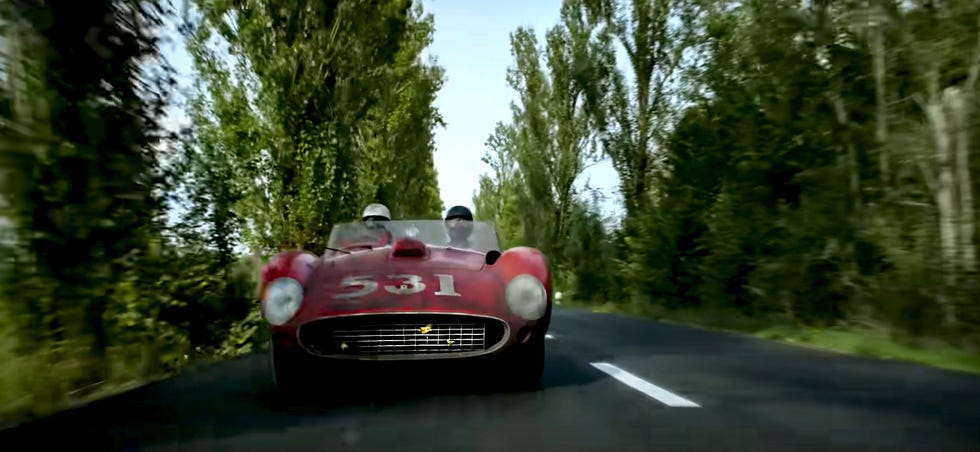
As the film builds to the 1957 Mille Miglia, Mann’s film reaches its emotional apex in juxtaposing the thrill of the race and horror of what occurs. The men hitting the track know what can happen, as they write letters to their loved ones the night before they begin. Enzo sends them all off with final words of strategy and wisdom, urging on Alfonso de Portago (Gabriel Leone) and Peter Collins (Jack O’Connell) as possible winners and grizzled veteran Piero Taruffi (Patrick Dempsey) as one who needs to prove himself to his wife and kids by winning. The men’s confidence and competitiveness power them through with a brief stop affording Alfonso a chance to see and kiss actress girlfriend Linda Christian (Sarah Gadon) one more time before pushing back onto Brescia for the finish. He asks her to be there, waiting for him because he is sure he will win. Even though she has a camera test that would otherwise pull her away, Linda will be there. The fragility of the drivers’ lives and of those cheering them on is evident with a jaw-dropping climax to come that one can feel being foreshadowed, but not the extent that it occurs. This is a jarring and harrowing experience, all while the subdued scenes of victory occur in cross-cut with Enzo and emergency personnel surveying the scale of tragedy.
Ferrari packs an emotional gut punch. Its racing drama may not be the focus, but it epitomizes the film’s balance between beauty and pain. Enzo Ferrari knew engines and cars, bending both to his whim and able to fix them in ways he could never piece together those in his life, especially himself. He and the drivers in his employ dance with death for the sake of a “terrible joy”, a passion that possesses their soul and will not let go, all while he struggles to cope with repressed emotion and constraints he has made up for himself in life. Adam Driver is terrific as Ferrari, but it is Penélope Cruz who steals the show as Laura Ferrari. Pulse-pounding in its action matched by a slow and understated approach to its drama, Ferrari finds legendary director Michael Mann in terrific form.
Discover more from Cineccentric
Subscribe to get the latest posts sent to your email.
 Cineccentric
0 comments on “Ferrari ★★★½”