
In his debut feature The Harder They Fall, Jeymes Samuel directed a Western using real life people and stories as inspiration for his characters. Featuring a star-studded cast of Idris Elba, Regina King, Delroy Lindo, Lakeith Stanfield and more, The Harder They Fall was celebrated for its performances, its stylish action sequences, and the fact that the film is one of the few Westerns with a primarily Black cast.
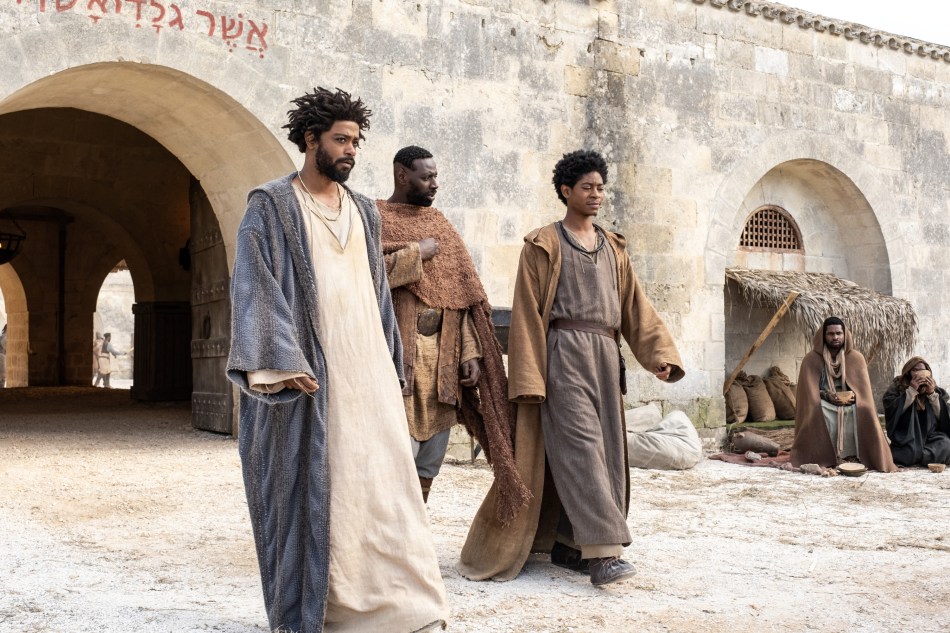
 The Book of Clarence reunites Samuel with Lakeith Stanfield as the titular Clarence, an opportunist who turns to theft, drugs, and his id to govern his life and decisions. Clarence is one of a few characters in The Book of Clarence that isn’t based directly on a Biblical figure, and we’re introduced to Mary Magdalene (Teyena Taylor) and Thomas the Apostle (also Lakeith Stanfield), Clarence’s brother, within minutes. Living in A.D. 33 Jerusalem, Clarence is surrounded by the stories of Jesus Christ and Jesus’ influence on everyday life can’t be ignored. Clarence is routinely scolded for his disbelief in Jesus and is jaded by stories of miracles that he regards as lacking believability.
Clarence finds himself indebted to Jedediah the Terrible (Eric Kofi-Abrefa) and his life is at stake if he cannot make good on the loan. While smoking opium with his friends, Clarence comes up with an opportunist idea – what if he were to become the thirteenth Apostle? Then, faith could protect him. No one would dare kill an Apostle. After being laughed at and mocked by the Apostles, including his brother Thomas, Clarence has another idea – what if he were to present himself as the Messiah? Clarence sees a lucrative opportunity available to fake miracles and collect a fortune. This irreverent, opportunistic premise becomes the cornerstone of The Book of Clarence and sets into motion the events that find Clarence enjoying a life of opulence with all his troubles fading away… But, like the story of Jesus, there is tragedy to come.
Film genres such as Westerns and Biblical drama, often period films, face an uphill battle to maintain relevance in a world that looks so dissimilar to that of the past (or even to the last 20 years). Revisionist Westerns have found success by crafting stories that are novel and weren’t told in the heyday of Western films or emphasize an injustice not able or willing to be acknowledged in the past. Comparatively, the Biblical drama genre has seen less experimentation than the Western and part of the difficulty in experimentation is the likelihood of detractors of both religious and non-religious backgrounds. Films like The Book of Clarence have to find a delicate balance in appealing to both audiences, and the film’s irreverent humor and stoner comedy undertones are more likely to appeal to those in the non-religious camp. To be certain, however, The Book of Clarence grapples with themes of faith, selflessness, and betrayal and its characters and minor plotlines will be recognizable to religious audiences.
Jeymes Samuel’s vehicle for exploring Biblical stories in a time that looks very different from Jesus Christ’s is satire. Samuel turns to humor to contrast stories from the Bible, presented in matter-of-fact prose as religious texts, to how one might perceive the stories if they were told for the first time as they were in 33 A.D. One scene shows Clarence visiting The Virgin Mary (Alfre Woodard) and Joseph (Brian Bovell), and Clarence is in disbelief that Joseph believed his wife’s story of how she was impregnated. The miraculous stories within the Bible and of Jesus’ life are stunning to Clarence, whose beliefs are deeply rooted into experience and what he has personally observed. Through presenting Clarence’s response to stories of miracles, Samuel emphasizes the strength of faith required from believers.
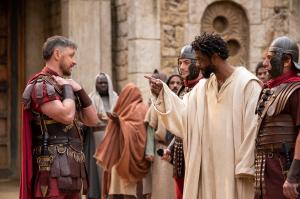
In other scenes, Samuel creates novelty through altering Biblical stories and characters, such as the story of Barabbas (Omar Sy). Samuel even goes as far as inserting contemporary colloquialisms into Biblical era language, Clarence remarking of the “testicular fortitude” needed to follow through with a plan as well as, in a scene with his love interest Varinia (Anna Diop), that he is “spirit over sandals” for her. Samuel finds humor through anachronisms, and this escalates to even showing a ‘club scene’, characters in period wardrobes participating in synchronized dancing. The Book of Clarence breaks from the mold of the Biblical genre, and while one might settle into the lighthearted “Book I” of the film, Book II and III escalate dramatically with weighty examination of Clarence’s epiphanies and Biblical-themed tragedy.
 While The Book of Clarence brings Samuel’s directorial vision to theater screens for the first time, the film is haphazard in its writing. A tighter script would remove some of the exposition in Book I while freeing up run time to more gradually portray changes in Clarence’s character. And some jokes, frankly, don’t land. Nonetheless, casting Lakeith Stanfield as Clarence pays off in spades, the actor able to compensate for shortcomings in script through the conviction of his acting. Stanfield portrays a man who comes to see the value of every person and unwittingly becomes Christ-like. Clarence’s inevitable suffering becomes dreaded and Stanfield’s pained expressions make moments of The Book of Clarence a challenge to watch, but nonetheless draw in our attention to his captivating performance.
Despite its flaws, there’s much to admire in The Book of Clarence. The film is well within Jeymes Samuel’s wheelhouse, and is an earnest attempt to tell a Biblical story with contemporary sensibilities: ‘Biblical revisionism’. Samuel continues to distinguish himself as a director and there’s no doubt his best film is yet to come.
Discover more from Cineccentric
Subscribe to get the latest posts sent to your email.
 Cineccentric
0 comments on “The Book of Clarence ★★½”