
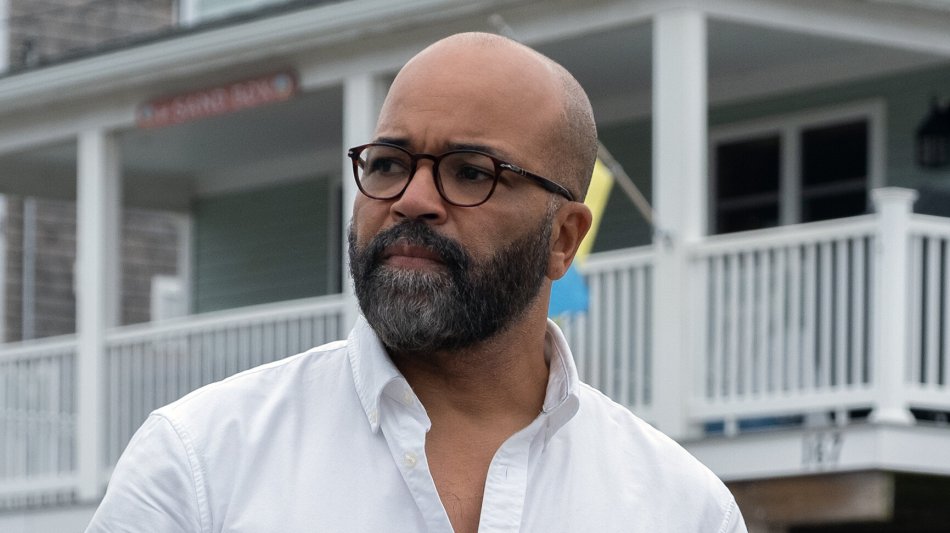
Cord Jefferson‘s directorial debut American Fiction is a satire aimed at a variety of targets such as the book publishing industry, Hollywood, White people, Black people, entertainment trends, and more. The film follows Thelonious “Monk” Ellison (Jeffrey Wright). He is a professor and a writer, having been published on a few occasions with books that never sold well as they are “complex.” He has been shopping his latest work, but his agent Arthur (John Ortiz) has been unable to find a buyer. At a book festival in Massachusetts, he is introduced to the debut novel by Sintara Golden (Issa Rae), We’s Lives In Da Ghetto. In his mind, it is a novel that traffics in Black stereotypes to placate a White audience by meeting their expectations of what Blackness is and allowing them to feel progressive for championing or enjoying a work by a Black writer. Confronted by this, as well as a litany of personal issues, he decides to write his own novel under a pseudonym – Stagg R. Leigh, who is described as a “wanted fugitive” who spent 12 years in prison – which embraces the same style as a tongue-in-cheek joke for him and Arthur to enjoy. To both of their surprises, it is not long before publishing companies and Hollywood producers are beating down their door to publish it and buy the movie rights.
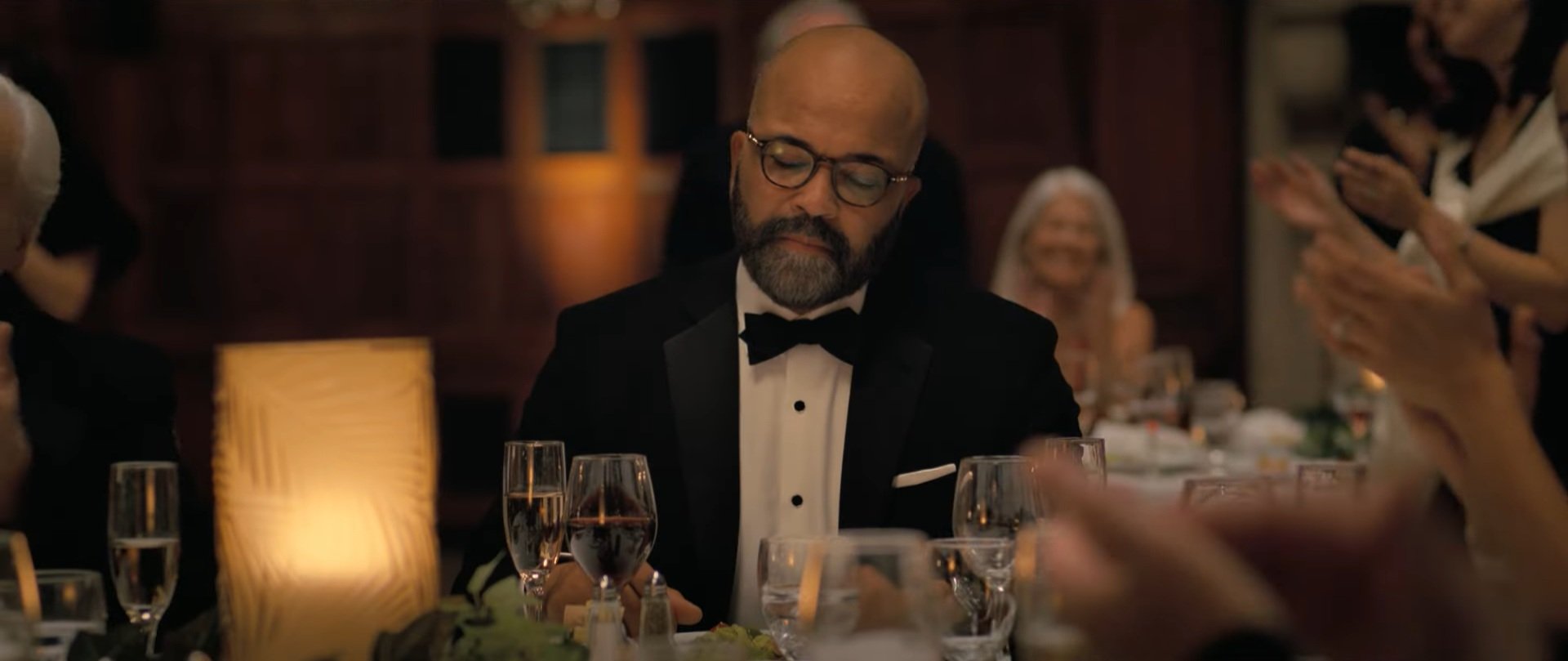
In its cultural commentary, American Fiction is shrewd and insightful. Thelonious sees a world where works by Black artists must meet White-defined standards of what is Black art to be published and the few that slip through the cracks will still end up on “African-American Studies” shelves at bookstores even if they have nothing to do with the topic. There are usual tropes and stereotypes about Black stories that must be fulfilled, while White audiences and decision makers will always be quick to pat themselves on the back for acceptance while ignoring actual Black thought on the works. American Fiction is consistently funny in its satirical edge here, especially as Thelonious encounters people like book publisher Paula Baderman (Miriam Shor), marketing director John Bosco (Michael Cyril Creighton), and Hollywood producer Wiley (Adam Brody). All typify the experience of dealing with the decision makers who continue to pigeonhole Black people into predetermined roles. The laughs are plentiful here, as well as in the voting of a literary award where Stagg R. Leigh’s debut novel Fuck is up for nomination. Thelonious is part of the panel of judges, alongside Sintara Golden, as the organization admitted to wanting a few Black judges to look inclusive. In the final meeting of the judges, one of the White judges declares, “We want to elevate Black voices,” as justification for voting Fuck as the best book of the year, all while ignoring the dissenting voices of the only Black panel members, Thelonious and Sintara.
Where American Fiction is especially fascinating in its commentary is in how it shifts gears. Early on, it is largely framed through Thelonious’ eyes where he, a bitter and jaded man who struggles to relate to most people, sees this world of cultural limitation as solely degrading and a negative contribution to the Black condition. But, through his discussions with Sintara on the panel, Jefferson shows Thelonious to be a rather unreliable narrator. He is harsh to judge Sintara and her work, while never bothering to read her novel or taking time to consider what she put into it – as she reveals, it may not be lived experience for her, but it is based on interviews she conducted with real people – while also looking down upon her, though both ultimately share the same viewpoint on a lot of topics, including the pandering nature of Fuck. While much of what he sees is true and his experiences are a chance for Jefferson to satirize general cultural issues around Black works, he is not some all-knowing figure immune to the biases and limited understanding that he is often quick to accuse others of possessing.
This is especially revealed in the family drama section of the film. American Fiction can be funny, poignant, and bittersweet in these moments as Thelonious returns home to Boston and is forced to reckon with his past as well as an uncertain future. Through conversations with his sister Lisa (Tracee Ellis Ross) and brother Cliff (Sterling K. Brown), Thelonious’ generally distant nature is revealed. Whether it is family secrets he had no idea about – but everybody else saw – or the goings-on with his siblings (including big things, like divorces), he has fallen out of touch with his family and, as Lisa and Cliff state, it is merely par for the course in his general disregard for them. He has an arrogance to him, looking down on others, their lives, intellects, and their tastes, a quality that even derails a romance with Coraline (Erika Alexander). As Cliff tells him later on in the film, “People want to love you, Monk,” but through his demeanor and behavior, he makes it immensely challenging.

Thelonious is a largely unsatisfied individual. He sees himself as a genius who is not meeting his full potential in life or his career, in large part due to the high standards he places on himself and others. He lacks relatability and understanding in the real world. There is an internal rot in him, which has largely rendered him lonely and unfulfilled. This same messy and uncertain nature is found throughout his family life, whether in the issues faced by Lisa, their family in handling Agnes’ (Leslie Uggams) Alzheimer’s, or in Cliff’s life as he fully embraces being a gay man after years of heterosexual marriage. American Fiction is a complicated and challenging film, one that embraces the type of story Thelonious wishes could be published more, a thoroughly non-stereotypically Black tale but one that is simply human and real. Wright is tremendous, bringing to life this difficult and funny figure who has plenty of charm and intelligence but struggles to maintain those qualities at all times. The entire supporting cast impress and bring to life the humanity of their characters, though Sterling K. Brown’s Cliff and the heartbreaking Leslie Uggams – her final scene as Agnes in which she expresses how she regards her deceased husband is incredible – often standout. Brown is charismatic and has incredible comedic delivery, but where he shines most is a quiet scene where his mother makes an off-color comment about him. He goes from happily dancing with her to silently walking out of the room with every bit of silence and facial change speaking volumes.
Cord Jefferson’s American Fiction is a sharp, funny, and emotional picture that balances social critique with interpersonal drama and hits both targets. Its cultural critique centers on Black art and whether the limiting, stereotype-driven nature of many popular works is to be blamed on White audiences and decision makers or the Black artists who indulge, or if those Black artists are merely wise in their decision to meet demand. Thelonious Ellison certainly has his own perspective to start, but American Fiction puts him through a series of encounters and situations that challenge his worldview, whether in terms of art or his family. He is a very complex character who is not always a reliable narrator nor is he always sympathetic. In this, American Fiction embodies the works Thelonious wishes more Black artists could make with complex and human characters who are not just rappers, drug dealers, or killed by the police.By contrast, Monk and his family are just people with their own set of challenges and troubled histories that color every family encounter to this day. It is messy and wonderfully realized. American Fiction is a bold and confident debut, one that marks Cord Jefferson as a name to watch in the years to come.
Discover more from Cineccentric
Subscribe to get the latest posts sent to your email.
 Cineccentric
0 comments on “American Fiction ★★★½”