
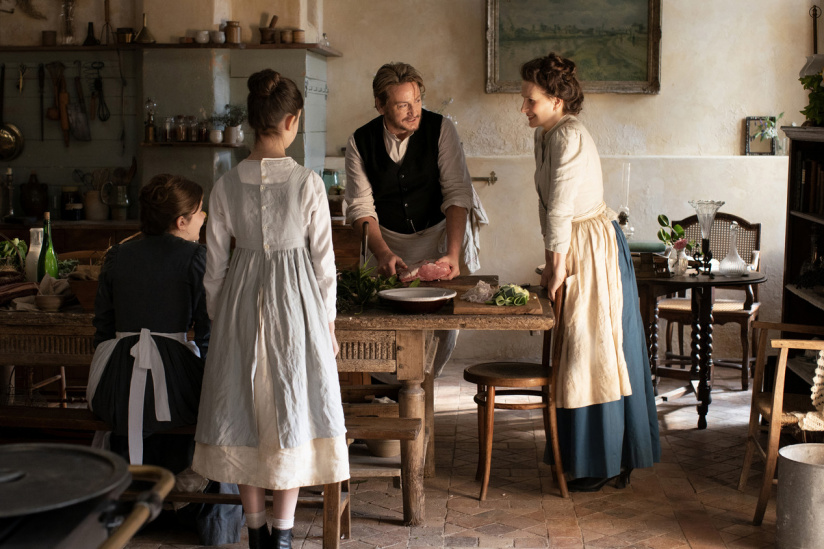
Never have I seen so much food in a movie. Trần Anh Hùng’s latest film The Taste of Things serves feast after feast from the talented chef Eugénie (Juliette Binoche), a live-in cook to gourmet Dodin (Benoît Magimel). Eugénie begins her day in the garden gathering vegetables for the day’s meals. With the help of assistants, Eugénie prepares a seemingly endless amount of savory dishes, Dodin dropping by the kitchen to sample the food and watch Eugénie in her element.
 During the opening scene of the film, the camera glides from chopping board to stove to countertop seamlessly as the food is prepared. The camera captures the scrumptiousness of the dishes, and also Eugénie’s fluid movement as she adds ingredients and stirs the food. The act of cooking is akin to a performance in The Taste of Things, and Eugénie is inarguably a master. In this scene, we see that Eugénie loves to cook and, after over twenty years of cooking for Dodin, loves Dodin. They converse about tasting the prepared food and Dodin is giddy with excitement about what Eugénie has prepared. Eugénie takes pride in her cooking, and Dodin and his guests offer praise for her cooking which she is delighted to receive.
The Taste of Things presents the act of cooking for another as a form of love. Cooking requires preparation, focus, and attention to detail, and isn’t done passively. With the complex recipes for the dishes Eugénie is cooking, passion has to be at the core of what motivates her – whether it be a passion for cooking or passion for Dodin – otherwise the food wouldn’t turn out as exceptional as it does. The Taste of Things also likens cooking to art. Dodin muses that a menu declares the chef’s intentions and is an expression of the chef towards his patrons and guests.
The emphasis towards great eating might seem alien to those of us with a less refined palette, but given that Dodin lives in a beautiful country estate without want, it’s clear that his passion towards fine dining is of great significance to him. Dodin’s life is one of comfort. Yet, the one element of Dodin’s life that has eluded him has been romance. Dodin and Eugénie are lovers, but Eugénie values her independence and retires to her bedroom at night rather than his. As the days wind down to an end, Dodin savors his time with Eugénie and knows he is to be lonesome once the day is over. In the late 19th century when The Taste of Things is set, marriage doesn’t have a strong appeal to Eugénie and she enjoys being Dodin’s chef and the relationship they have. Eugénie believes it doesn’t need changing, though Dodin thinks otherwise.
Any perceived distance between the couple is far from being a source of conflict between Dodin and Eugénie because they are enamored with one another. The passion between the two through twenty years of knowing each other is very much still alive. You can feel their mutual affection and desire emanating from the screen. Each time a dish is presented from one to the other to taste, there’s a tangible sense of romance and anticipation. The Taste of Things leans into this eroticism with a match cut between a desert item and Eugénie’s backside. As Dodin enters her room and sees her nude, the scene uses a male gaze but also shows that Eugénie is aloof and seductive. Binoche and Magimel don’t have to resort to words to express how their characters feel towards another. It’s these quiet moments that illustrate the tenderness of Dodin and Eugénie’s relationship. Early in the film, they’re shown observing a peaceful countryside sunset and chatting as a married couple would do at the end of a tiring day.
The Taste of Things is at its best when portraying the magnetism Dodin and Eugénie have towards each other. Outside of them, the film is thin in its story and the final 45 minutes of the film is evidence of this. The Taste of Things isn’t as certain of itself when not focusing on Dodin and Eugénie. As such, the film lacks the profundity we’d expect from a slow-paced, auteur film, and its closing scene adds little in terms of novelty regarding the film’s depiction of Dodin and Eugénie’s relationship. At its core, The Taste of Things revolves around cooking and desire though it pales in comparison to the great films of its genre that also mix art and desire such as Portrait of a Lady on Fire.
Discover more from Cineccentric
Subscribe to get the latest posts sent to your email.
 Cineccentric
0 comments on “The Taste of Things ★★”