
Few directors have the number of classics between them as the Coen brothers do. From Miller’s Crossing to Fargo, The Big Lebowski to No Country for Old Men, the Coen brothers have delighted audiences with their black comedy and crime dramas. Ethan Coen’s Drive-Away Dolls, the first film Ethan has directed as a solo endeavor, falls somewhat down the middle with a premise that promises adventure and the risque.
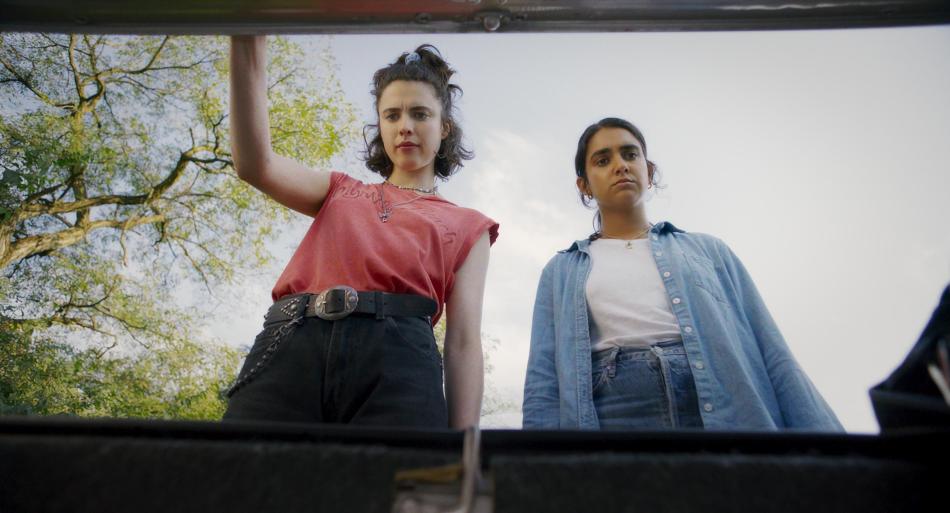
 Jamie (Margaret Qualley) and Marian (Geraldine Viswanathan) are twenty-something lesbians. They’re introduced to us as two people who couldn’t be more different – Jamie is mid sexual experience (and cheating on her partner) when she receives a call from Marian who is working an office job. Jamie is a sexual being, promiscuous, while Marian is more reserved and hasn’t had sex since her last long term relationship. When Jamie is kicked out of her partner Sukie’s house – played by an appropriately enraged Beanie Feldstein – she arrives at Marian’s doorstep and is able to convince Marian that they should go on a road trip. Marian has family in Tallahassee, and while Jamie isn’t the biggest fan of the destination (‘it has Spanish moss and live oak!’ Marian retorts), they’re able to quickly find a car from a driveaway service. Remarkably quickly, in fact. The manager receives a phone call immediately before the two walk through the door telling him a Dodge Aries is to be transported to Tallahassee with two people arriving to pick up the vehicle. Thinking Jamie and Marian have come for the car, he sends them on their way with the Aries. Hopefully they don’t notice the briefcase in the trunk..
To make matters worse for Jamie and Marian, Jamie isn’t inclined to deliver the vehicle on time. She views the road trip as an opportunity to make scenic stops and frequent lesbian dive bars. Jamie tries to find someone for Marian to have a one night stand with, but Marian is averse to the idea. Viswanathan’s performance in Drive-Away Dolls is centered on her deadpan humor and disgusted responses to Jamie while Qualley flaunts an exaggerated Southern accent. The clash between Jamie’s extroversion and Marian’s introversion provides for some humor while henchman counterparts pursuing Jamie and Marian share a similar dynamic. Neither pair make for a particularly compelling duo compared to distinctive characters the Coens have introduced us to in the past, and Drive-Away Dolls leans on its strong supporting cast for pivotal scenes. Pedro Pascal, Colman Domingo, and Matt Damon all make appearances, and Pascal’s role as Santos is darkly sacrilegious to the internet’s “daddy” and referential to another one of the actor’s performances.
 Once the mystery of what is in the briefcase is uncovered, Drive-Away Dolls spins out. The 2000s computer animation-inspired cuts between scenes and psychedelic imagery become explainable, but the effect provides little more than aesthetic. Drive-Away Dolls isn’t terribly invested in the broader themes the film touches on – sexual liberation, the 1960s, the rise of conservatism around the turn of the century. The film prefers to lean on its raunchy comedy and phallic imagery, which offers diminishing returns as the film progresses. Though I anticipated the film’s theatrical release, it’s hard to deem Drive-Away Dolls as anything but underwhelming for a film directed by Ethan Coen. I could see Drive-Away Dolls having a second wind when it is available for streaming, but until then Tallahassee seems too far a drive – even for its Spanish moss and live oak.
Discover more from Cineccentric
Subscribe to get the latest posts sent to your email.
 Cineccentric
0 comments on “Drive-Away Dolls ★★”