

A masterpiece of Senegalese cinema and a classic action film (and its remake!) are at the center of April’s What We’re Watching column. Read below:
Mandabi (1968)
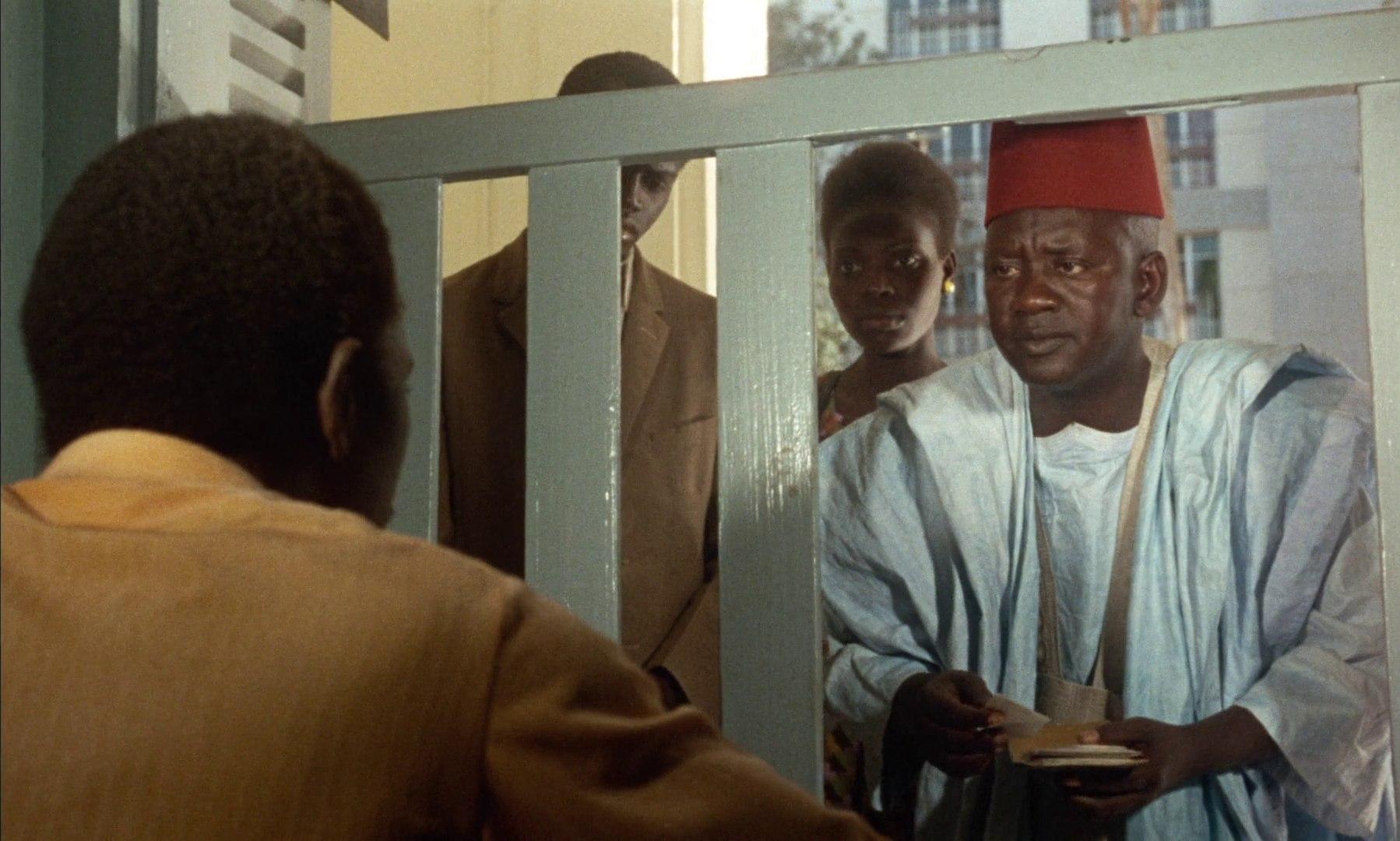 Ousmane Sembène’s 1968 film Mandabi is a case study for the merits of film restoration and independent distribution. It wasn’t until 2019 that film enthusiasts would be able to see the film, likely for the first time, at the Lumière Festival and not until 2021 that the film was released on home media by The Criterion Collection, opening the film to a broader audience.
Mandabi, translated as “money order” in English, is set in Dakar and follows the experiences of a family and its patriarch Ibrahima (Makhouredia Gueye) who receives a substantial money order in the amount of 25,000 francs from his nephew Abdou in Paris. Abdou specifies to save 20,000 for himself, and gifts 3,000 to his mother and 2,000 to Ibrahima. After receiving the money order, Ibrahima and his wives feel a sense of liberation and begin to make purchases on credit and even sing about the receipt of the money order while tending to the household. They attract the attention of beggars and those willing to exploit Ibrahima. At the same time, Ibrahima is facing challenges when attempting to cash the money order: he does not have a photo ID and can’t get an ID until he can procure documents to prove his identity. Ibrahima becomes entangled in layers of bureaucracy all while others regard him as if he already has the funds from the money order.
With its 4K restoration and themes of wealth, charity, and financial exploitation, Mandabi looks – and feels – as if it were set in the present day. As Sembène’s and cinema’s first film in his native Wolof and adapted from a novella he wrote, the film’s authorship is deeply apparent and I recommend seeing Mandabi as a starting point into Sembène’s filmography. – Alex Sitaras
Road House (1989)
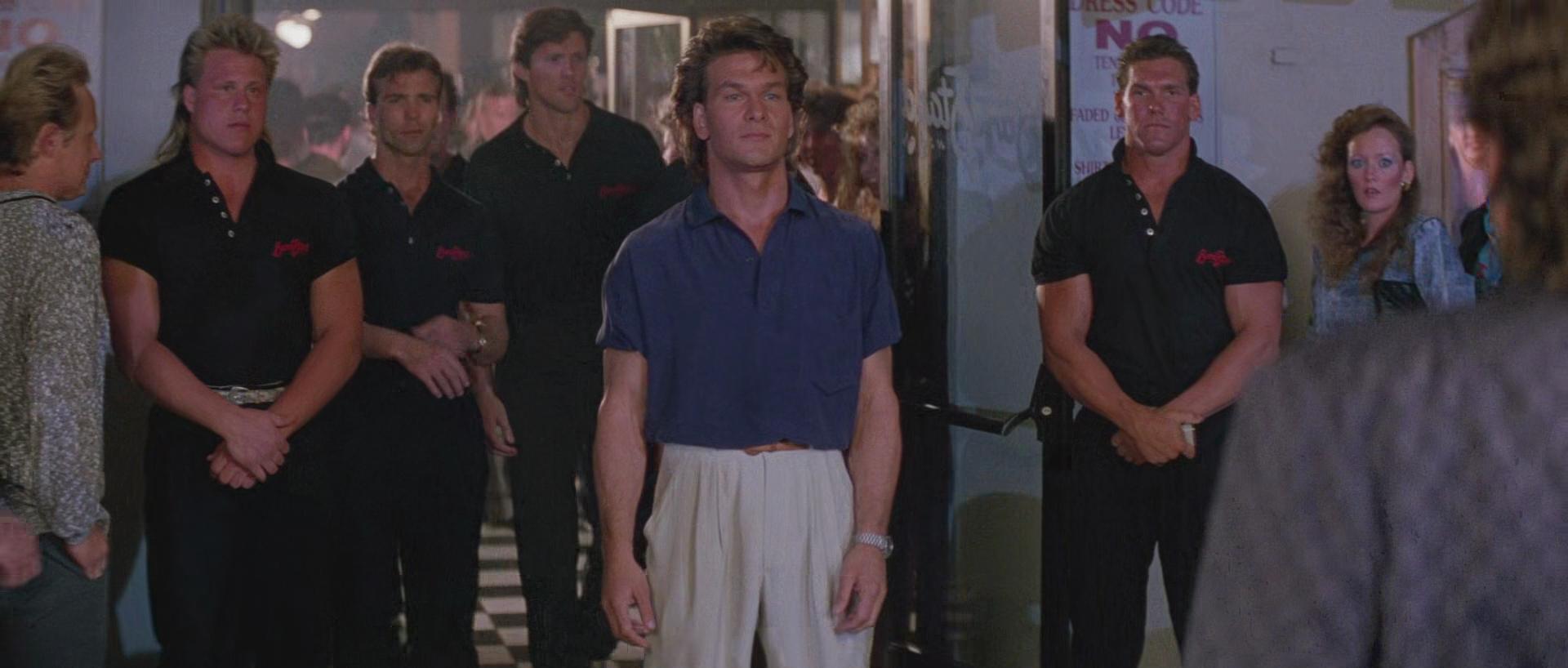 Chances are that if you are a fan of 80’s and 90’s action, you have seen a movie produced by Joel Silver. Lethal Weapon, Die Hard, Predator, Commando are just some of the films he ushered into being. When someone says that an action movie from this time period was basically fueled by cocaine, they often meant Joel Silver and his eccentric, overbearing temperament (Tom Cruise’s Les Grossman in Tropic Thunder is meant to be a parody of Silver). It may be difficult to see how a producer can be the auteur of a film, but the films he is most famous for tend to share themes of performative masculinity, reckless violence with no concern for the cost it wreaks on human lives, and a sort of bravado that can sometimes transcend pedestrian filmmaking and scripts.
Road House may be the film that best epitomizes the Joel Silver trademarks. Patrick Swayze plays enigmatic bouncer and cooler Dalton who apparently is highly educated yet chooses to work at the worst dives. When he takes up a new gig to clean up a bar in Missouri, he finds himself embroiled in a larger fight against a greedy businessman (Ben Gazzara) who wants to drive the bar out of business. Road House is almost two hours of posturing, violence and male gaze. It is decidedly problematic and would be rightfully called out for its misogyny. Most of the characters are cartoon characters, especially the number of almost faceless goons that Swayze fends off in often over the top ways, most notably tearing out one man’s throat. Yet Road House is also compulsively watchable, mainly due to Patrick Swayze. While everyone around him is a cartoon character with the possible exceptions of Ben Gazzara and Sam Elliott, Swayze remains stoic and cool. He physically embodies his role with a ferocious yet graceful physicality. He delivers his ridiculous lines without so much as a wink and helps fulfill the audience’s need for retribution fulfilled by gratuitous violence. Road House has sometimes been classified as a “so bad it’s good” type of film, but it has managed to endure, despite the datedness that Joel Silver projects tend to suffer because of changes in cultural attitudes. – Eugene Kang
Road House (2024)
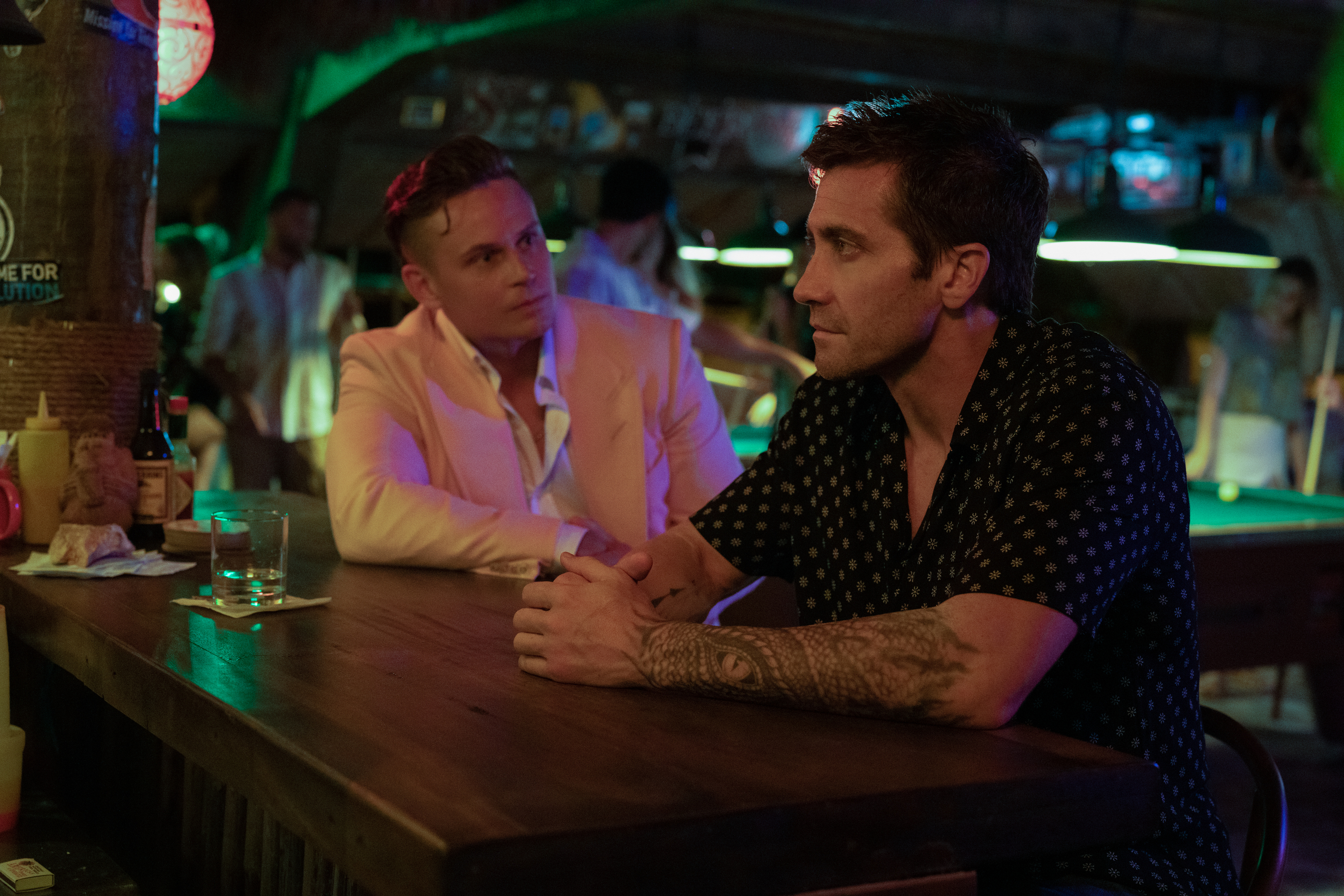 2024’s Road House, a remake of the above 1989 Patrick Swayze starring vehicle, is certainly imbued with a self-awareness that the original lacked. Jake Gyllenhaal plays Dalton, not as the slightly detached American ronin that Swayze did so well, but as a weary, down-on-his-luck sad sack who happens to have be excellent at kicking ass. Though the fights are certainly a step up from the original (Doug Liman is a far better action director than Rowdy Herrington was), they are undercut by a postmodern irony from the script and Gyllenhaal’s performance. When he fights, it’s as if he can’t even take himself seriously. At one point, Dalton even resorts to saying “What’s that over there?” as a distraction. If the film had been about twenty minutes shorter then this shtick wouldn’t have grated as much, but it definitely overstays its welcome even though it is only slightly longer than the 1989 original.
While the original was populated with cartoonish but forgettable goons, Road House (2024) improves on this aspect by casting good character actors. Billy Magnussen as the entitled millennial magnate trying to drive out the Road House is hiss-worthy in his smarminess. Jessica Williams almost matches Gyllenhaal in how self-aware and amusingly out of place her character is. And while this version lacks a Wade, Dalton’s trusted friend played with swagger by Sam Elliott in the original, there is the notoriously hotheaded MMA fighter Conor McGregor in his feature film debut instead. Known for being an outsized presence in the ring, McGregor more than delivers as a formidable foe against Dalton in this film. Their fights give the film some much-needed juice but only for so long. – Eugene Kang
Discover more from Cineccentric
Subscribe to get the latest posts sent to your email.
 Cineccentric
0 comments on “What We’re Watching – April 2024”