
Crime, romance, and the absurd take center stage for our May What We’re Watching column, a trio of films from the second part of the 20th century. Keep reading below:
Gun Crazy (1950)
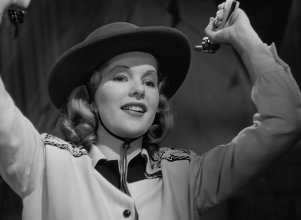 Nomen est omen in Joseph H. Lewis‘ 1950 noir romance Gun Crazy, a tale of a rampaging couple, drunk on love and high off the rush of their criminal lifestyle. While Bart Tare’s (John Dall) lifelong fascination with guns is somewhat at odds with his refusal to turn one on humans or animals, his sweetheart and partner in crime Annie Laurie Starr (Peggy Cummins) isn’t held back by such scruples. (As is later revealed, she already has one murder under her belt.) Her desire grows out of the barrel of a gun, murderous urges once not-so-neatly tucked away behind a kinda-sorta respectable gig as a carnival sharpshooter now let loose to wreak havoc on society.
Laurie’s reckless criminal mania and Bart’s military career and reticence to take lives — the latter, it is implied, is what cut the former short — initially position him as a kind of lost soul, “a good kid” manipulated by a ruthless femme fatale hungry for the good life. But in spite of his misgivings, he keeps going along with her schemes, compelled by his own unacknowledged libidinal appetites as well as his love and lust for Laurie. It’s this lust that makes Lewis’ tale of lovers on the run so remarkable: every held up gas station, every trembling store clerk, every squeezed trigger only makes them gun crazier until they eventually — inevitably, tragically, orgasmically — flame out. – Fred Barrett
Some Call it Loving (1973)
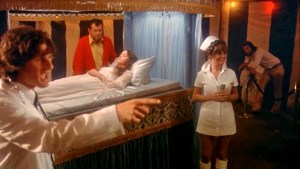 When jazz musician Robert Troy (Zalman King) visits a carnival he happens upon a Sleeping Beauty sideshow where male spectators are encouraged by a carny (Logan Ramsey) dressed up as a doctor, to fork over a buck for a chance to wake Jennifer (Tisa Farrow) with a kiss. Robert is smitten with the young beauty and gives the carny $20,000 to buy the slumbering woman, as well as the potion which has kept her asleep the past eight years, and drives her up to the mansion he shares with two women named Scarlett (Carol White) and Angelica (Veronica Anderson) and waits for her to wake up, which she eventually does. The two soon fall in love but his commitment — a self-imposed confinement, really — to the elaborate fantasy world he constructed with the other women, threatens to sabotage their relationship.
In a (highly positive) 1975 review, Jonathan Rosenbaum described 1973’s Some Call It Loving as “a series of outlandish imponderables” and it’s easy to see why: it’s exceptionally difficult to get a handle on the ever-shifting dream reality of James B. Harris‘ second directorial effort — he had previously been a producer for three of Stanley Kubrick‘s early films, including 1962’s Lolita, a film Some Call It Loving is in conversation with — and the film is permeated by such a powerful, tangible loneliness, that watching it can feel a lot like peering into the depths of someone’s subconscious, with all the discomfort that implies.
Harris, himself apparently grew uncomfortable with offering the audience these glimpses into his psyche as well — the fact that the film was unjustly savaged by most American critics certainly didn’t help — and the filmmaker would set his sights on gritty crime thrillers like 1988’s Cop and 1993’s Boiling Point, starring James Woods and Wesley Snipes respectively. However, Some Call It Loving stands as his most powerful feat, a sad, entrancing, and erotic fairy tale that is as much about male desire as it is about the nature of dreams or, more specifically, the impossibility of sustaining them. Harris’ melancholy is profoundly lyrical but it’s melancholy nonetheless. – Fred Barrett
StrayDog: Kerberos Panzer Cops (1991)
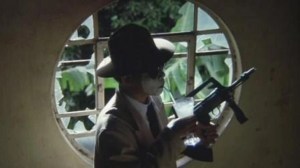 The Kerberos Saga is one of the more fascinating media franchises, spanning mangas, novels, radio dramas, monographs, and, of course, feature films. Set in an alternate timeline where Nazi Germany won World War II, the world of Kerberos is one of militarism, political intrigue, and psychological torment. However — and this is a huge “however” — expectations are best put aside when settling into Mamoru Oshii‘s eclectic dystopia. Inaugurated by the 1987 radio drama While Waiting for the Red Spectacles, Oshii made his live-action film debut with The Red Spectacles, the saga’s first film entry, later that same year. The film was a surreal mishmash of science fiction, slapstick comedy, and film noir, fusing the sensibilities of Jean-Luc Godard, Seijun Suzuki, and Buster Keaton into a wildly eccentric whole.
StrayDog: Kerberos Panzer Cops takes its central conceit in yet another direction, trading its predecessor’s oppressive atmosphere for something more delicate and serene though no less emotionally tortured. Set in Taiwan, much of the film’s first half evokes Taiwan New Wave filmmakers such as Edward Yang and Hou Hsiao-hsien — still not exactly the straightforward sci-fi nightmare implied by its plot and setting. StrayDog follows Inui (Yoshikatsu Fujiki), a former member of a paramilitary police unit nicknamed “Kerberos,” who sets out to find Kōichi Todome (Shigeru Chiba), the leader of his squad who fled the country after a government crackdown forced the Kerberos unit to dissolve. Aided by a mysterious handler named Hayashi (Takashi Matsuyama), Inui’s mission transforms into a desperate quest for liberation.
Looming over all of this is the figure of the red-eyed, Stahlhelm-wearing Kerberos cop, a symbol of sorts around which much of the saga revolves. Though the unit has been dismantled, its specter haunts even the film’s pictorial setting and finally causes a rupture when Inui, powered by the Kerberos exoskeleton suit and MG 42, fragments the mellow ambience during a final set piece filled with squib-heaven violence that is nonetheless riddled with the first film’s Suzukian absurdity. A truly remarkable film — as beautiful as it is strange. – Fred Barrett
Discover more from Cineccentric
Subscribe to get the latest posts sent to your email.
 Cineccentric
0 comments on “What We’re Watching – May 2024”