

With Inside Out 2 arriving in theaters this month, Pixar Animation Studios is on our mind. Our critics grew up watching Pixar films, the studio creating numerous characters and stories that have entertained us, related to us, and have even brought us to tears. Through decades of animation innovation, Pixar continues to be a leader in filmmaking and imagination, maintaining its relevance amongst cinema audiences and Pixar enthusiasts. Keep reading to revisit some of our favorite Pixar films:
Toy Story (1995)
 Some people might see the invention of computer-generated animation as an opening of Pandora’s box. However, if studios and filmmakers use the medium’s technology thoughtfully to tell stories, it can be just as gratifying as traditional techniques. Computer animation is something Pixar has often been exceptional at, particularly with their early films, and Pixar’s first film is a perfect example of using this style of animation to tell a great story. Toy Story follows the premise of what it would be like if toys were living beings, and the story of Woody (Tom Hanks), who is a cowboy doll that has long since been his owner’s favourite toy until his birthday when his mum gives him Buzz Lightyear (Tim Allen), a spaceman action figure with all sorts of fancy gadgets. However, Buzz believes he’s a real spaceman lost on a strange planet, whereas every other toy knows they’re a toy. The behaviour of Buzz, along with his arrival, irks Woody, and his resentment eventually leads to them both becoming lost from their owner and having to work together to find a way back.
Nearly thirty years after its release, some might argue that the animation in this film might seem dated and rudimentary because of the novelty of computer-generated animation. However, when you see other attempts to emulate Pixar’s success, you realise that Toy Story is timeless. I think its animation works perfectly, even today, because it’s a story with toys at the centre of the film, and the style captures the look of toys using animation’s principles well. The creative crew, some of Pixar’s founders, John Lasseter, Pete Docter and Andrew Stanton, have given great thought to what the world of toys would be like, including acting unconscious when actual living beings are around and how this affects their lives and the story.
Toy Story will likely always be in my cinematic heart, mainly because it’s a part of my childhood. However, it’s a story adults can identify with, having likely had toys too. Pixar has often had success with entertaining adults and children simultaneously, particularly with later films, including the extended Toy Story franchise. – Ian Floodgate
Monsters, Inc. (2001)
 Monsters, Inc. was a staple of my childhood. It was the combination of wacky, sometimes whimsical, characters and a sense of anticipation in scenes such as when a door arrives that entertained me and filled me with excitement each time I would watch. With the sheer number of monsters within the film, awe-inspiring set pieces, and fast-paced scenes, Monsters, Inc. was a film I simply could not get tired of. My enjoyment of the movie was enhanced by owning the special edition of the DVD, full with hours and hours of content surrounding the production of the film and its art direction. I remember being fascinated by an extra showing the process of animating monsters’ hair, a challenging feat at the time Monsters, Inc. was produced. The DVD even had an interactive menu with animated doors that piqued curiosity before even watching the bonus features.
Though Monsters, Inc. may not be the first film that comes to mind when someone says “Pixar”, the film stands as my favorite Pixar film. Monsters, Inc.‘s humor and heart is some of cinema’s most memorable, even when compared to fellow Pixar films, and its characters each have their own charm. Mike Wazowski (Billy Crystal), Sully (John Goodman), Boo (Mary Gibbs), Roz (Bob Peterson), … even The Abominable Snowman (John Ratzenberger). – Alex Sitaras
Ratatouille (2007)
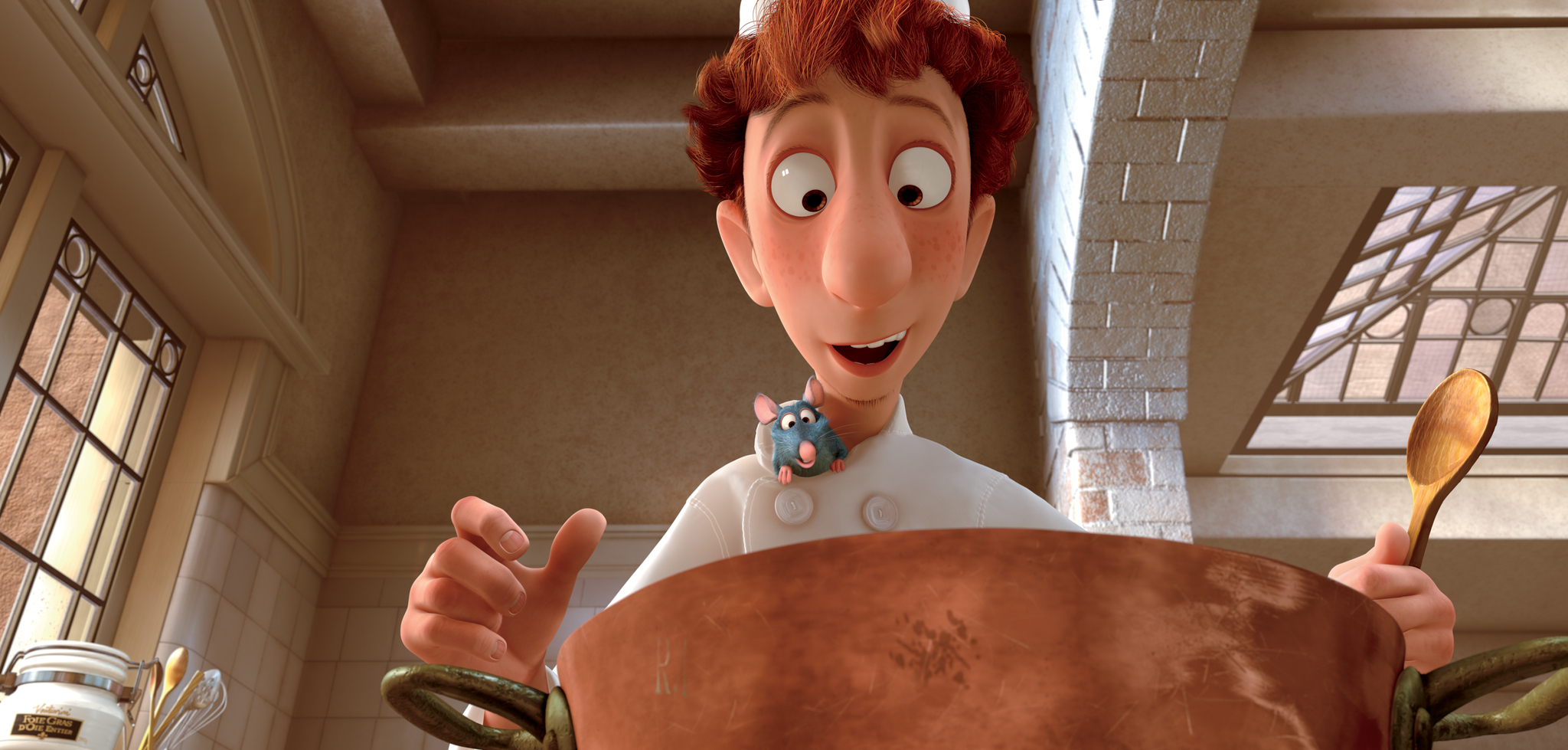
Before director Brad Bird was brought in, Ratatouille was known as ‘Rats!’ Animator Jan Pinkava had been toiling away for nearly six years on his story about a rat who wants to be a top chef in the cutthroat Parisian restaurant scene, but eighteen months before the film was supposed to premiere, the film was far from done. When Brad Bird came in at the behest of the Pixar heads, he made many significant changes including casting Patton Oswalt as Remy, changing the look of the rats to make them more rat-like, and beefing up the part of Colette (Janeane Garofalo), the only female chef in the kitchen who (rightfully) rages against workplace sexism and initially resents having to look after Linguini (Lou Romano).
It was a miracle that Ratatouille not only came together, but also because it is such a winning underdog tale. The film is packed with tons of physical comedy (a trailer made specifically for the film features Remy braving a gauntlet of dangerous kitchen equipment and towering humans) that strikes the right balance between cartoonish and grounded. Also, as talkative as Remy is, and as rich and layered Oswalt’s performance is, it is mostly Remy’s wordless interactions with Linguini and their symbiotic relationship that is perhaps the most memorable part of the film, apart from the food, of course. Much of the credit for the depiction of the food goes to Brad Bird, but Pinkava was the one who met with top chefs such as Thomas Keller and Anthony Bourdain to really observe chefs and to consult on food presentation and preparation. It’s no wonder Ratatouille has arguably inspired the foodies of Gen Z, and has even been reinvented as a TikTok musical, a welcoming balm during the height of the pandemic in 2020. – Eugene Kang
Inside Out (2015)
 Part of Pixar’s early success was having many original stories. Within the first fifteen years since Toy Story‘s release, the only sequels were successful follow-ups to that film. However, within the following five years, Pixar released another two sequels, Cars 2 and Monsters University, both of which were not as warmly received as previous films, and along with Brave, the only original film in that period, people were beginning to speculate if Pixar were running out of ideas. Then came the arrival of Inside Out. The story follows Riley (Kaitlyn Dias) and her core emotions of Joy (Amy Poehler), Sadness (Phyllis Smith), Anger (Lewis Black), Disgust (Mindy Kaling) and Fear (Bill Hader). Life seems great for Riley until her parents decide to move from Midwest America to San Francisco, throwing her emotions into turmoil.
Like many of Pixar’s earlier films, the world is developed from its creative premise. There are inventive concepts like storing memories and imaginary friends with humour that appeal to adults with a play on the phrase ‘train of thought’. Of course, Pixar’s animation has come a long way in twenty years until this point, with fantastic use of colour and light, which Inside Out showcases well, and this encompasses a story that captures the attention of both adults and children and with heartfelt emotion, which Pixar does so well.
Inside Out is currently the sixth-highest-grossing film worldwide from Pixar. It is also the second-highest-grossing original film behind Finding Nemo, proving that audiences loved this story, its characters and its animation. People have a right to be apprehensive about its sequel with the track record Pixar has had with sequels since Toy Story 3, having mainly released original stories since entering the 2020s. However, I am excited to see the addition of new emotions, as Pixar showed with the first film. As long as they have a strong story and pioneering animation, it will be a success. – Ian Floodgate
Soul (2020)
 The COVID-19 pandemic was disruptive to theatrical releases and accelerated America’s reliance on streaming services for entertainment. Soul was one film whose future became drawn into question after being pushed back from a summer release to November, and then finally to Christmas Day on Disney+. That same year, Disney had piloted Disney+ Premier Access which allowed Disney to release its titles intended for theatrical release on its streaming platform for a premium fee. Soul fortunately was not released on Premier Access, and its ease of accessibility enabled the film to be one of the most streamed titles of 2020, possibly contributing to Pixar’s decision to release the film along with Luca and Turning Red theatrically following the conclusion of the pandemic.
Soul is one of Pixar’s most ambitious films in recent years, following music teacher Joe Gardner (Jamie Foxx) as he experiences a truly life-altering day. Joe wishes to become a professional jazz musician, though for now he teaches middle school. You can imagine how disparaging that effort is. When Joe finally achieves a big break, his dreams are put into question as a misstep quite literally takes him into the afterlife. The first depiction shown of the afterlife is minimalist, yet deeply terrifying. Pixar is no stranger to depicting loss or themes more often reserved for adult audiences, though Soul takes the cake for its abstract depiction of the afterlife while otherwise maintaining its appeal to child audiences. Like the best of Pixar films, Soul and its thematic messages will remain relevant over the course of our lives as we interpret the film differently as the years pass. Soul is a film to be rewatched and rewatched again for its thoughtful exploration of the human experience as is WALL-E, Up, Coco and hopefully many more to follow from Pixar. – Alex Sitaras
Turning Red (2022)
 In light of the poor year for Disney in terms of its theatrical releases in 2023, Bob Iger declared that Disney would be moving away from message-driven personal films. Iger conveniently forgot that Black Panther was one of the highest-grossing Marvel movies ever, and that Lightyear, a naked attempt at mining established intellectual property, was a box office flop. Turning Red, which was relegated to streaming despite theaters being open in 2022, would never have been made with this new vision in mind.
Directed by Domee Shi, who also directed the wildly creative short Bao for Pixar, Turning Red follows Meilin Lee (Rosalie Chiang), a thirteen-year-old residing in Toronto Canada in the early 2000s. She is an accomplished student from a very traditional background, but she is also a recognizable teenage girl who loves hanging out with her friends and obsessing about 4 Town, a immensely popular boy band. Soon, however, life hits Meilin hard when she suddenly wakes up as a giant red panda, a legacy passed down to all the female members of her family.
Turning Red can be rightly seen as a thinly veiled allegory of puberty, but the film also juggles ideas of balancing filial loyalty with identity, especially in Western society. The film is briskly paced and colorfully animated. It is also one of the recent Pixar films to diverge a bit from the Pixar house style. While many Pixar films are very technically accomplished, the animation style can be a bit homogenous. Domee Shi draws from many inspirations such as anime, her own culture, and the city of Toronto to make a film that actually stands out visually. Turning Red will resonate with people who have had to wrestle with their parents to assert their own identities, which is everyone to some extent, but hardest for children of immigrants. The top brass at Disney may have extremely questionable ideas of what type of movies and entertainment will resonate with audiences, but this film and many other projects prove that there is no lack of interesting talent there. – Eugene Kang
Discover more from Cineccentric
Subscribe to get the latest posts sent to your email.
 Cineccentric
0 comments on “Pixar Films”