
Donald Sutherland is best remembered for his performances in 1970s film classics, representing one of the strongest actors of his time. He excelled at playing characters with deep internal turmoil in films such as Don’t Look Now and Ordinary People that would be an unsurpassable challenge for many actors. Sutherland had a commanding on-screen presence that couldn’t helped but be noticed even when playing supporting characters such as President Snow in the Hunger Games series. Keep reading for our thoughts on a number of memorable Donald Sutherland performances:
Klute (1971)
 The first film of director Alan J. Pakula’s informal paranoia trilogy (Klute, The Parallax View, All the President’s Men), Klute is a detective story starring Donald Sutherland as John Klute who is investigating the disappearance of company executive Tom Gruneman (Robert Milli). An obscene letter Gruneman wrote to call girl Bree Daniels (Jane Fonda) is found, and Klute is hired to investigate his disappearance. Klute meets with Daniels and begins a long, winding investigation to determine Gruneman’s whereabouts. As he discovers more information, it becomes clear that Daniels is being stalked and is perhaps in danger. Klute takes a liking to Daniels and the two waver between restraint and attraction.
Released in 1971, Klute is a product of its time with themes of surveillance and paranoia. Yet the film’s appeal isn’t beholden to these themes as Klute and Daniels are well-crafted characters. Sutherland’s cool demeanor provides both calm and unease to audiences depending on the gravity of the scene and Fonda’s anxious energy contrasts Sutherland’s and complements her character’s psyche. Klute is a compelling work of New Hollywood cinema and contributes to broader discourse on privacy, identity, and surveillance. – Alex Sitaras
Don’t Look Now (1973)
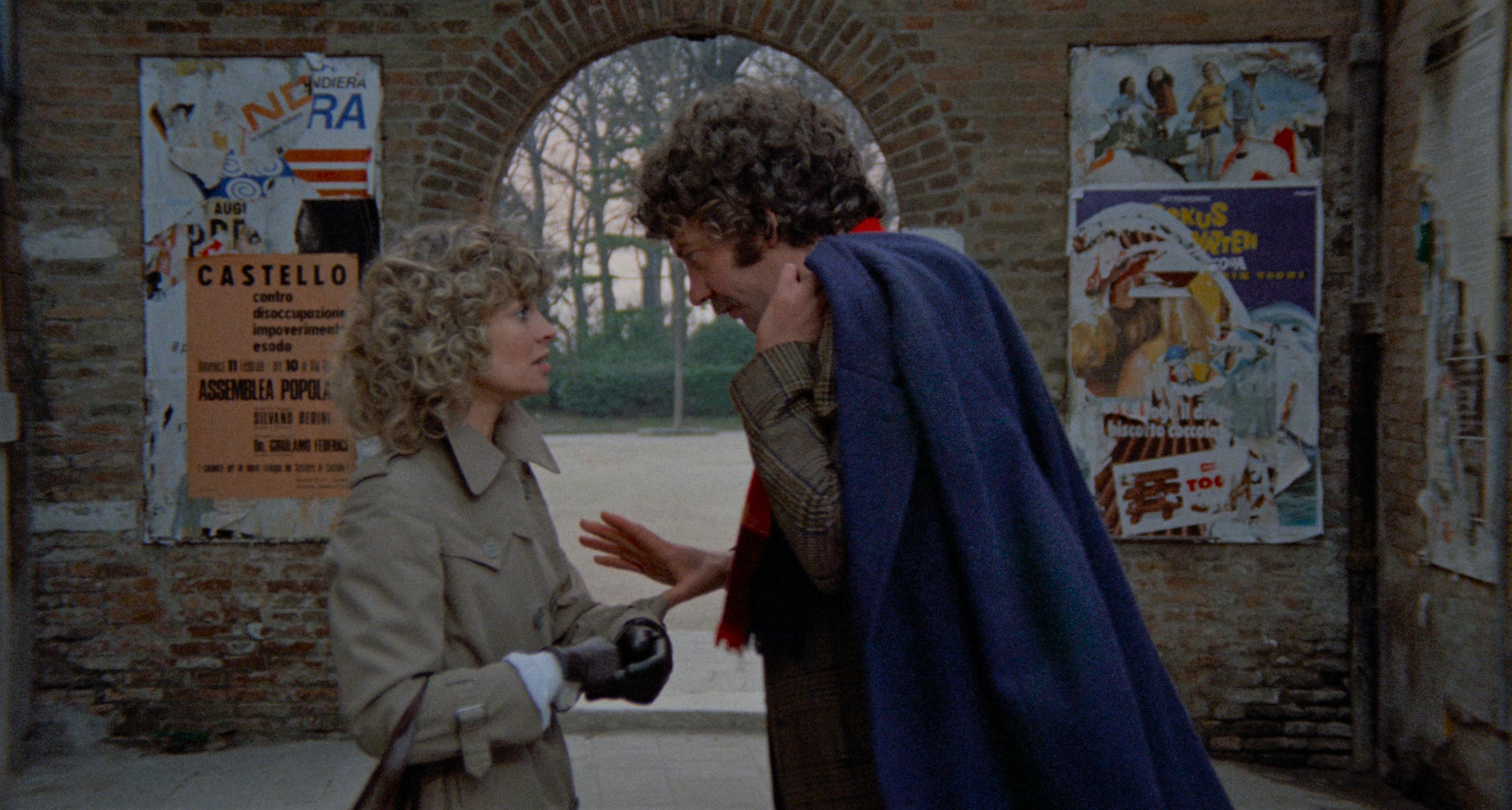 In a film of striking images and compositions, the most memorable striking image besides the very end may be Donald Sutherland’s face of anguish when he discovers his daughter has drowned towards the beginning of the movie. The intense grief he conveys is enough to color the rest of this ghost story. Don’t Look Now walks a fine line between genre picture and intense personal drama, as the death of his daughter affects his marriage with his wife Laura (Julie Christie), especially as she seeks a way to alleviate her grief by consulting with the occult.
Though Don’t Look Now is billed as a horror movie, the real horror of this movie is the alienation that John (Sutherland) and Laura experience that even the infamous sex scene (which was considered daring at the time) underlines. The passion of the sex is intercut with scenes of them getting ready to go to dinner, undercutting the deep connection that they were seeking. John is doubtful and angry throughout most of the movie, mainly because Laura’s distance from him is compounded by her insistence that there is a supernatural way of connecting to their daughter. So when John starts seeing premonitions of a small figure wearing a red raincoat just like the one his daughter wore, he start spiraling. There is a fearlessness in Sutherland’s performance, which he channels into both intense anger and doubt. He wears his grief so heavily that even when he lashes out at Laura and others, we are always aware of how much he is suffering. Sutherland’s emotional vulnerability in Don’t Look Now goes a long way to breaking the stereotype of emotionless antiheros that were popular during the 70’s. – Eugene Kang
Invasion of the Body Snatchers (1978)
 Philip Kaufman’s remake of the classic Invasion of the Body Snatchers stands as one of the best science fiction horror films of all-time and Donald Sutherland is crucial to that success. Sutherland’s Matthew Bennell is a health inspector who is cool and confident. Nothing gets by him in his work. He is assured and detail-oriented. Sutherland always had such a natural and authentic feeling in his roles, and whether he was the protagonist, a supporting character, or the villain, he always disappeared into his roles. Matthew is no exception, Sutherland exuding the calm and calculating demeanor of him to the point that the audience feels just as confident whenever he is involved. One is sure that he and Elizabeth Driscoll (Brooke Adams) will get to the bottom of this, putting their scientific minds together to figure out what is happening.
As the film wears on, the alien pod conspiracy grows, and fear starts to set in, Matthew’s increasing anxiety amplifies that feeling for the viewer. Sutherland so capably shifts from this assured and reasoned man – who, at his first encounters with aliens, runs right to calling the authorities and following protocol for such an outlandish occurrence – to one panicking and desperately clinging to his belief that the process will work out in his favor. As Sutherland slides out of the confident exterior and begins to show the terror within Matthew, one can feel the walls closing in and the doom of the film really takes hold. All of this builds to the film’s iconic closing scene with Sutherland shifting from the affable, approachable, and familiar look into something truly otherworldly. It is a great performance, one of Sutherland’s finest and one that makes the events of Invasion of the Body Snatchers feel hauntingly real. – Kevin Jones
Ordinary People (1980)
 Robert Redford’s Ordinary People follows… ordinary people who have to come to terms with the death of a loved one. Calvin (Donald Sutherland) and Beth (Mary Tyler Moore) are father and mother to Conrad (Timothy Hutton) and Buck (Scott Doebler) who tragically lose their son Buck in a boating accident. Conrad was with Buck at the time of the accident and blames himself for Buck’s death. Meanwhile Beth is cold to Conrad and Calvin, and Calvin is unsure of what he can do to hold the family together after Conrad attempts suicide and experiences issues at school.
Ordinary People is a character-driven exploration of grief and while many a film has centered on this topic, there’s something raw to the performances in the film. Released in 1980, most of the film’s characters exhibit a surprising willingness to turn inwards and examine how and why their emotions manifest in uncomfortable ways. Following its 1980 theatrical release, the film was even noted for its positive portrayal of psychiatry which at the time was a less positively perceived occupation. Playing the role of Calvin, Donald Sutherland exhibits a prowess for nonverbal acting as he attempts to maintain his stoicness and dependability as a father. Him and Conrad’s emotional journey through Ordinary People lead up to a surprising yet believable end that is a strong contrast to the conclusions of most Hollywood stories. – Alex Sitaras
Discover more from Cineccentric
Subscribe to get the latest posts sent to your email.
 Cineccentric
0 comments on “The Films of Donald Sutherland”