
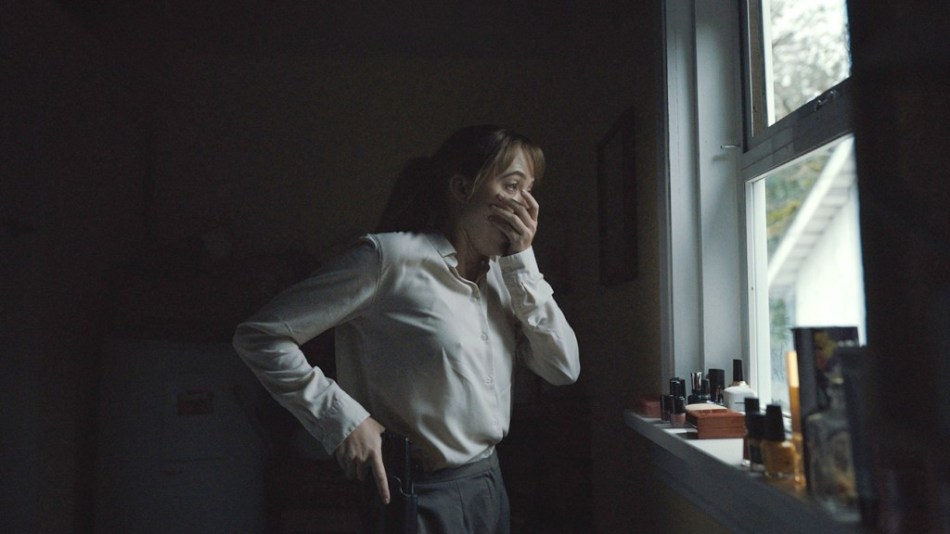
It is natural to compare Osgood Perkins‘ Longlegs to Jonathan Demme‘s The Silence of the Lambs. Both follow a woman FBI agent in pursuit of a serial killer who seems to have unusual connections to her and women like her. However, as Perkins himself noted in subsequent interviews, while there may be some worm of The Silence of the Lambs in the setup, Longlegs is something else entirely. Lee Harker (Maika Monroe), nonetheless, feels like a direct descendant of Jodie Foster‘s Clarice Starling, finding herself having to confront her traumatic past while in pursuit of a dreaded killer that only she can seemingly make sense of when confronted with mind boggling clues and riddles. Thematically, Longlegs has more in common with recent grief-stricken, familial trauma, and Satanic horrors like The Witch and Hereditary, finding its terror in the beyond, its scars in the past, and in the growing dread that, just perhaps, something or someone else is watching right over your shoulder.
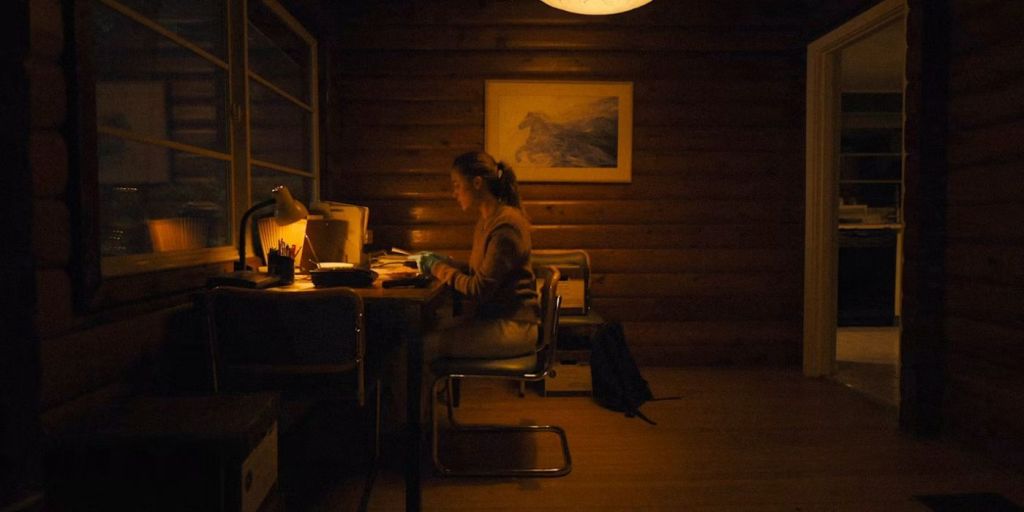
Perkins’ film excels when it is setting the stage for what is to come. The unseen killer in the distance, a beastly figure with horns in the trees, coded letters with messages from the Book of Revelation, and haunting flashbacks set an unnerving tone. As Lee Harker is brought onto the mysterious “Longlegs” case by her superior, Agent Carter (Blair Underwood), she shows an almost psychic knack for deciphering what Longlegs (Nicolas Cage) is trying to communicate in the letters he leaves at crime scenes. In old evidence photographs, Lee knows right where to look to find traces, while the possibility that Longlegs is killing families without ever stepping foot inside their homes never seems to strike her as odd, though Carter and others recoil at such witchcraft-laden nonsense. Perkins creates a suffocating and enthralling atmosphere, where one dreads what could come next but cannot dare look away. The little glimpses of Cage’s killer going about his daily life are more than enough to set him up as somebody nobody wants to encounter. As Lee pours into the details of the case – including a great scene set at a library at night with her going through old files on a huge, 90s computer – and into the lore of Longlegs, Longlegs has one planted firmly at the edge of their seat.
By the time the smoke clears and Perkins demystifies what is going on, Longlegs begins to sputter. In those early scenes, the camera – from DP Andrés Arochi – drove the tension by showing the audience what the characters could not see, such as something unidentifiable lurking outside an open door or in the distance through a window, or in tracking along with them as they move through a home or a barn with something horrible lurking just beyond. The shadows of a scene at night or the restricted frame with rounded edges in flashbacks – like an old, worn out polaroid – set a mood that really grabs the viewer. The images feel haunted, while the characters cannot quite perceive that yet. Once demystified, Perkins leans on the outlandish and the edgy. The smashing of a head on a table, the regimented flashbacks showing these families killing themselves, the demonic lore, and the repeated utterances of “Hail Satan” never capture the same quality as the early, more psychological mood. They are empty stabs at unnerving the viewer with blasphemy and gore, while narratively serving as an attempt to reconcile the mystery it sets out with exhaustive detail and re-iteration. The power in the film is that which we cannot know, can barely see, or cannot even see at all but can feel. The power is not in trying to shock, all of which leaves Longlegs’ final chapter feeling like a series of deflating balloons on an initially compelling premise and a great opening two acts.

While the third act disappoints, the film’s consistent strengths are found in the aforementioned work of DP Arochi and in the performances of its cast, namely Maika Monroe and Nicolas Cage. The former has earned herself a reputation as a strong leading actor in indie horror films such as the excellent It Follows and Watcher with Longlegs standing as another crowning achievement in her young career. She has an inner sorrow in her take on Lee that makes the character so fascinating initially and a disturbing edge that makes one instinctually believe she could have this psychic ability to identify traces of Longlegs. As the film wears on, the trauma and horror that emerges from her past is all believably represented by the increasingly fraught and petrified Monroe. Her scenes at home with her mother, Ruth (Alicia Witt), are some of the most unnerving in the film, in large part thanks to how on-edge Monroe seems and how unhinged Witt plays the role (she, too, is fantastic in the film). Cage has earned many plaudits for his role as the Satanic killer Longlegs and it is not undeserved, as he leans into the absurdity of the character while his typically committed performance keeps it from ever feeling comedic. Rather, Longlegs is a twisted, demonic entity that is a full-throated believer in what he utters, even if it comes out as mangled nonsense to the average person. Cage sells every word, allowing the audience to look past his unusual attire and look to see the sociopath lurking within and feeling quite unnerved by that presence.
Osgood Perkins’ Longlegs received a magnificent marketing campaign that has led to its considerable box office success and while the promise of being one of the scariest films ever may be too much, it is a good film. Its third act is where many of its flaws arise, leaning more into shock value than in the masterclass of restraint and tension that it possesses in its first two acts. Strong cinematography and great performances see it through its rough patches. Longlegs lacks the cursed feeling it seeks, but offers more than enough atmospheric chill to be an impressive film.
Discover more from Cineccentric
Subscribe to get the latest posts sent to your email.
 Cineccentric
Wow this was wonderful Kevin🎉🎉🎉
LikeLike