
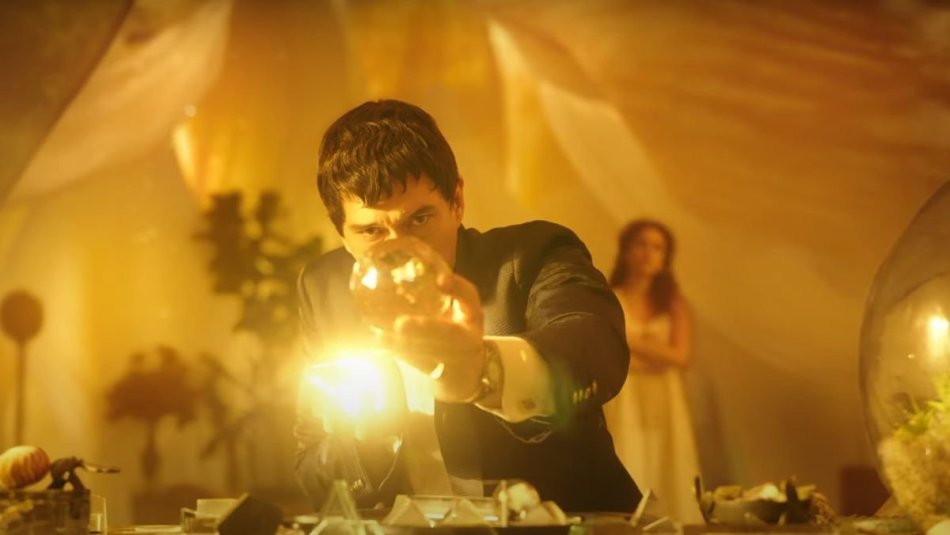
Francis Ford Coppola‘s Megalopolis is a singular piece of work. Though based in history on the Catilinarian conspiracy in Ancient Rome, Coppola crafts a film that feels like a dream, half-remembered and later re-told to others in odd parts that sort of make sense but seem to exist in an alternate plane of existence. It is billed as a fable, a warning to society about the future that may be coming and what an artist like Cesar Catilina (Adam Driver) must do to spur society towards a better world. Given his advanced age, Coppola’s obsessive concern with the world to come, one he likely will not see much of, and whether or not the United States and society at-large are on the brink of a Roman-like fall or a descent into fascism are at the forefront of Megalopolis. It is beyond that a complex and eclectic collection of vignettes, characters, and ideas from its setting of “New Rome” (an alternate history New York) with conspiracy, oddity, and politicking abounding.

Catilina, first and foremost, wishes to usher in a Utopia. In his mind and in Coppola’s, simply asking questions about what humanity is capable of, what world we want to live in, and what must be done to change the status quo, is enough to live in a Utopia. It is perhaps idealistic, though Catilina takes steps to see his visions come to life, while fighting with regressive Mayor Cicero (Giancarlo Esposito) and, soon, his populist upstart cousin Clodio Pulcher (Shia LaBeouf). His vision of the world is remarkable, but even he is not immune to questioning with protests over his destruction of buildings and the safety of the building material – a new invention of his called “Megalon” – that he uses. True to postmodernism, New Rome is a hyperreality where everything has already been built and Catilina is an artist and architect, thus to build and express himself, he must destroy to then re-build. The people ask who he thinks he is to destroy and, for him, he sees them and wonders who they are to question why he would try to create this vision. When a disaster destroys much of New Rome, Catilina is right at the forefront and given a grand opportunity to see his vision through. To some extent, Megalopolis and Catilina’s vision are one, a justification for why to indulge in one’s dream to the degree that Coppola has – spending over $100 million, selling his wineries to fund the project, and working on it on-and-off since 1977 – amidst so much questioning and outcry. Both see the justification as doing it to create discussion, to raise important questions about the world, and to, hopefully, help save society from losing interest in itself. Coppola also dedicated Megalopolis to his late wife Eleanor and Catilina, in time, grows from his romance with Julia Cicero (Nathalie Emmanuel). His art and are vision are enhanced by this love with his Utopian plans given new meaning.
It is nonetheless bizarre, steeped in modern re-settings of Ancient Roman activity, side characters like news reporter Wow Platinum (Aubrey Plaza) who at times can feel cut from another film, and unusual character decisions, line deliveries, and artistic choices. These have helped solidify Megalopolis as a divisive film, one that transgresses every idea of how to make a film and good taste, possessing a brashness and abrasiveness that can be off-putting but is certainly never boring. Perhaps more challenging are accusations faced by Catilina of statutory rape of pop star Vesta Sweetwater (Grace VanderWaal) and the murdering of his wife with him being cleared and acquitted, respectively, with both allegations being attempts to prevent him from fulfilling his Utopian vision. Both mirror allegations leveled against the real Catilina in the Ancient Roman Catilinarian conspiracy. Given the accusations of sexual misconduct against Coppola during the film’s production, it is hard not to see this as an answer from him on the validity of these charges, a nasty side that comes to epitomize the overall indulgence of the film. If one sees Coppola as akin to Catilina, fighting against the status quo of art, the conservative limitations around its creation, and a man willing to push boundaries to see his vision through, then one can (albeit, erroneously) see the justifications for any bad behavior, of artistic indulgence, and self-importance quite clearly.

The film’s indulgence is evident in its bloat. It may have a clear thematic thrust, but Megalopolis feels like the by-product of Coppola’s nearly 50 years of thought on the project with every idea smashed together. It is unencumbered by good taste, though it benefits from its cast’s general willingness to go with it – Driver is committed as always, while Plaza’s eagerness to chew scenery brings her character to life – which helps to carry Megalopolis through its unusual approach. Nonetheless, whether or not the film truly captures its ideas of Utopia, delivering its warnings, and capturing a terrifying reflection of society, or just merely talks about it in narration (from Fundi Romaine (Laurence Fishburne) and monologues from Catilina), is not clear. It certainly skewers modern thinking when it comes to city development – Cicero wishes to build a casino because it will provide an immediate cash influx, but Catilina wants to start building Utopia to usher in a new world, for example – and politics – Pulcher stirring up populist and fascistic rebellion in the streets that challenges any progressive development. All the while not ignoring the reality of income inequality in our world or in New Rome’s with fundraisers for the poor, which the poor are locked out of, and their homes being destroyed while they starve in the name of an artistic vision. It makes an impact and has an urgency that is hard to forget, but Coppola is generally punching wildly and these ideas may be captured, but are flattened into meaning something without really expressing its humanistic core. It is a reflection of reality inhabited by characters that feel cut out of Invasion of the Body Snatchers and are mere vessels for thematic thought. For a film so deeply concerned with civilization, its inability to capture anything but a cartoonish version of it can be unsatisfying.
Megalopolis’s narration and monologues make its intentions quite clear. The characters, for the most part, function as parts of this thematic whole with their behavior either rooted in history or flattened to fit the film’s fable intentions. It does lack consistency, is at times incoherent, and its tonal variance from deathly serious plea to often hysterical comedy makes it an experience like few others. Its concern over the future is obvious, while Coppola musings on the role artists and citizens alike must take are thought-provoking. It is hard to quantify, as it does not all work and it has legitimate drawbacks that prevent it from reaching Coppola’s prior heights. Stylistically, it feels cut from another world like the hyper-stylized One from the Heart and just as daring as it and Rumble Fish (which, too, was inspired by Ancient stories) while consumed with ideas of legacy and future a la The Godfather. Nonetheless, Megalopolis only intermittently reaches the heights of these films, flitting wildly between brilliance and madness into an experience that stirs the heart, scratches the brain, and leaves one bewildered.
Discover more from Cineccentric
Subscribe to get the latest posts sent to your email.
 Cineccentric
0 comments on “Megalopolis ★★½”