
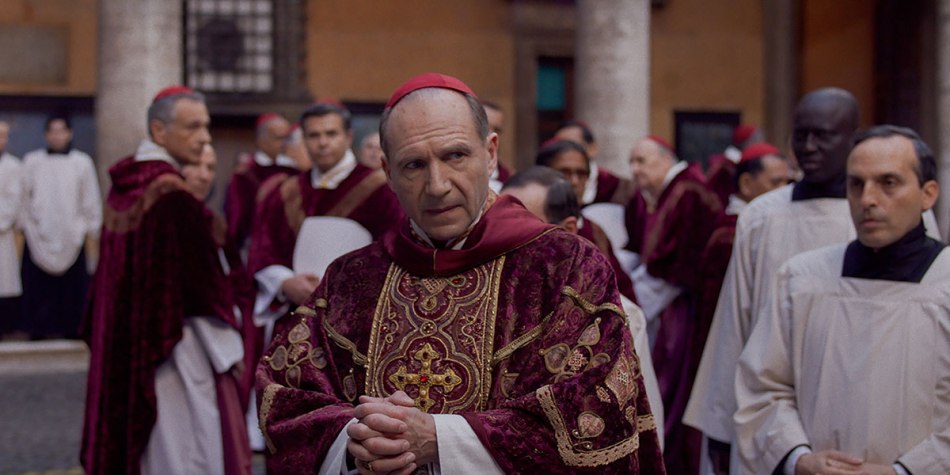
The Pope is dead. After a period of mourning, it is time for a papal conclave to identify the man who will ascend to the Papacy. Cardinal Lawrence (Ralph Fiennes), as Dean of the College of Cardinals, is the man who must lead the selection process. It is a task of great managerial requirement. Every Cardinal is sequestered and must be kept from outside influence that could impact their vote. But, what if Cardinal Lawrence comes across information that could and should impact a candidate’s validity to be Pope? Keeping away outside influence now is one thing, but what about any influence before the voting or the internal gossip that stalks the Vatican? Director Edward Berger‘s Conclave is a gripping film that follows every inch of this process, wringing great suspense out of its politicking, secrets, alliances, betrayals, and the challenge of determining who, if anyone, is truly worthy of being Pope.
Berger’s film is marvelous entertainment. Its writing is sharp and punchy with the audience hanging on every word. Every reveal and character that comes into play adds to the layer of mystery and intrigue encircling this Holy endeavor. The Cardinals can be petty, catty, and dramatic, while wildly ambitious, often feigning humility while harboring wishes for themselves to be elected as Pope. All of them come with their own political agendas, as well as their own backstories with the now-deceased Pope that further cloud and impact their various candidacies. Rare is the case that religion seems to actually factor into the election process, even if every Cardinal prays before casting their ballot and Cardinal Lawrence even starts off the voting with a prayer for the process to yield a man befitting the role. It is all about power, influence, and socio-political cliques. Even Lawrence is involved, aligned with the liberals and voting for Cardinal Bellini (Stanley Tucci), who was a close ally of the prior Pope. He wants nothing more than to keep power away from a man like Cardinal Tedesco (Sergio Castellitto), a traditionalist, racist, misogynist, and homophobe. Other leading candidates such as Cardinal Adeyemi (Lucian Msamati) and Cardinal Tremblay (John Lithgow) carry with them their own set of supporters, but also their own political and personal baggage.
All the while, Cardinal Lawrence is having a crisis of faith and receives a handful of votes for himself to become Pope in every round of the process. Adding to the bewilderment and confusion is the arrival of Cardinal Benitez (Carlos Diehz), who was not on the original list of Cardinals as nobody but the Pope knew he was a Cardinal, having been made one in pectore (in secret), due to his high-risk position as the Archbishop of Kabul. It is chaotic and fascinating to watch unfold with Berger fully at the helm, pacing the film to perfection. So enrapturing is the story that one can even forgive indulgences like a well-timed explosion outside that feels like God’s rebuke of a certain vote. Even its finale, though shocking, sticks the landing with its theological and dramatic implications. It also further emphasizes how Conclave wears its modern political parallels on its chest with the Cardinals often arguing about issues around women, homosexuality, and acceptance and tolerance of other faiths. A late-night meeting in a hallway between Cardinals Lawrence, Bellini, and fellow liberal ally Sabbadin (Merab Ninidze) finds the men worried that Bellini’s candidacy is not gaining enough support to actually win with them debating who they should support instead. With only conservative options available, Lawrence wonders why they must settle for a “less worse” option instead of an actual good one, an admittedly on-the-nose but nevertheless apt summation of the average election process.
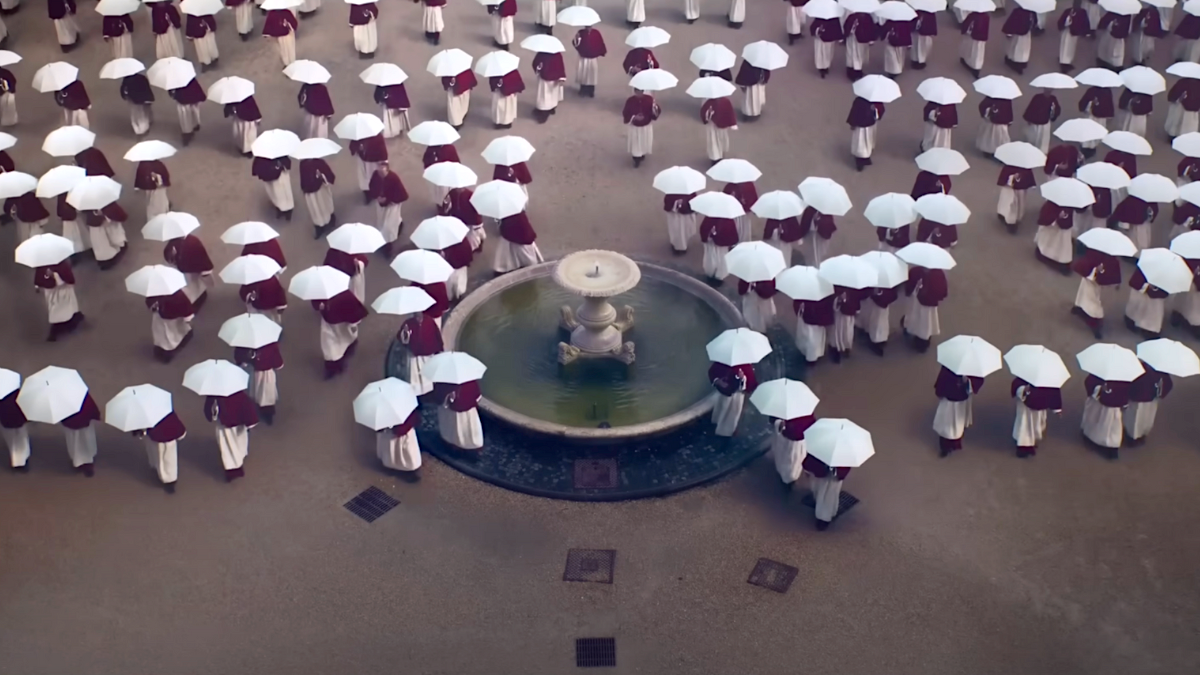
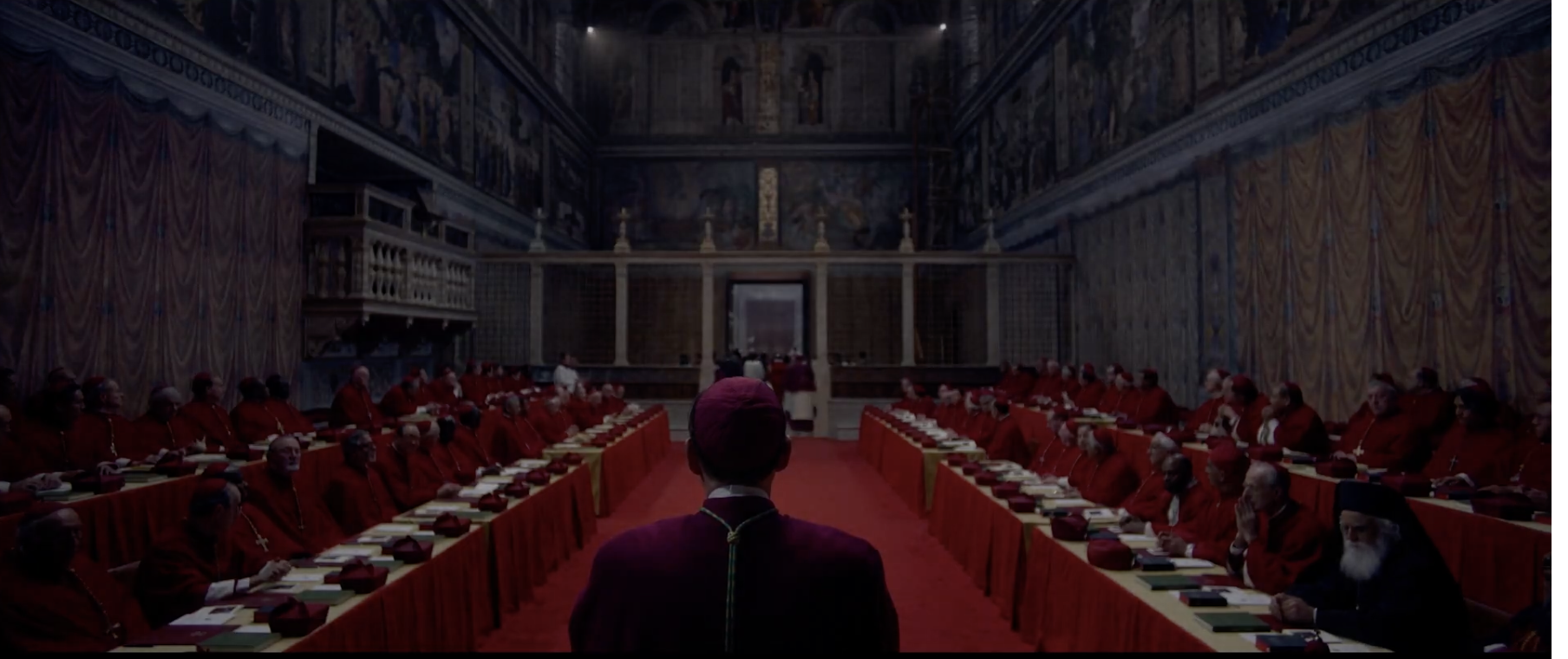
Conclave offers not only great thrills and suspense, but fine tuned artistry. Perhaps the greatest accomplishment of the film is its replica of the Sistine Chapel, an incredible feat of production design that is rich in detail and always wonderfully photographed by DP Stéphane Fontaine. Every inch of the set is similarly impressive with the use of long shots and deep focus allowing the scope of the effort to really come into focus. However, the film is particularly striking in its close-ups and medium shots, whether as Cardinal Lawrence wades through a crowd of on-looking Cardinals at the beginning of the process, in the Cardinal’s faces as they cast their votes, or as Lawrence, enshrouded in shadows, searches for a hidden document that would illuminate the truth behind a candidate’s validity. The film’s more audacious shots – such as an aerial of all of the Cardinals walking with umbrellas for the rain, except for Lawrence who braves the elements – impress, but it is in the tight framing and facial expressions that this film really clicks. Even the final reveal of who will be Pope is handled largely in tightly framed medium shots with a shot of the Cardinals all clapping, Lawrence wading through a crowd, and then finally an over the shoulder shot that at first obscures the man who won but shows all of the expectant eyes of the men who elected him staring at him. It is intentionally suffocating, placing upon his shoulders not only the camera but the weight of the Church. Mirroring the earlier scenes of the eyes falling upon Lawrence as he moves through the crowd of Cardinals, it carries with it the stakes of the process and the responsibility that has been placed on this man.
The cast is universally tremendous. Ralph Fiennes has rarely been better, wearing the weight of Lawrence’s ideological conflict as well as the feeling of fidelity towards the Pope. He has a wonderfully measured way of speaking, one befitting this solemn yet intense man who has such a burden on his shoulders. Isabella Rossellini does not have many scenes, but what she does have are very impactful as Sister Agnes. No words or expressions are wasted with her, while delivering her lines with strength and power. Stanley Tucci, John Lithgow, and Sergio Castellitto are all strong as well, crafting very well-rounded characters who express themselves so clearly that one can see who each man is without needing greater detail. They, and the entire cast, make everybody feel believable with all of the in-fighting, gossip, and debating, benefiting from this authenticity. Carlos Diehz is also impressive in capturing Cardinal Benitez’s mild-mannered nature, his quiet loyalty to Lawrence, and the power in his words when he speaks up. He is not an actor with many credits, but his striking screen presence and delivery make Benitez into a memorable character.
Director Edward Berger’s Conclave is riveting and engrossing entertainment. It is tremendously well-rounded with impressive direction, cinematography, production design, and music that it pairs with top-notch acting and sharp writing that combine to drop the audience into the Sistine Chapel and the Vatican, hanging on every word to find out where this conclave will turn next. Carrying with it real life parallels and an ending that will surely have people talking, Conclave is a great film.
Discover more from Cineccentric
Subscribe to get the latest posts sent to your email.
 Cineccentric
0 comments on “Conclave ★★★½”