
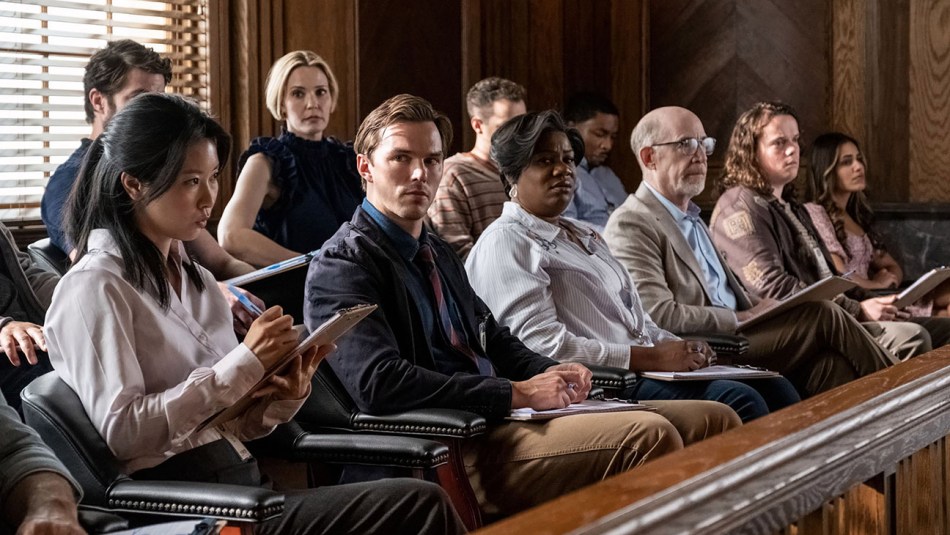
Justin Kemp (Nicholas Hoult) is a recovering alcoholic and working journalist. His wife Ally (Zoey Deutch) is due with their first baby any day now. He receives a summons for jury duty and though it is the last thing he wants to do, he is chosen to serve. The case is a murder trial where James Michael Sythe (Gabriel Basso), a man with a criminal and gang-affiliated past, is accused of murdering his girlfriend Kendall Carter (Francesca Eastwood) and dumping her body off an overpass after they publicly had a fight at a nearby bar. James is represented by public defender Eric Resnick (Chris Messina). District Attorney Faith Killebrew (Toni Collette) is serving as prosecutor, keen to get a big win on the cusp of an election. As a news report states early on, the fate of the election may hang on Faith’s ability to get a conviction in this case, especially as she is running on being an ally for women in abusive relationships. As Faith delivers her heartfelt opening statement and begins to detail the events on the night of Kendall’s death, Justin has a startling realization: he killed Kendall Carter.

Director Clint Eastwood‘s Juror #2 finds its protagonist in a unique moral dilemma. Justin is actively serving on a jury in a trial where he is actually the man responsible. It was an accident. He hit her with his car on a dark and rainy night as she walked along the edge of a tight, dimly lit road. As her body went over a guardrail and into the pitch black area below, Justin could not see what he hit. A nearby deer crossing sign provided a logical answer, so he drove home. Now, he could just speak up and explain what happened. But, as he was at the same bar that James and Kendall were in and is an alcoholic with DUI convictions in his past (Justin professes that though he ordered a drink that night, he did not drink), he knows how things will look. His sponsor and defense attorney Larry Lasker (Kiefer Sutherland) confirms it all for him: if Justin speaks out, he will be convicted and sent to prison for perhaps 30 years, as nobody will believe that he was not drunk. This is a legal drama less centered on the battle in the courtroom than it is on the battle in the jury room with a man torn on whether to back up a conviction for what he knows to be an innocent man but that would save his own freedom or to fight for a not guilty verdict (or, at least, a hung jury) and risk coming under suspicion.
At Juror #2’s core are many classic Eastwood themes, particularly redemption, guilt, justice, duty, and family. Justin is a man fighting addiction and is haunted by his past convictions and now this incident of killing Kendall. Past family trauma adds to his internal anguish, while he feels not only indebted to Ally’s kindness in seeing the goodness in him and helping him to change, but he feels duty-bound to be there for her and his family. His duties there naturally come into conflict with his own duty as a jury member and to the legal system. To let James be convicted despite what he knows is as if he is saying a man cannot change – many in the jury room argue that, even with a flimsy case, James’ violent past is enough evidence to convict – and deserves to be punished even if not guilty for this specific crime, all while Justin himself is a man who hopes he has changed. As Justin comes to fear any evidence that could acquit James and begin to point the finger at himself, his dilemma shifts from finding a way to escape culpability to whether or not he can live with convicting an innocent man while always looking over his shoulder, waiting for his past to leap out and grab him.
Every step of the justice system is followed is Juror #2, tracking Justin from the summons to arriving in the courtroom on day one, voir dire, the trial, the deliberation, and the final verdict. The details of the investigation are delivered as testimony then re-examined in flashbacks and later re-investigation. Though the editing can be a bit rough at times – some scenes feel a bit too short, while the transitions too abrupt – Eastwood’s focus is less on the artistry than it is on the story and the characters, relaying every detail to paint a full picture of what occurred and the present plight facing Justin. It is a “meat and potatoes” film, finding considerable thrill in each step and detail, while Eastwood uses it to examine a system in which everyone involved has a duty to uphold its tenets and, up to now, everybody has failed.
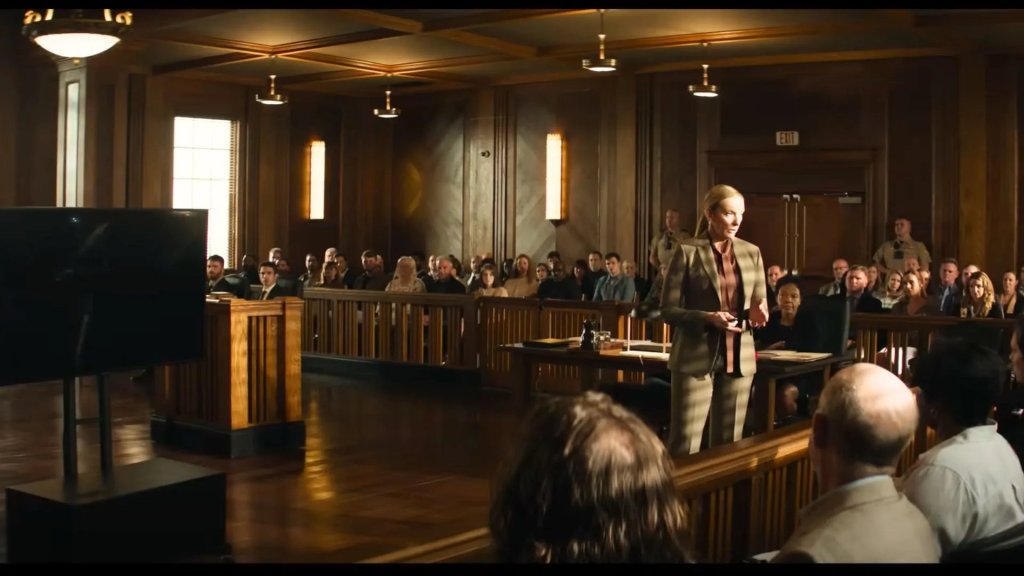
Eastwood repeatedly shows the image of Lady Justice, blindfolded and balancing the scales of justice, as a reminder of what this system should be. As jury member and former cop Harold (J.K. Simmons), discusses, it is easy for detectives to get tunnel vision. They seek truth, but can soon fall into confirmation bias and are keen to avoid extra paperwork. A District Attorney who wants a big conviction may think themselves focused on truth but it is a means to an end for their own ambition. A public defender who, despite good intentions, is not as skilled as their prosecutor counterpart and is too busy to devote their full attention to the case may fulfill their constitutional obligation to their client, but is not a consistent advocate for truth. An overworked medical examiner can make mistakes that further waylay the pursuit of justice. A jury can be consumed by information aside from the evidence and driven more by a desire to go home than to find a just verdict. It is easy for the system to fail, for life to go on, and for the truth to stay buried in under-examined or misunderstood pieces of evidence. If not for a fatalistic coincidence of Justin ending up on this case (which he previously did not even know existed), it is possible the truth stayed buried and nobody involved, aside from James Sythe, was any the wiser. But, life and fate have a way of re-balancing the scales. True to Eastwood’s western roots, a man can change, but their past and their choices have a way of catching up to them.
The cast is terrific, especially Nicholas Hoult. His face adds an incredible depth to the picture with his every internal conflict, responsibility, and pain laid bare in his every reaction and moment. Eastwood and DP Yves Bélanger lean heavily on close-ups for Hoult, allowing the audience to take in his every reaction and feeling as the case develops and his own involvement grows. It is a wonderfully nuanced performance and one that invites the audience into feeling the stress and panic setting into the character’s soul. His chemistry with Zoey Deutch is also vital to the film’s success with one able to feel the real romantic and emotional entanglements that drive his character’s crisis. A scene in their garage is especially moving with Deutch playing Ally with such heart, wearing her fear over what she thinks to be true about Justin’s actions that night being proven right. Toni Collette impresses particularly as Faith begins to grow in her own doubts about James’ guilt. Her own duty to her job is in conflict with her ambitions, a dilemma that begins to emerge in Collette’s eyes and her demeanor.
Juror #2 is unflashy, but premier entertainment. Minor editing quibbles aside, it is finely tuned by Eastwood to be maximally enthralling and tense, wringing every bit of suspense out of the premise with one feeling and truly absorbed by the conflict at its core. The sharp writing, engaging and thoughtful themes, a strong cast, further ensure that Juror #2 delivers a morally complex courtroom drama that would fit alongside the best the genre has to offer.
Discover more from Cineccentric
Subscribe to get the latest posts sent to your email.
 Cineccentric
0 comments on “Juror #2 ★★★½”