
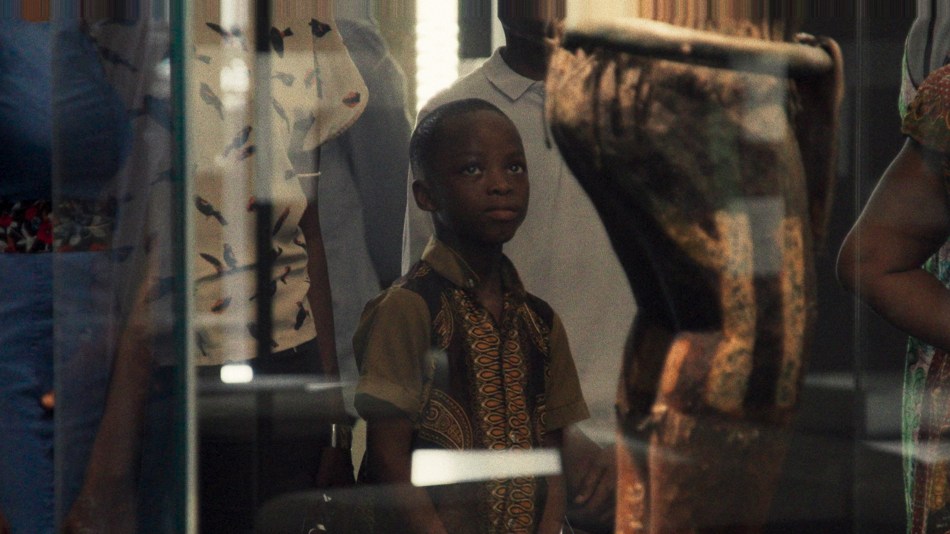
In the early 1890s, the Kingdom of Dahomey was at war with France to protect significant ports & territories and resist colonization. King Béhanzin led the Dahomey people in two unsuccessful wars against the French and was exiled following his defeat. The Kingdom of Dahomey would become part of the French Protectorate until its independence in 1960 and later renamed Benin. As an outcome of the wars, French troops would seize Dahomey artwork and cultural artifacts to be displayed in French museums. Mati Diop’s Dahomey documents the return of 26 of these artifacts to Benin and the response of Benin’s citizens and preservationists to their return.
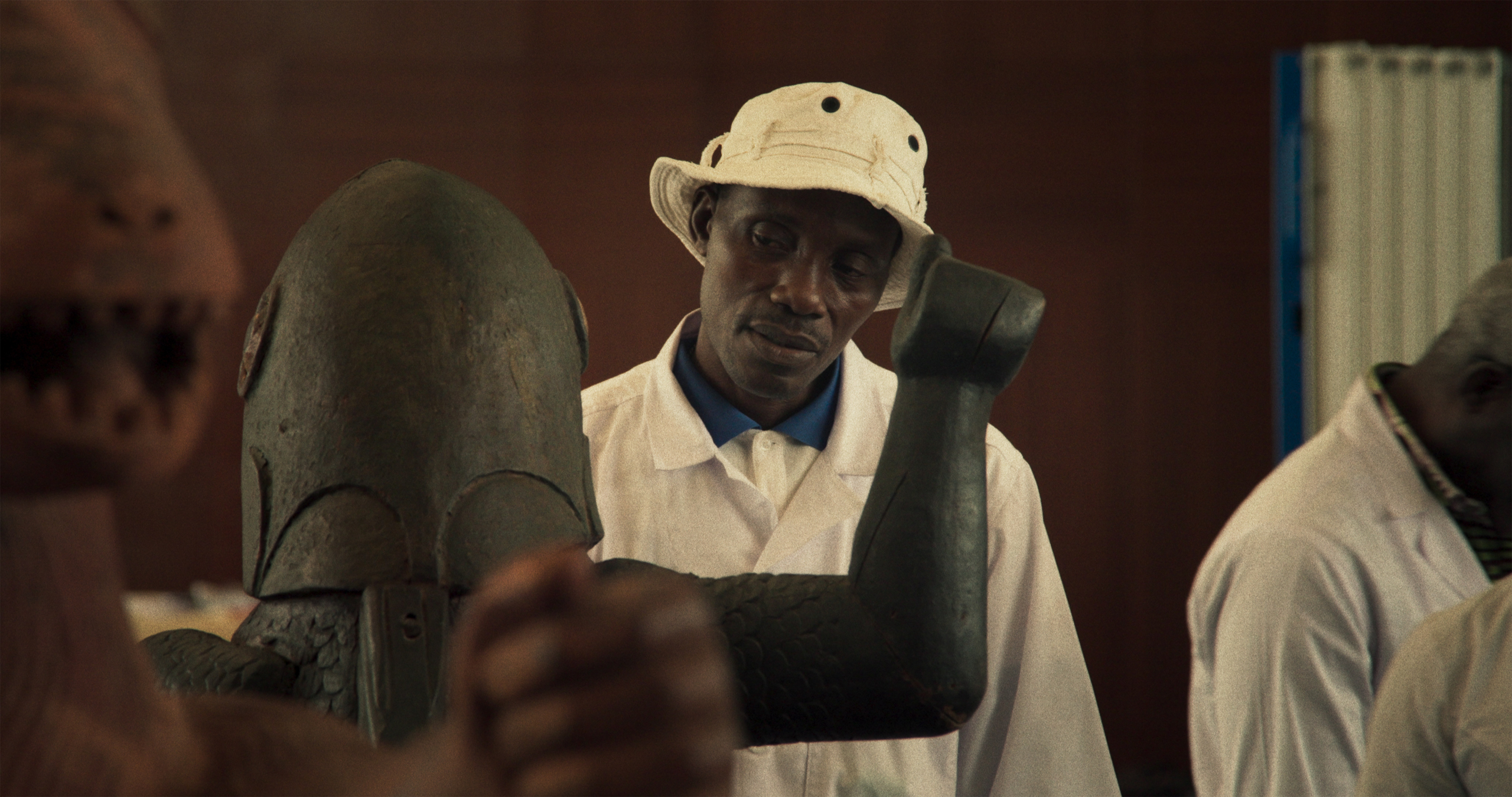 A statue of King Ghézo becomes central to the telling of Dahomey, referred to as “26” to represent the 26th artifact. The film is narrated by writer Makenzy Orcel from the perspective of 26 and shares the statue’s musings on its origins, history, and return to Benin. A first person point of view from the statue is even provided as 26 is transported via container with a camera enclosed alongside the statue.
When the artifacts arrive in Benin, its citizens anticipate their return and for many this is their first experience with Dahomey cultural artifacts. A printing press is shown printing a frontpage story about the artifacts. The second half of Dahomey features a discussion between University of Abomey-Calavi students related to the artifacts and their return. Their discussion is illuminating into all of the different perspectives one might have regarding the artifacts.
Most students believe the return of the artifacts is a revelatory step towards reclaiming Dahomey culture and experiencing their heritage in a new light; however, some are critical that only 26 artifacts were repatriated – Dahomey mentions there are 7,000 such artifacts that have not been returned. Others are critical that the return of the artifacts can be perceived as a political gesture from France and is not solely benevolent in intent. Another student notes that they are communicating in French and not the Dahomey languages of Fon or Yaruba, which are no longer widely taught, as a means of conveying how much revitalization will be necessary to restore their culture. And, interestingly, one student makes the observation that the experience of going to a museum is an aspect of Western culture and that the religious and royal expression of the artifacts were never intended for display in a museum.
There is an immense breadth of ideas conveyed by the students in Dahomey regarding what Benin culture was, is, and can be, ideas that have no doubt been relevant to Diop when directing her film Atlantics, a film with thematic exploration of migration, colonization, and ghosts that is original in its storytelling approach and contribution to Senegalese cinema. While Dahomey is just over an hour long, the film is filled to the brim with ideas and is hopefully a teaser of films to come from Mati Diop.
Author’s Note: I would also like to recommend the documentary Dadiwonisi (We Will Speak) about the revitalization of the Cherokee language to those interested in similar themes explored in Dahomey.
Discover more from Cineccentric
Subscribe to get the latest posts sent to your email.
 Cineccentric
0 comments on “Dahomey (documentary) ★★★”