

Julianne Moore is one of cinema’s strongest actresses, collaborating with famed auteurs such as Todd Haynes, Paul Thomas Anderson, and the Coen Brothers. She joins Tilda Swinton this month in Pedro Almodóvar‘s latest film The Room Next Door. Moore excels in arthouse cinema and in portraying fascinating characters ranging from Carol White in Safe to Gloria Bell in Gloria Bell. Ever since her rise to fame in the 90s, Moore has remained consistently in film watchlists and awards circuits from the strength of her performances. Continue reading for some of our favorite films of Julianne Moore:
Safe (1995)
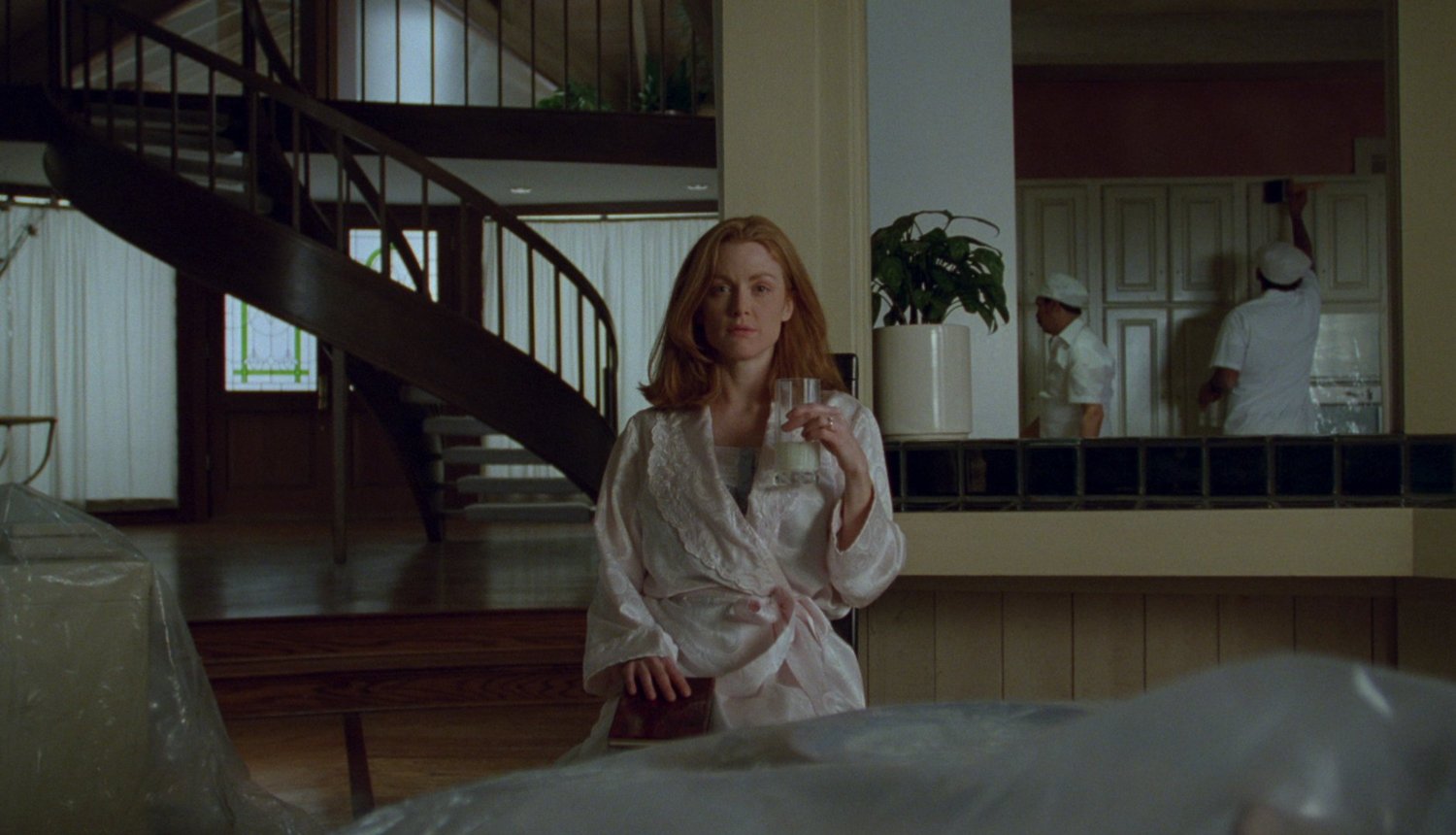 1995’s Safe is the first collaboration between Julianne Moore and director Todd Haynes which has continued to this day in Haynes’ latest film May December. For that alone, the film could hold relevance to cinephiles but as it turns out, that is only the cherry on top for what is an outstanding film. Julianne Moore plays Carol White in Safe, a housewife who begins to mysteriously become ill. The film offers suggestions but no firm explanation why she is ill – Carol’s life and family seems impersonal rather than a source of warmth, and she exhibits symptoms following exposure to fumes and chemicals. Carol decides to pursue different means of treatment and finally joins a new-age community as an unconventional attempt for healing. Safe is a cryptic film where Haynes probes at and provides commentary on numerous themes such as suburbia, industrialization, self-help, therapy, medicine, indoctrination, consumerism, and feminism, and the sum of this analysis plays into a fascinating story. Much of Safe is driven by Julianne Moore, and her non-verbal acting and experiences of confounding symptoms makes her performance in this film impossible to forget. Safe would not only become one of Moore’s best early career performances: to this day, her role as Carol White is one of her strongest. – Alex Sitaras
The Prize Winner of Defiance, Ohio (2005)
 The Prize Winner of Defiance, Ohio is the kind of film that makes one want to hug their mom. Based on the memoir of the same name by Terry Ryan, it tells the story of Evelyn Ryan (Julianne Moore), a suburban housewife in 1950s and 1960s Ohio who, when she is not busy doing everything in the home, passes the time entering contests. She is prolific at them, winning enough on many occasions to bring their low-income family some expensive delights and, in time, her winnings will even be crucial in helping the family keep their home. Married to manchild Kelly (Woody Harrelson), who does not help and can barely keep a lead on his volatile and aggressive emotional state, and practically raising 10 kids on her own, Evelyn is rightly exalted as a superwoman by Terry and Moore’s performance epitomizes every bit of brilliance in her.
The film, naturally, critiques a society that stifled such creative and brilliant women as Evelyn, while enabling and placating men like Kelly. There is a scene of Evelyn watching television at one point where a woman notes that “women are more emotional”, and in seeing Evelyn and Kelly, one needs no more evidence of this falsehood. Moore plays as the epitome of grace and inner strength, maintaining a strong face through every insult, fear, and emotional strain. She is the glue that holds this family together, but it naturally takes an incredible toll on her. Moore plays this side especially well, most notably in a scene where she finally allows her to cry (albeit in private) after discovering just how badly Kelly has screwed the family over financially.
Her quiet pain after painstakingly planning a trip for herself to visit some fellow prize-contest friends is a master-class of understated acting. Derailed at the last minute by some incidental mischief by one of her sons, Evelyn simply exits the car and sets about fixing everything with Moore exuding resignation and having a pit in her throat. She knows that only she can fix everything, thus she must sacrifice and keep her cool, all while burying her own sorrow over not getting the one thing she wanted for herself. It is incredible selflessness and a tragic self-sacrifice, all played with aplomb by Moore. When Evelyn’s charm and wit is on display, Moore has an internal glow that shines. When Evelyn speaks heart-to-heart with Terry (Ellary Porterfield), her gentle and heartfelt delivery captures the wonderful spirit of this woman. The Prize Winner of Defiance, Ohio is an earnest ode to mothers and, especially, Evelyn Ryan, and Julianne Moore shows why one would love Evelyn so dearly and how much was sacrificed so that her kids could go on to live a life without restriction. – Kevin Jones
Children of Men (2006)
 In a career of stellar performances, Children of Men may be an unusual pick to highlight for Julianne Moore. However, Alfonso Cuarón’s dystopian film about mass infertility set in England is a great showcase of how much of an impact Moore can make in limited screen time. She appears as Julian, the leader of a refugee liberation group who hires her estranged husband Theo (Clive Owen) to secure transit papers for and to escort a pregnant woman (the first in almost 20 years) to a ship awaiting her arrival. Julian and Theo have an emotional together with a son who died in a 2008 flu pandemic, which has left considerable emotional scars for both. Julian responds by throwing herself into being a cold and calculated resistance leader. Moore exudes this, though there is a fraying at her tough exterior. She is all business at first when the group first kidnaps Theo, but as she begins to explain some of what they need from him, one can start to see the toughness dissipate and some of their old familiarity come back up to the surface. Her chemistry with Owen is terrific, even if they only let their guards down briefly. The years have made them jaded but as shown in her final scene, set in a car as they travel around the countryside, she and Theo have a level of comfort and connection with one another that is special. They jump back into old gags and have a laugh, while there is a wistfulness and forlornness in Moore’s voice that communicates multitudes of how Julian felt and still feels about Theo. It makes what comes next all the more tragic and sets the stage for the growing emotional hole in Theo’s heart. This is a story of hope and faith, and needing to maintain both to bring about a better future. But, for Theo and Julian, their lives are never meant to be in that future. Their lives ended in 2008 and Moore’s scenes in Children of Men are essential in establishing this emotional tragedy and the film’s connection to what life was like before. – Kevin Jones
Maps to the Stars (2014)

The glamor of celebrity has been thoroughly demystified over the past decade through social media and the seemingly endless revelations of impropriety in behavior that make headlines. David Cronenberg’s Maps to the Stars was released in 2014, a few years before the MeToo movement, and follows a handful of encounters between stars, their staff who make their success possible, and all the odd happenings that occur in between. Julianne Moore plays Havana Segrand, an actress whose best years are behind her, who is desperate for a role in a remake of one of her mother’s films. Moore expresses clearly that Havana is not a very good person, but does so in a manner that is not over-the-top. She also conveys that Havana is worthy of sympathy as the shadow of her mother looms very clearly over her (something the audience may have in common with her) and she desires to restore the success she had earlier in her career. In a movie filled with odd characters, Moore is able to provide a much needed sense of humanity that is otherwise hard to find here. – Alex Sitaras
Discover more from Cineccentric
Subscribe to get the latest posts sent to your email.
 Cineccentric
0 comments on “The Films of Julianne Moore”