

In the television show The Good Place, there is a Point System described that assesses the good deeds and bad deeds of an individual to determine their fate in the afterlife. A high enough score rewards the individual with afterlife in The Good Place while a low or negative score punishes the individual to an eternity in The Bad Place. It’s noticed that over time there are no positive scores and individuals become destined to damnation in The Bad Place for their involuntary involvement in the world’s evils. The show provides an example of the act of buying a tomato: buying a tomato from a grocery store supports the use of toxic pesticides and exploits labor. With this criteria, it’s no wonder that an afterlife in The Good Place becomes unattainable. In modern times, your life is interconnected with countless lives and your actions have often unintended or difficult to avoid effects.
 The characters in Joshua Oppenheimer’s The End face the challenge of coming to terms with the impact of their decisions on the lives of others. Unlike in The Good Place however, their actions are directly responsible for great harm – the family in The End live in an underground bunker due to the destruction of the world above them. The Father (Michael Shannon) was an oil baron and accumulated great wealth from his employment. It’s mentioned that the world above is burning and Father is astonished how this came to occur. He wonders how he could have known this would happen, and chances are you know exactly how this happened.
His wife, Mother (Tilda Swinton), was a former ballerina and brought works of art into their bunker prior to the disaster. Their bunker is laid out as if it were a museum with rectangular rooms that open on each side to the other rooms with paintings on every wall. Mother is preoccupied with appearances (despite there being no one to please) and believes being untidy reflects a perturbed inner self. She and Father also take care to ensure that their Son (George MacKay) is raised well and want to give him a life worth living (despite there being little prospect for self-fulfillment or life outside the bunker).
Life in the bunker is a life in denial. The family relies on their denial to maintain their sanity – they even decorate for the holidays and celebrate the best they can (Halloween has a different sense of spookiness when there are no trick-or-treaters). This denial threatens to become undone when a Girl (Moses Ingram) mysteriously arrives underground and encounters the family. The family wonders how she could have made it to their bunker and where she came from. They debate forcing her to leave, which would almost certainly result in her death, but decide she can stay with them perhaps due to the guilt of not saving more people by bringing them to live in the bunker when they could have. We hear the story of the Girl’s family and this brings to the surface thoughts of guilt and shame that the family has up to this point been able to suppress.
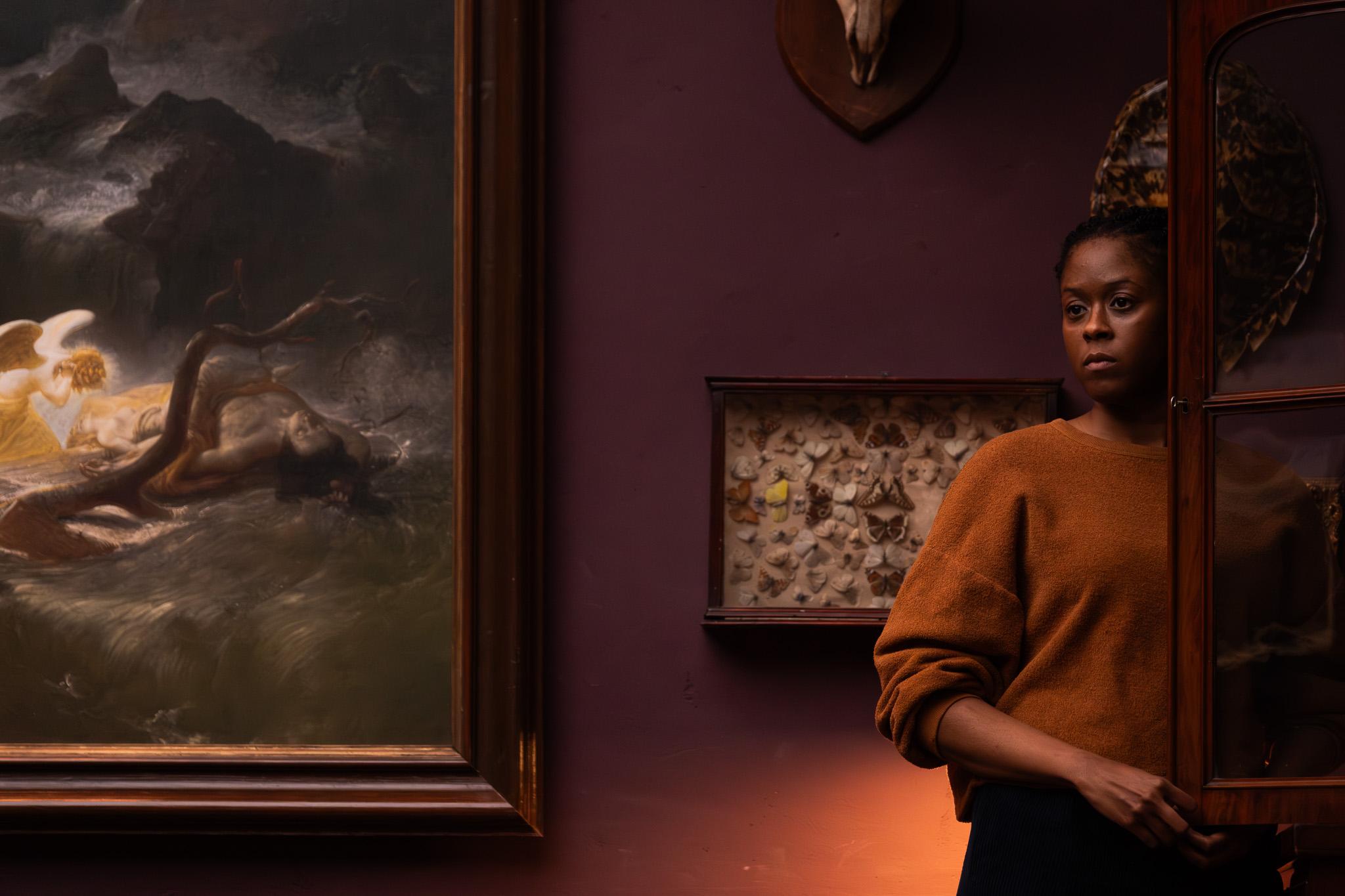 The arrival of the Girl forces the family to reassess the lies they have told themselves and their state of comfort. We see the impact of the Girl’s arrival in the writing of the biography of the Father that the Father and Son are working on. The Father says writing his biography is his way of recording history and giving back to humanity although it’s obvious to the audience, but not to the Son as he did not firsthand experience life outside the bunker, that the contents of the biography are not factual. They are warped by the Father’s belief in his innocence and his suppression of memories and distortion of the truth results in his reliance on his Son to add details and emotional backdrop to the story. The Son suggests to the Father what it was like for Father to fall in love with Mother based on the Son’s experience of falling in love with the Girl, and the scenes of the Father and Son writing the biography are some of the best in The End for their subtext. The Father seeks to absolve himself of guilt by writing the biography with a favorable perspective towards himself and by presenting the destruction as inevitable while the Son tries to discover what feelings one would have and what the experience of life was like in the real world before it was destroyed. Michael Shannon and George MacKay excel in expressing yearning in The End from these two very different perspectives.
In Joshua Oppenheimer’s documentaries The Act of Killing and The Look of Silence, Oppenheimer explored the justifications that those committing acts of genocide made to reconcile with themselves the heinous acts they were committing. The End marks Oppenheimer’s first fictional film and the film grapples with similar themes of denial and the lengths people will go to lie to themselves and live in comfort. Oppenheimer makes the choice to film The End as a musical and it’s fitting given that the life the family has created for themselves is a fantasy.
In modern times, with the Internet and access to information available to anyone, it has never been easier to search for and learn the truth. Yet misinformation is rampant and we have the tendency to mimic empty talking points and seek out information that confirms our biases. It is easier than ever to be aware of the lies we tell ourselves, although changing our behavior as seen in The End is a much greater challenge. In the interconnected world we live in, being able to reflect on our beliefs and change what is harmful is necessary since it is unquestionable that acting on erroneous beliefs will hurt others. While it might not be feasible in your household to buy pesticide-free tomatoes from farmers markets, it is feasible, and essential, to act and to raise children in a manner informed by truth and empathy. Oppenheimer’s tragic film holds immense relevance to the present and the upcoming decade or two will answer whether this period of time will be remembered as a renewed Age of Enlightenment or for the lies we tell ourselves to find false comfort.
Discover more from Cineccentric
Subscribe to get the latest posts sent to your email.
 Cineccentric
0 comments on “The End ★★★½”