
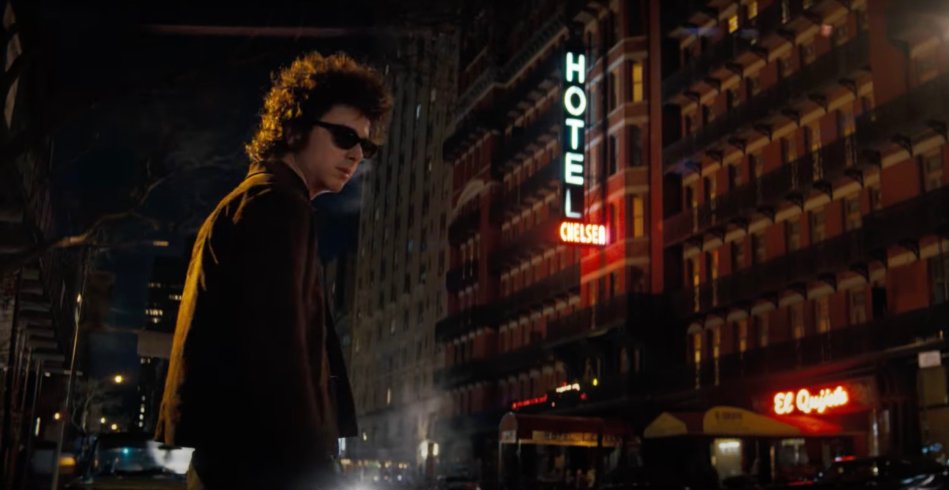
Throughout A Complete Unknown, Bob Dylan (Timothée Chalamet) laments any attempt to label him. “They should just let me be,” he complains after a party where he felt pressured by everyone in attendance to perform. When pressed for details on what they should let him be, he responds, “Whatever it is they don’t want me to be.” He will find exactly what they don’t want him to be when he begins experimenting with electric instruments, a perceived betrayal in the folk music community that comes to a head in the film’s climax, the 1965 Newport Folk Festival. Director James Mangold’s reverential piece of American mythmaking that doubles as a Bob Dylan biopic largely plays to Dylan’s desires, leaving the man himself “a complete unknown”, rather exploring his artistry and placing his music at the center of the film.
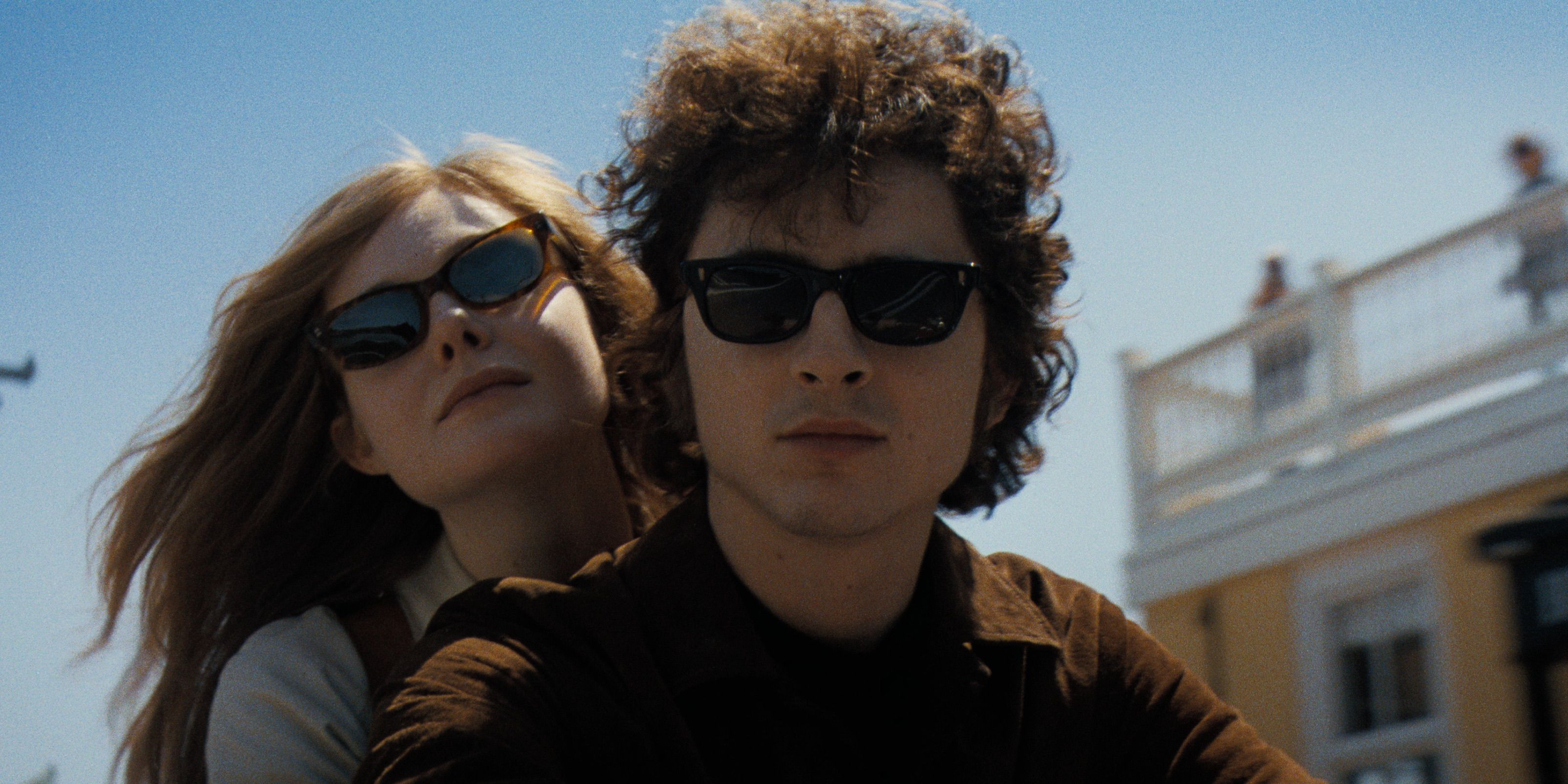
On his first date with Sylvie Russo (Elle Fanning) – a re-named Suze Rotolo – the two watch Now, Voyager with Bette Davis and Paul Henreid. Throughout the film, Mangold will have Sylvie and Bob discuss or reference the film, including Sylvie using Bette Davis’ iconic line, “Don’t let’s ask for the moon. We have the stars,” when she says her final goodbye to Bob in Newport. Most pertinent is a restaurant-set discussion between them after watching the film where they discuss how Bette Davis left home and made herself into, as Bob sees it, “something different.” This is what Mangold showcases as a parallel for Bob, a man who is constantly making himself into “something different” as an artist. He goes where the music takes him, chasing a “spark” then fulfilling it to his end, no matter what the audience or those around him demand. Fame is an unwanted phenomenon, a pair of shackles that restrict him simply living and being in the world and in his artistry. As such, Mangold deploys a fairly atypical approach for a biopic. It is less interested in demystifying the man than in simply elevating the myth. It is mostly centered on performances and recording sessions, showing his artistry in private, his brilliance on stage, and his devil-may-care attitude that created him into a revolutionary and a pariah in equal measure. The dramatic scenes’ only attempts at filling in Dylan’s background do the exact opposite, playing into his often fictionalized past and, aside from calling attention to the fact it is all fake, the film only offers loose definitions of who he was behind the music. This can be somewhat unsatisfactory, while A Complete Unknown can certainly be repetitious in emphasizing just how much of an enigma Bob Dylan is, but like the man himself, A Complete Unknown never tries to be something more defined, flowing along with the music and the historic moments that surround them to be a nostalgia-filled vignette of life along with him in the early 1960s.
It never hides that, as Joan Baez (Monica Barbaro) says, he can be a “kind of an asshole.” He can be temperamental, selfish, and arrogant, firm in who he was, who he was not, and never giving a damn about how he was perceived, but the by-product was also a man who was inconsiderate of others. His relationship with Sylvie is especially evident of both his shortcomings and the film’s loose details in dramatic scenes. At one moment, he is with her and betraying her without her knowledge, then he is with some other never-introduced woman having broken up with Sylvie off-screen. None of these women, Sylvie, Joan, or his other romantic attachments, get much depth. Instead, they are defined solely in relation to Bob Dylan, an especially egregious decision considering Joan Baez’s own incredible talent. A Complete Unknown is content to leave out heavy personal details, instead showing Fanning’s pained expression as she watches Bob and Joan Baez perform at the 1964 Newport Folk Festival, trusting the audience to know how her relationship with Bob was trending. It works, but Sylvie is left underdeveloped as a result. His relationship with mentor and friend Pete Seeger (Edward Norton) and his inspiration Woody Guthrie (Scoot McNairy) are included, just as his eventual artistic disagreements with Pete are, with just enough detail provided to give a rough outline. As with Fanning, Mangold leans on Norton’s expressive face to show his prideful joy at watching Dylan’s “The Times They Are A-Changin’” enrapture a crowd – bringing folk music to the masses like Pete always dreamed – and his abject horror at seeing Bob’s electrified “Like a Rolling Stone” anger and split a crowd.

These elements give A Complete Unknown some foundation, but Mangold rarely cares about details, largely just basking in the glow of watching Bob Dylan write and play music. In this, A Complete Unknown finds its greatest successes. Chalamet is tremendous, embodying not only his voice but his spirit. He transcends imitation into truly inhabiting the man, finding a level of personality and internal expression that captures his essence. His stage presence is impressive, growing from a slightly sheepish young man performing in a smoky nightclub to delivering a truly rock-and-roll stick-it-to-the-man performance at 1965’s Newport Folk Festival with all of the defiant energy of a Johnny Cash (Boyd Holbrook). As much as this is Chalamet’s show, every performance impresses. As noted, Elle Fanning and Edward Norton lend great humanity to their characters, using their expressive faces to communicate multitudes. Norton, too, gives a couple of great musical performances as Seeger. Holbrook is slick and cool as Cash, radiating an aura that is felt long before he even appears on-screen. Among the supporting cast, however, it is Monica Barbaro who steals the show. From her first musical performance as Baez, she captures an almost mystical and heaven-sent quality to her. As with Chalamet’s take on Dylan, she inhabits Baez as a human while still possessing an almost ethereal quality, as though she were a goddess come to life moving through this world of folk music and 1960s Americana. One cannot look away when she is on screen.
Mangold and DP Phedon Papamichael give the cast plenty of room to express themselves and universally, they take advantage, while the close-ups on stage draw the audience into the magic that is occurring, allowing the music to strike us right in our soul, and the occasional silhouetting and heavy backlighting gives these performance a magical feeling that etches them into the history books. A Complete Unknown is mostly made up of musical performances, using its subject’s life as a loose connective thread and excuse to play the hits and look into the past for a “spark” of brilliance. Its narrative can be slack and lacking in detail, especially as it relates to the supporting cast, and its protagonist can be a bit rough around the edges and the film is unabashedly reverential. However, A Complete Unknown finds power in simply bringing the audience along for the ride and seeing life in the 1960s folk scene as it was. Dylan remains as enigmatic and undefinable as ever with Mangold tracking him through this transitory era, keen to keep him the distant mystery that he admires and to celebrate the way he never shied away from being “something different.”
Discover more from Cineccentric
Subscribe to get the latest posts sent to your email.
 Cineccentric
0 comments on “A Complete Unknown ★★★”