
The upside-down American flag is seen as a form of protest, or to represent that something is terribly wrong. The upside-down cross holds two meanings – for Christians, it represents the humility of Saint Peter while others interpret it as a symbol for atheism or Satanism. When László Tóth (Adrien Brody) arrives in America by boat, the Statue of Liberty is shown upside-down. From his perspective, he is below and therefore the monument should appear to him as rightside-up. But the camera does not show this portrayal. With booming orchestral horns and László’s euphoric yells upon seeing the Statue of Liberty, the scene invites marvel and grandeur yet the depiction of the Statue of Liberty as upside-down suggests a darker sense of foreboding. The latter is a closer representation of the effect that Brady Corbet’s The Brutalist imparts.
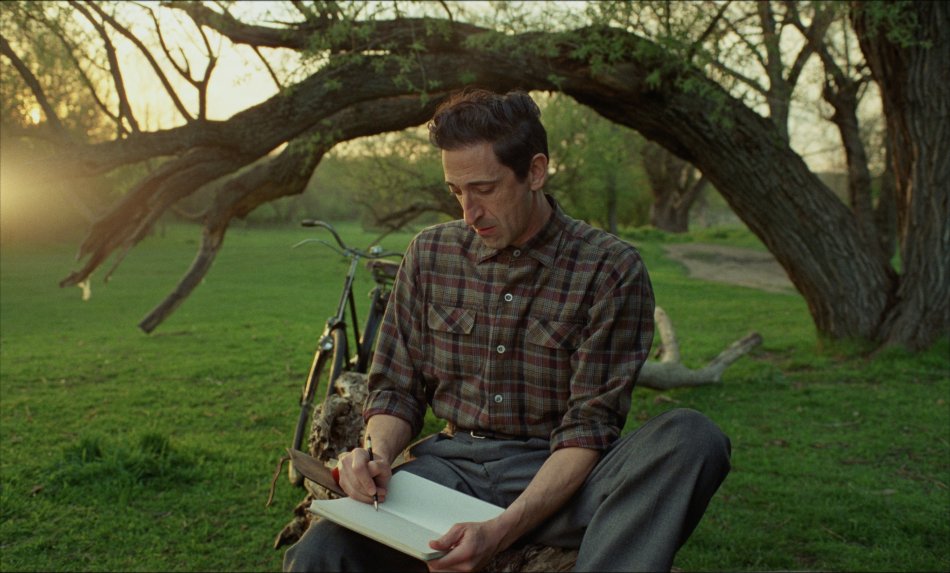
From Hungary, László is a renowned architect. Separated from his wife and niece during the Holocaust, László arrives in America with hope, yet his previous success holds little bearing in the new country. László travels to Pennsylvania to stay at his cousin Attila’s (Alessandro Nivola) until he can find work and László is grateful for Attila’s accommodations. This arrangement soon turns sideways when Attila, a furniture store owner, is commissioned by the son of industrialist Harrison Lee Van Buren (Guy Pearce) to renovate a study at the magnate’s estate as a surprise for his father. Attila enlists László to design the changes and manage the crew and materials. Originally in antiquated design, the study’s walls and floors are covered by curtains and carpet, leaving little room for light to illuminate the room. It is stated that this is to protect the books in the study from sunlight. László realizes that he can address this concern by designing doors to the bookshelves that can be angled to block sunlight while taking advantage of the light that comes in above through the skylight in the placement of a reading chair. László’s design is functional but a sharp contrast to the original room’s design. When Van Buren unexpectedly arrives during the renovation, he is enraged and refuses to pay Attila for the project. This cements a rift between Attila and László due to the high cost of materials and Attila’s wife’s disapproval of László, and László is forced to move to community housing. Through his experience with Attila, László learns that a helping hand can quickly turn into a clenched fist.
Time passes, and László finds work and befriends Gordon (Isaach de Bankolé), a single father. Gordon becomes László’s only friend in America, their friendship starting when László helped Gordon get food for his young son after the community kitchen closed. Their friendship extends through the duration of The Brutalist and is an uncommon occurrence of a friendship in the film that is not exploitative. László and Gordon experience solidarity in their shared experience of struggling to make a living in America.
Their lives take a turn, seemingly for the better, when László is visited at work one day by Harrison Lee Van Buren. Van Buren is apologetic for his behavior when reacting to the new study, and pays László for the project. He tells László that he discovered László’s background as an architect and is surprised that a man of such renown would be living in community housing and constructing a bowling alley. Such is beneath László, Van Buren believes. He invites László to his estate for a party where he reveals to the attendees – and László – that he will be commissioning László to construct a community center in honor of his late mother. The center will have a library, a theater, a gymnasium, and a chapel, and be a grandiose monument in an otherwise ordinary town. László is taken aback by the commission, and feels deep gratitude for the opportunity to be an architect again. Van Buren promises László will be well-compensated and provides László a room to stay in given the immense scale of the project. Van Buren connects László with his personal lawyer, and the lawyer explores expediting the immigration of László’s wife and niece. László’s unexpected turn in fortune is deserved and invigorates him for the first time since he arrived in America.
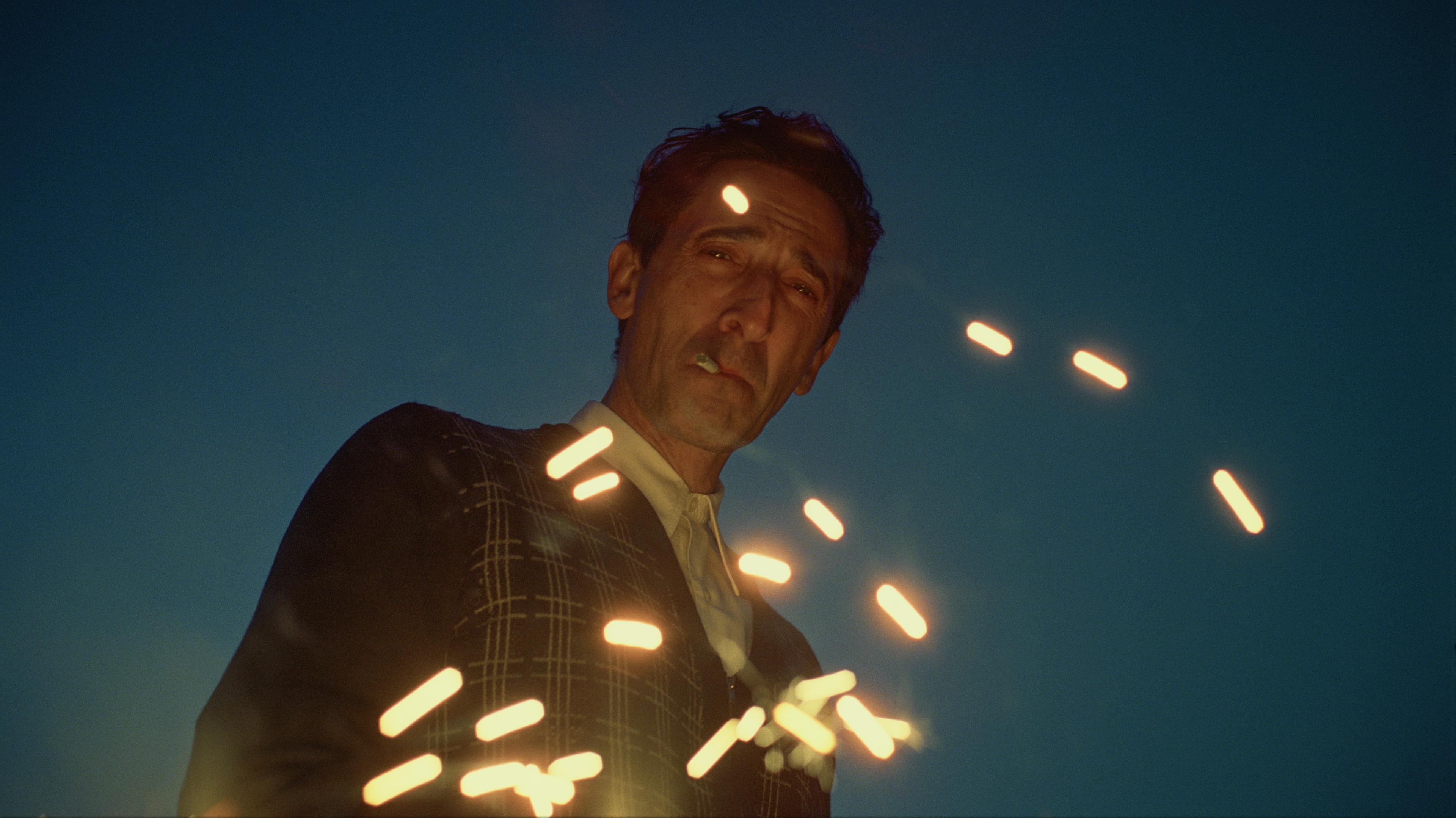
László’s vision for the project is in line with his previous architectural works, though the brutalist style is unlike other buildings seen in the Pennsylvania town. The scale and specificity of László’s ambitions are drawn into question and though Van Buren remains outwardly encouraging, he has his lackeys oversee the development of the project who attempt to cut corners and reduce the project’s cost. László is not open to compromise and insists the center be built as he designed even if confrontation is necessary or it comes out of his commission. Many other films would portray a descent into madness for László as a result of his obsession though this is not the story that is told. The Brutalist provides a discussion between László and Van Buren on why László is an architect and is revelatory in its expression of the significance of architecture to László, a man who has survived the Holocaust and has been dealt immense pain in his life.
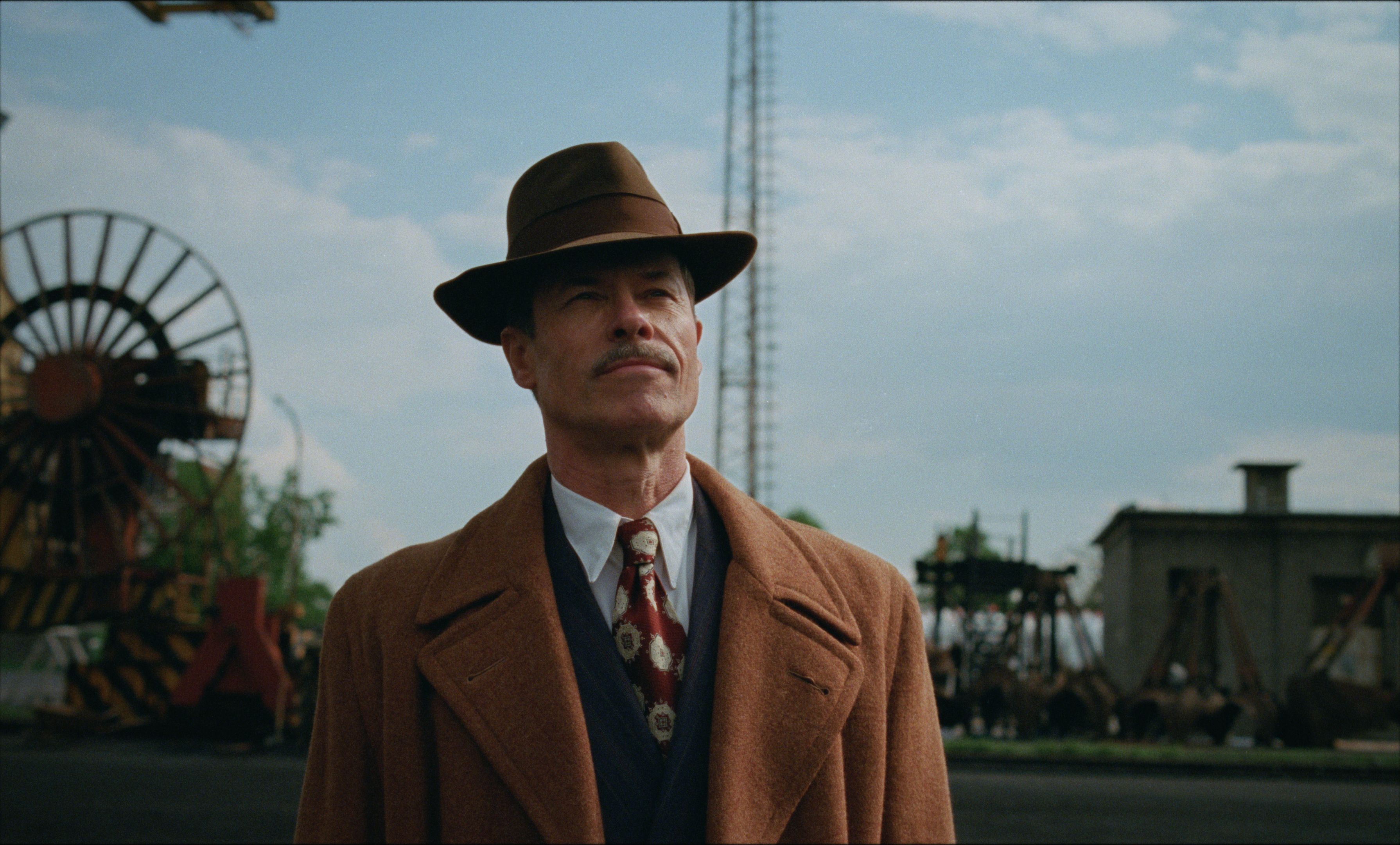
Personal differences between László and Van Buren come to surface as the project experiences delays. László begins to recognize that Van Buren’s patronage and recognition of László’s talents is fickle and a result of the novelty of László’s arrival. Once the reality of requirements for the commission set in and László expresses his vision, Van Buren starts to feel contempt for László. This is worsened upon the arrival of László’s family and Van Buren’s belief that László is a curious novelty and discardable is at odds with the multiyear scale of the build. Van Buren and his family become toxic to László’s family and don’t mince words when it comes to expressing their distaste and xenophobia. “We tolerate you,” Van Buren’s son tells László after a discussion on the project’s requirements, and it is clear that the Van Buren family believes that László should be indebted to them for providing him with an opportunity and that they look down upon him as an immigrant. Threats to László and his family are thinly veiled, and the Van Buren family are perturbed when László expresses anything that resembles an independent opinion. The struggle that László faces in asserting his dignity in The Brutalist becomes as equally immense as his architectural ambitions while the Van Buren’s attempt to diminish László at every turn. From László’s experiences with Attila’s and Van Buren’s families, The Brutalist expresses a deeply cynical portrayal of the immigrant experience and of how those with different backgrounds than our own are regarded.
The character of László is compellingly written. A Holocaust survivor, László illustrates the great suffering of a people who were denied not only their dignity, but their lives. László’s elation upon arriving in America and his prospects of a better future for himself and his family soon fade and he experiences disillusionment as he realizes the dark side of human nature remains present. Just as grace and kindness knows no borders, neither does cruelty. In his film The Childhood of a Leader, Brady Corbet explored the roots of evil and the way that evil manifests. Here, his film The Brutalist examines the impact of this dehumanizing evil on an individual. László’s struggle for dignity and desire for basic human kindness and recognition of his worth – not even as an architect, but as a human – is so fundamental to the human experience and Adrien Brody delivers a heartful performance that is raw with László’s emotion and pain.
By the second half of The Brutalist, László holds none of the optimism he once had, and the film becomes gratuitous in its misery. An argument could be made whether or not this is necessary for the film to deliver its commentary on dignity and the immigrant experience. The Brutalist also offers much in examining the role of the architect – or the artist – in expressing the meaning of their work and their intentions in relation to the financiers or later observers of the work. Corbet’s film invites interpretation around László’s intentions as an artist, particularly in the film’s closing scene and in showing how László’s work is remembered. It is suggested that symbolism can be a means to uncover the true meaning of a work, and offers a fitting justification for László’s steadfast commitment to his vision. While László’s humanity may attempt to be denied by those who hold power over him, it is the meaning of his work that provides László with strength and conviction that his vision will be the one that prevails.
Discover more from Cineccentric
Subscribe to get the latest posts sent to your email.
 Cineccentric
0 comments on “The Brutalist ★★★½”