

Steven Soderbergh is always experimenting. Messing with form, how to shoot a film, and how to tell a story, his films are often noted for non-linear storylines, hyperlink cinema, re-creation of classic styles with modern technology, editing tricks, breaking the fourth wall, or using unconventional cameras (like an iPhone). He is often breaking cinematic conventions and narrative rules, pulling apart the medium to see what makes it tick to see how it can progress and shift with the availability of new ideas and technologies. Presence is a perfect example, telling a ghost story from the perspective of the ghost or “presence.” One can think of films like The Others or A Ghost Story that offered a similar perspective, but in blending it with a first-person POV camera that drops the viewer into the vision of this entity, Presence sets itself apart as a unique experience all its own.
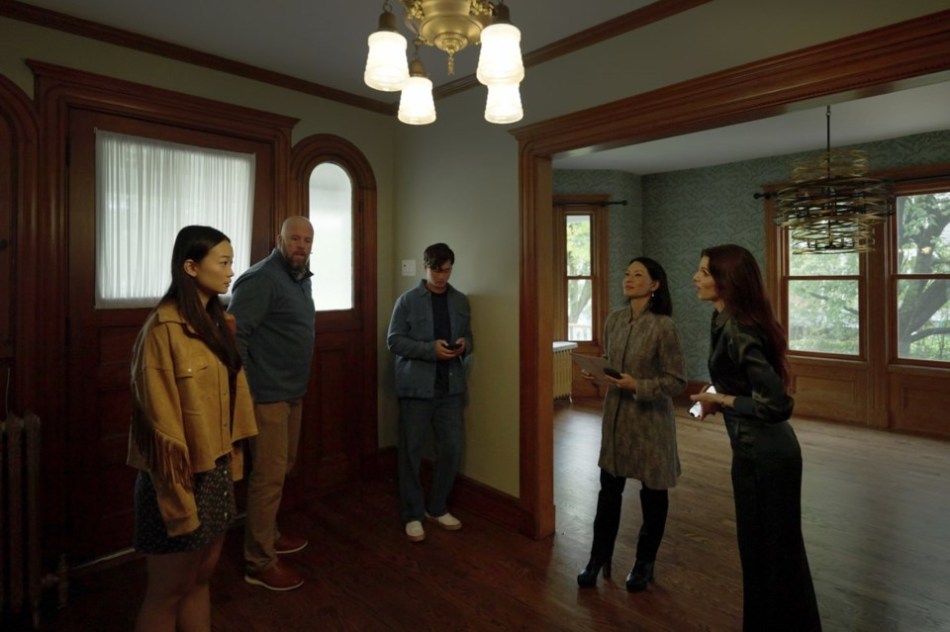
Its motives are initially unclear as it lingers in an empty home. The camera tracks through the upstairs then makes its way downstairs as Cece (Julia Fox), a realtor, comes in to flip on lights and prepare herself for a showing. A family – parents Rebecca (Lucy Liu) and Chris (Chris Sullivan) with their two teenage children, Chloe (Callina Liang) and Tyler (Eddy Maday) – soon arrive and Rebecca immediately sets her intentions on owning this home. They soon move in, and it is not long before their old troubles find them in this new place. Chloe is grieving the death of her best friend Nadia, but Rebecca never pays her any mind, preferring to shower attention on talented swimmer Tyler who she practically admits is her favorite child. It is largely on Chris to be there for Chloe, but even then she is generally emotionally vulnerable and isolated. All the while, the presence is there, watching and taking in the minutiae of this family’s life. Details are sometimes sparse – especially regarding some potentially criminal actions that Rebecca committed – with the presence always in the home, but not omnipresent within every corner. As its attention moves, so does the camera with conversations sometimes happening off-screen as the presence moves or looks elsewhere in the home.
Heavily relying on tracking shots and long takes, this approach lends Presence an intimacy with the presence. As such, it is never scary when it is in the room, though it can be quite chilling when a character feels it in the room and moves gingerly towards the camera or, as in one scene with a medium, Lisa (Natalie Woolams-Torres), a character looks straight at the camera. The feeling of knowledge, of breaking through that fourth wall, and of the voyeuristic illusion being broken gives Presence a unique edge and uncommon eeriness. Soderbergh feels especially fascinated here by voyeurism and how films offer audiences a chance to watch but not be involved with the actions undertaken by characters. We are simply observers and, for much of the time, the presence is the same as it tries to remain out of the picture and simply take in what happens to those in this family. But, as Chloe embarks on a relationship with Ryan (West Mulholland) and finds herself in increasing danger, this barrier begins to break with small intrusions and then larger interventions on the family’s behalf. When Soderbergh transgresses the barrier between the watcher and the watched, bringing this presence out of the corner and into the middle of the action, his thematic and emotional intentions become quite profound.
This is a story peeling back what could trap a spirit in a home, presenting a sort-of mystery that must be unraveled, while offering fascinating emotional themes and metaphysical implications. This is a presence that, as the medium notes, has something it needs to do but does not know what or why it is in this home. Early on, there are feelings of trauma and pain, while Soderbergh introduces a fascinating angle regarding anachronism that opens ideas of guilt and regret that end up being the overpowering feelings of the film. It all builds to a thunderous crescendo of a final act, bringing to a head all of the themes that Presence introduced in satisfying fashion. Cinema is at its most potent as a vehicle for empathy and here, Soderbergh brings the audience into the mind of this presence, matching its early confusion over why it is made to witness these scenes, dread of what horror could be coming, regret and guilt over how things transpired that it could control, rage and anguish as it tries to fulfill its purpose, and longing to be more than just the watcher. In this, Presence becomes more of a personal horror story, an intimate look at a soul haunted by what it did and did not do in life with the events transpiring as an attempt to re-do something within its grasp and make amends for its sins or wrongdoings in life. The villain is a bit too over-the-top in both performance and writing for this particular story, but Presence handles every other element of its story, family drama, and emotional core with understanding, clarity, and poignancy.

When Soderbergh switches things up, Presence is at its most arresting. For the most part, the film is made up of long takes and tracking shots throughout the home with the presence lurking from room-to-room, looking away when things become too much, or eavesdropping on conversations it only has partial details for. There is generally no sound other than dialogue and any diegetic music in a scene, while much of the action is in medium shots from the other side of the room, through a glass door, or across a table. In a few moments, however, there is a piercing sound and visual distortions as the spirit seemingly reaches out from the astral realm to impact this world. There are a few important close-ups and a shocking final shot that feels like an absolute punch to the gut.
That shot relies on a bit of foreshadowing and a great bit of mise en scène, indicative of Soderbergh’s overall formal brilliance in Presence. How the scenes are blocked is especially fascinating. It heightens this feeling of spying and looking in on this family with the characters never placed in conventional positions, rather moving about the frame, sometimes drifting out of the frame, and the camera remaining stagnant or hurrying up to catch up with them as they walk away or through the home. It can be disorienting at first with a chilliness to the presentation, but with the blocking and camera placement being purposefully out-of-sync, it yields such fascinating results. As noted, the element of voyeurism is ever-present in Presence while Soderbergh self-reflexively calls attention to the presence of the camera, turning it into a character of its own, and placing no barrier between it and the characters, enabling us to see the world as they do, to feel what they feel, and to cut through any conventional theatrical barriers.
As it lays out its scenario, Presence feels disquieting and eerie, possessing an unnerving quality that is hard to pin down at first until the drama builds, the presence’s personality and feelings become clearer, and the peril threatening this family becomes inescapable. Tragic, stirring, and unexpectedly powerful, Presence is a horror film not out to scare, but to ruminate on the feelings of a supernatural being cursed to watch the world it left behind. Finding Soderbergh in one of his experimental flourishes, it blends formal brilliance with an engrossing story that packs a punch.
Discover more from Cineccentric
Subscribe to get the latest posts sent to your email.
 Cineccentric
0 comments on “Presence ★★★”