

“It’s not about politics. It’s about emotion.”
-Roone Arledge
Roone Arledge (Peter Sarsgaard) delivers this line in regards to airing the boxing match between the United States and Cuba in the 1972 Summer Olympics, though it becomes an apt summation of September 5’s approach to its subject matter. It tells the behind-the-scenes story of the Munich massacre in which a Palestinian militant organization known as “Black September” entered the Olympic village, killed two members of the Israeli Olympic team, and held nine more hostage. Current events of the Israeli-Palestinian conflict, of course, make September 5 into a tricky endeavor for writer and director Tim Fehlbaum. However, his film is solely focused on the television coverage of this event. It was, as text at the end reveals, being watched by over 900 million people – including the Ohio-based family of one of the hostages, Israeli weightlifter David Berger (Rony Herman) – and it was in the hands of Arledge and his team at ABC Sports to deliver this news to the world.
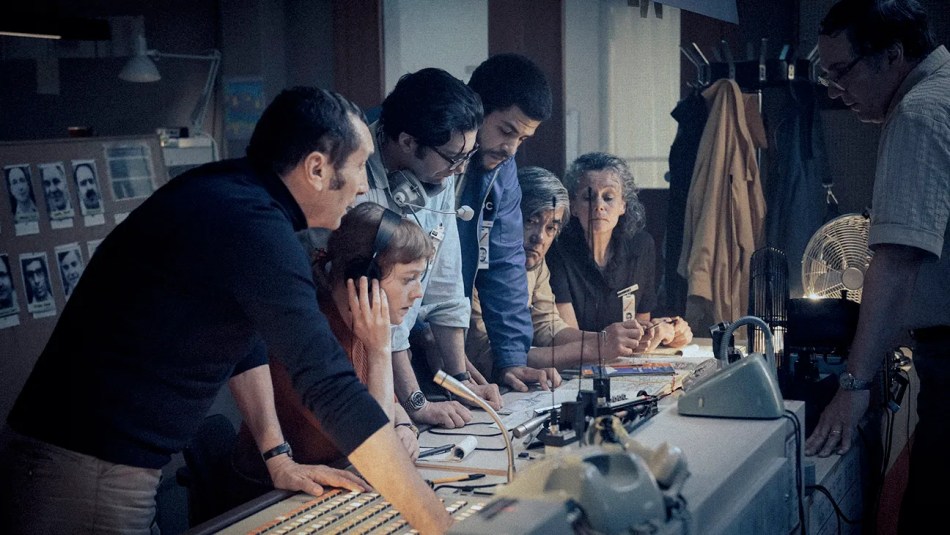
ABC was known for the phrase, “The thrill of victory, and the agony of defeat,” but now real human lives are on the line. Men with families who are waiting on every new report to find out if they are even alive, not fans hoping to see their favorite swimmer win gold. This job comes with stakes they have never encountered, maneuvering through the ethical and moral minefield of the situation and their place in the crisis. Reporter Peter Jennings (Benjamin Walker) even advises Roone that ABC News should handle it, even if they would have to broadcast from the United States, because they know all of the pitfalls in reporting on such a volatile situation. Yet, Roone fights for it, determined to keep this story with the sports division and trusting men like control room head Geoffrey Mason (John Magaro) and head of operations Marvin Bader (Ben Chaplin) to ensure the story is told the best it can.
September 5 finds itself musing over the many questions that arise with such a story, as well as the morally gray ethics of it all. As Roone watches television, he sees an interview with an escaped hostage, Tuvia Sokolovsky, and is incensed that his team did not get this man for their own broadcast. Geoffrey quickly moves to fix this and, in archival footage (editor Hansjörg Weißbrich wonderfully weaves in such footage throughout the film), soon this clearly shell-shocked man is put on television to be interviewed by ABC Sports anchor Jim McKay. It is necessary, in Roone’s mind, to have this man on air, but what of the ethics of doing so while his friends’ lives still hang in the balance? The team’s translator Marianne (Leonie Benesch), when on the ground reporting, finds herself struck by how she and everyone else watching this hostage stand-off happen is standing there ready with a camera, waiting and hoping for something to happen. They want the outcome to be good, but every gunshot in the distance carries with it an importance that feels lost amidst this sea of reporters eager for a scoop. It is a story that, as motivated Roone’s fight to tell it, carries with it both great responsibility and opportunity. The division’s name and reputation and the careers of those who report it can forever be benefitted by how they tell this story. But, it is a tragic event and one with grave political ramifications around the world. How can they report what they see without being exploitative and be praised for how they reported it when innocent people died?
Beyond this, the professional questions of how to cover the events consume much of the drama of September 5. What can be shown and how can it be shown? They have cameras everywhere, but what if those cameras capture police movements or a live execution? What are the responsibilities in terms of language used – as Peter Jennings warns, a term like “terrorist” carries with it meaning that, at the moment, they have no idea if it applies – and when can they run with reports from the ground? September 5 dives right into the newsroom as they deal with the tricky ethical minefield of the situation, while considering their own place in the story. Fehlbaum draws a fascinating parallel in the news team’s uncertainty in handling it with the overall inexperience of everyone from the news to the police to even those at home watching.
Germany, keen to restore its reputation in the world post-WWII, has laws preventing the military from intervening in such a matter. Thus, the local police, who have limited if any experience in hostage crises (and even need to receive weapons from the military to equip themselves), are thrust into the situation. They need to handle not only the hostages and militants, but the media, who introduce a new element that further complicates matters. The world at-large is consuming it in a new way, a non-stop news cycle with ever-changing information delivered to them through screens, while they sit there consumed by helplessness and terror watching and waiting to see the latest. Even the newsroom team is not immune to this phenomenon, stuck hearing on-the-ground reports, half-stories, and interpretations from camera crews, never quite sure if they are getting the full picture and how to process the new developments while never witnessing them first-hand.

September 5 is an always engrossing and thrilling ride, wonderfully written by Fehlbaum, Moritz Binder, and Alex David to maximize this suspense with the feeling of minute-by-minute anxiety. With the news starting slowly from just idle gunshots in the night to realizing what is going on and navigating the confused situation in the Olympic village, September 5 consistently rides a wave of highly involved tension. The work of DP Markus Förderer is essential, using a digital camera but mimicking the grain of 16mm, which drops the viewer into the ecosystem of this newsroom, the personalities at play, and the fraught emotions of all involved. The action is set entirely within the ABC Sports office in Munich with the dark room lighting, the glow of screens, and the suffocating feeling of being so close to the story yet still in the dark on the full picture. The natural drama of waiting on edge for information, the click of the wire spitting out the latest intel, and all of the minutiae of 1970s television reporting from ABC’s rivalries with other networks (and their shared use of a helicopter for aerial footage), how the stories come together technically, and the limitations and challenges they must confront.
September 5 is a film about emotion, of watching tragedy occur right next door and being stuck watching and reacting to the roller coaster of emotion. It is about the ethics and morals of reporting on these events, the responsibility of the news reporters, and the emotional toll it takes on them to have to witness such horror and to then be recognized for how well they handled it all. The cast is wonderful, highlighted by Peter Sarsgaard, John Magaro, Ben Chaplin, and Leonie Benesch. Strong cinematography, editing, and writing bring it to life, all while delivering a nerve-jangling story about the men and women who told the story about one of the great tragedies of the late-20th century.
Discover more from Cineccentric
Subscribe to get the latest posts sent to your email.
 Cineccentric
0 comments on “September 5 ★★★”