
Few directors have had the kind of career that Jonathan Demme had. Like his filmmaking peers Martin Scorsese, Joe Dante and John Sayles, Demme emerged from the sophomore class of the same burgeoning Roger Corman Film School that’d already produced Peter Bogdanovich, Francis Ford Coppola and Monte Hellman. But only Scorsese can match Demme in his career-long obsession with mixing pop songs with images while at the same time devoting a significant portion of their careers to concert films and music documentaries. While Marty may be Dylan’s documentarian of choice, Demme’s the one who made a trilogy of highly-watchable Neil Young movies.
Thanks in part to the recent remastering of Stop Making Sense, a lot of people have once again been recognizing the impeccable talent Demme had for capturing live performances. What’s less lauded is how Demme used that very same skill in his next film, 1986’s Something Wild, which uses a live, five-song performance by The Feelies to impressive storytelling ends. Something Wild is Demme’s ninth film. And while it is the follow-up to Stop Making Sense, it’s really the first film to crystalize the unique sensibility that would make Demme a cinematic icon — his peculiar talent for taking a wide range of design and musical inspirations and applying them to an unpredictable cinematic narrative.
Since leaving Corman’s New World Pictures after 1975’s Crazy Mama, Demme had been hopping from one studio to the next, making quirky movies like Citizen’s Band and Melvin and Howard that were (and continue to be) generally regarded as “good, but not great.” His biggest swing (sorry) came with the 1984 Warner Bros. picture Swing Shift, starring and executive produced by Goldie Hawn. But disagreements between Hawn and Demme, along with endless rewrites and reshoots, caused the director to walk away near the end of production.
Bitterly disappointed, that’s when Demme took a step back and pivoted into his first concert film, Stop Making Sense, and recharged his creative spirit with the help of David Byrne and Co. A career pallet cleanser of sorts, but also a hint of the spontaneously surreal approach that would inform his subsequent output. As if riding a giddy high, his very next film, Something Wild, threatens to become a musical at times, thanks to a soundtrack that features just under 50 songs of peak 80s new wave, post-punk, Nigerian rock and Caribbean rave-ups. Rarely is music not being heard, either in the foreground or the background of the film. The sounds of The Feelies (under the guise of The Willies), Oingo Boingo, UB40, New Order, The Go-Betweens, The Motels, X (under the guise of The Knitters), Fine Young Cannibals, as well as contributions from Laurie Anderson, John Cale, David Byrne and Jerry Harrison, are all woven into the movie’s off-beat and aggressively colorful tapestry.
(This is probably a good time to give a tip of the hat to Demme’s excellent 1985 video for New Order’s “The Perfect Kiss.”)
A big reason why Something Wild is the way it is, and sounds the way it does, is because it was Demme’s first movie with Orion Pictures, the beleaguered “mini-major” that has bounced between deals with Warner Bros, Columbia and MGM over the years. In 1986, Orion was about to become the star-bellied boy of Hollywood, with Platoon, Hoosiers, Robocop, Hannah and Her Sisters, and Back to School all being released in quick succession. For the first time, Orion was basking in both awards and profits. It was reaping the reward of having developed hands-off relationships with big personalities like Oliver Stone, Woody Allen and Paul Verhoeven. Orion seemed particularly taken with Demme because even though Something Wild barely made back its $7 million budget, the two remained close until 1991 when Demme won his Oscar, having delivered the once-in-a-career juggernaut, The Silence of the Lambs. Ironically enough, at the same time Demme was about to win that Oscar, Orion was about to go bankrupt following two years of torpedoing the box office.
But in the mid 80s, Orion was on the up-and-up and willing to take a risk, and in nearly every possible sense, Something Wild was just that. It’s a head-spinning genre mashup written by a first-time writer, E. Max Frye. Much of the movie’s success or failure was going to rest on the shoulders of some actor no one had ever heard of before: Ray Liotta. Of the two primary stars, Melanie Griffith was making her first attempt at being the lead, while Jeff Daniels was making only his second attempt. On top of that, no rational mind could consider any of the songs on the soundtrack as a potential chart-topper. With The Feelies on one end and Jimmy Cliff on the other, it doesn’t even fit very comfortably in the en vogue New Wave category. The only thing tying it all together is a conceptual, eccentric, zeitgeisty Demme aesthetic that had yet to be established.
If you’re familiar with the movie, then you know that what really makes Something Wild a risky investment, both then and now, is the way it pivots between tones. What starts as a modern romantic screwball comedy about an uptight yuppie and a liberated, bohemian woman ends up being a violently intense thriller preoccupied with the state of masculinity in the late twentieth century. Few movies have ever attempted to pull off anything like this, never mind do it so well. And no filmmaker but Demme would ever think to score that pivotal tonal shift to a live performance by The Feelies.
In particular, Demme uses a rendition of the band’s “Loveless Love,” a highlight from the New Jersey band’s landmark 1980 album Crazy Rhythms, as the signifier for the breakneck, hairpin turn the movie makes at its half-way point. Now it should be noted that to most of the movie-going public, The Feelies were a non-entity. Certainly, they were never on the same level as The Talking Heads, and I don’t think anyone thought they ever would be. They make jangly, tense music that is probably best summed up by the title of the first song on their first record, “The Boy With Perpetual Nervousness.” While some of their songs have incredible earworm potential, no one’s ever accused The Feelies of having the potential for mainstream appeal.
Even if you were aware of them in the early 80s, there was the fact that it took them six years to release a follow-up record to Crazy Rhythms. While their appearance in Something Wild could be pitched as a way of reintroducing the band to audiences around the same time as their sophomore album, The Good Earth, was finally released in 1986, I doubt anyone was thinking in these terms. The simple fact is, Demme liked the jangly, nervous energy of The Feelies. He’d been a fan for years, and he knew they were veteran musicians that had a semi-hidden talent as being one of New York City’s preeminent cover bands. Why not cast them as the guys playing the high school reunion party that serves as the centerpiece of the movie? It’s the same kind of thinking that leads to casting John Waters as a used car salesman.
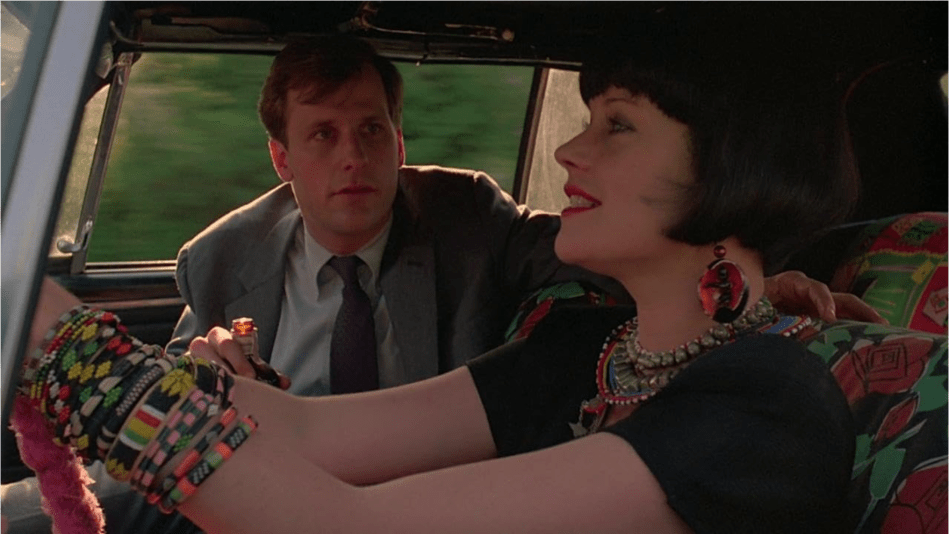
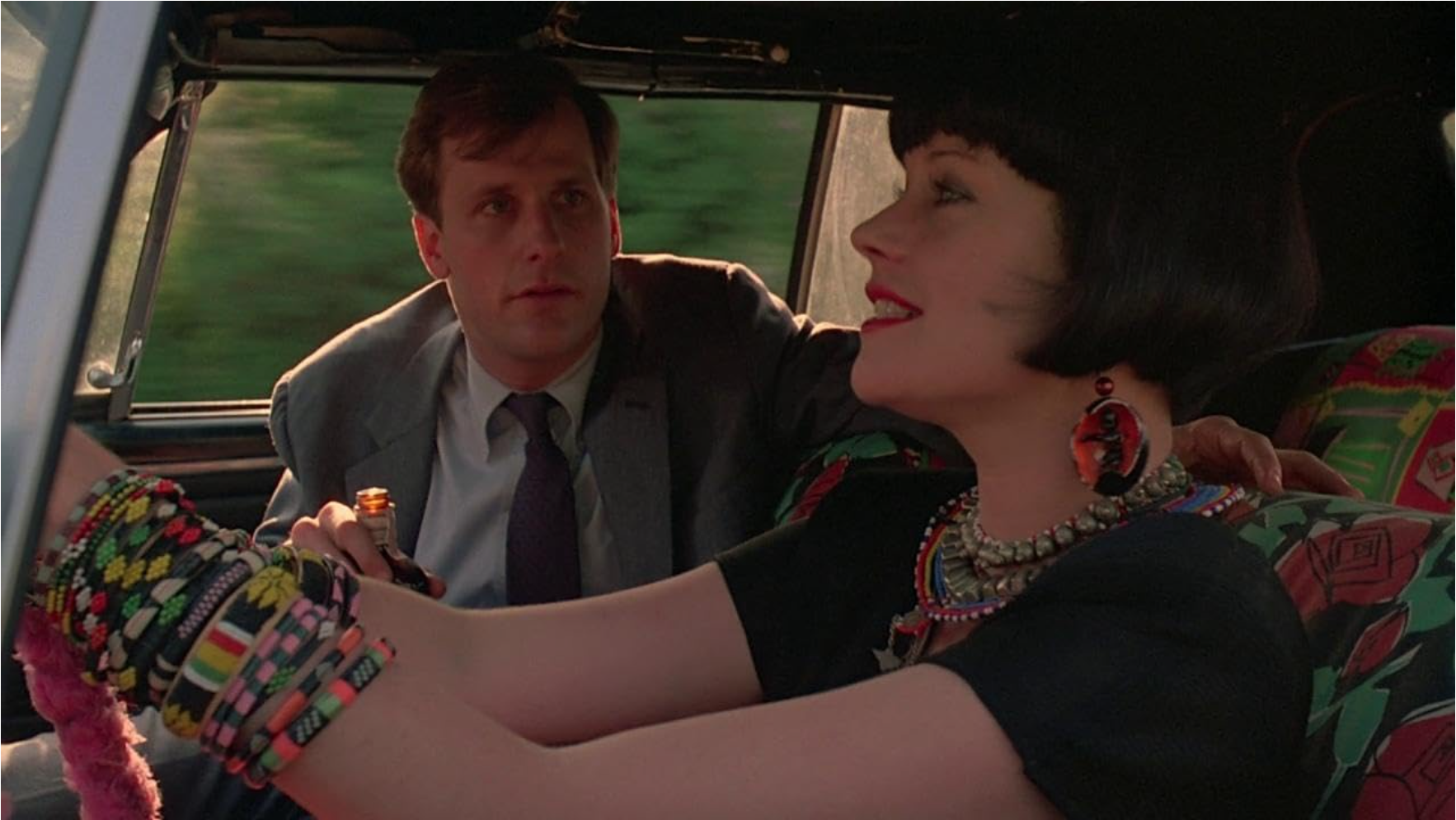
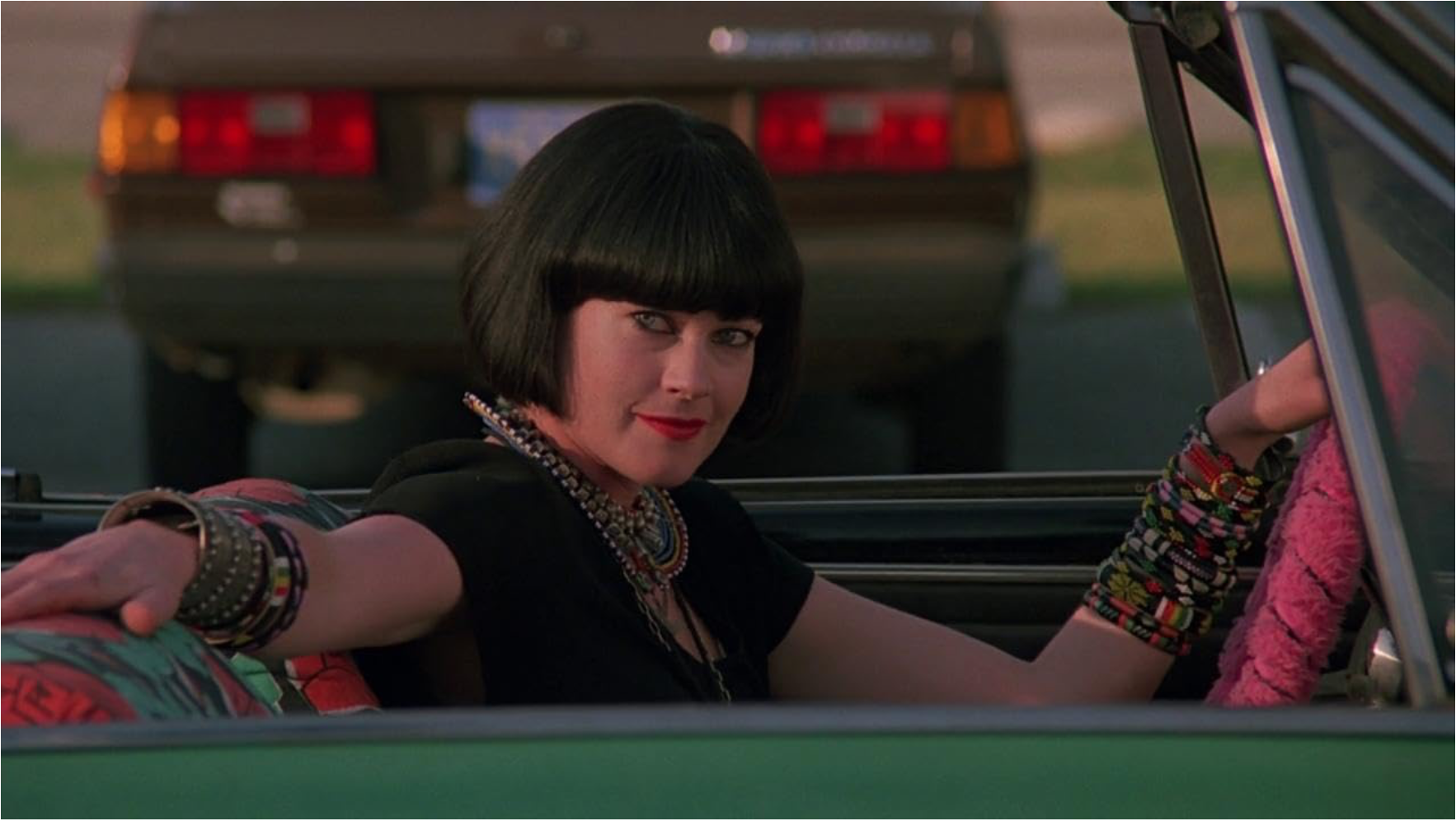
The first half of the movie, the screwball romantic comedy half, begins with a wonderfully efficient bit of character establishment. We watch as a young yuppie, an investment banker named Charlie Driggs (Daniels), finishes his meal at a funky Soho diner, and then carefully decides to leave without paying. It isn’t that Charlie forgot his wallet or anything, he just wants to start this day with a low-stakes illicit thrill. Immediately, we know there’s something peculiar going on with this guy. His petty crime is noticed by Lulu (Griffith), a boldly accessorized woman with an overall style that could be called “sexy thrift store Cleopatra.” A scenario of flirtatious blackmail and quasi kidnapping ensues. It should also be noted that Lulu also has a badass green 1967 Pontiac GTO convertible, and the well-framed image of Griffith behind the wheel of this vehicle, with her sharp, black bangs and dime store sunglasses, holds a power over Charlie (and the viewer) — one that can’t be underestimated.
So, Charlie is swept away to the hinterlands of New Jersey by the mysterious Lulu. For a while, it’s a game of playful escalation, with Lulu prodding Charlie to go along with relatively harmless acts of shoplifting, lying to his boss, more dining and dashing, and some light bondage sex play at a by-the-hour motel involving handcuffs. The most interesting part happens after the afternoon delight, when Charlie pretends to call his wife. We can hear the dial tone on the other end, but Lulu can’t. It’s a signal that says, yes, it’s a sexy comedy right now, but there’s more going on that’s just waiting to come to the surface.
Is Charlie a broken man? Is he lying about being married? Why would he do that? We can make some assumptions. Lulu wants a plaything, and by picking up a guy with a wedding ring she can rest easy that Charlie won’t get too attached. When this is over, he’ll go back to his wife and she can move on with her life. Charlie wants to play along. Like the viewer, he’s smitten by this day-drinking manic depressive dream girl, and seems all too willing to wear those handcuffs under the sleeves of his sport coat, like a friendship bracelet.
Maybe because he’s lying about his own life, Charlie doesn’t mind when he finds out the character of Lulu is just that, a character. Faced with the one-two punch of a hangover and early morning sunlight, the mask — or rather the Cleopatra wig — starts to come off. Lulu is actually Audrey, a divorcee who comes from a nice suburban upbringing in Pennsylvania. Turns out she’s closer to the blonde-haired girl-next-door type than Charlie could have ever imagined. But, oddly enough, this other side of Audrey may turn Charlie on even more than the criminally-inclined boho-chic sexpot he just spent a couple days on the road with.
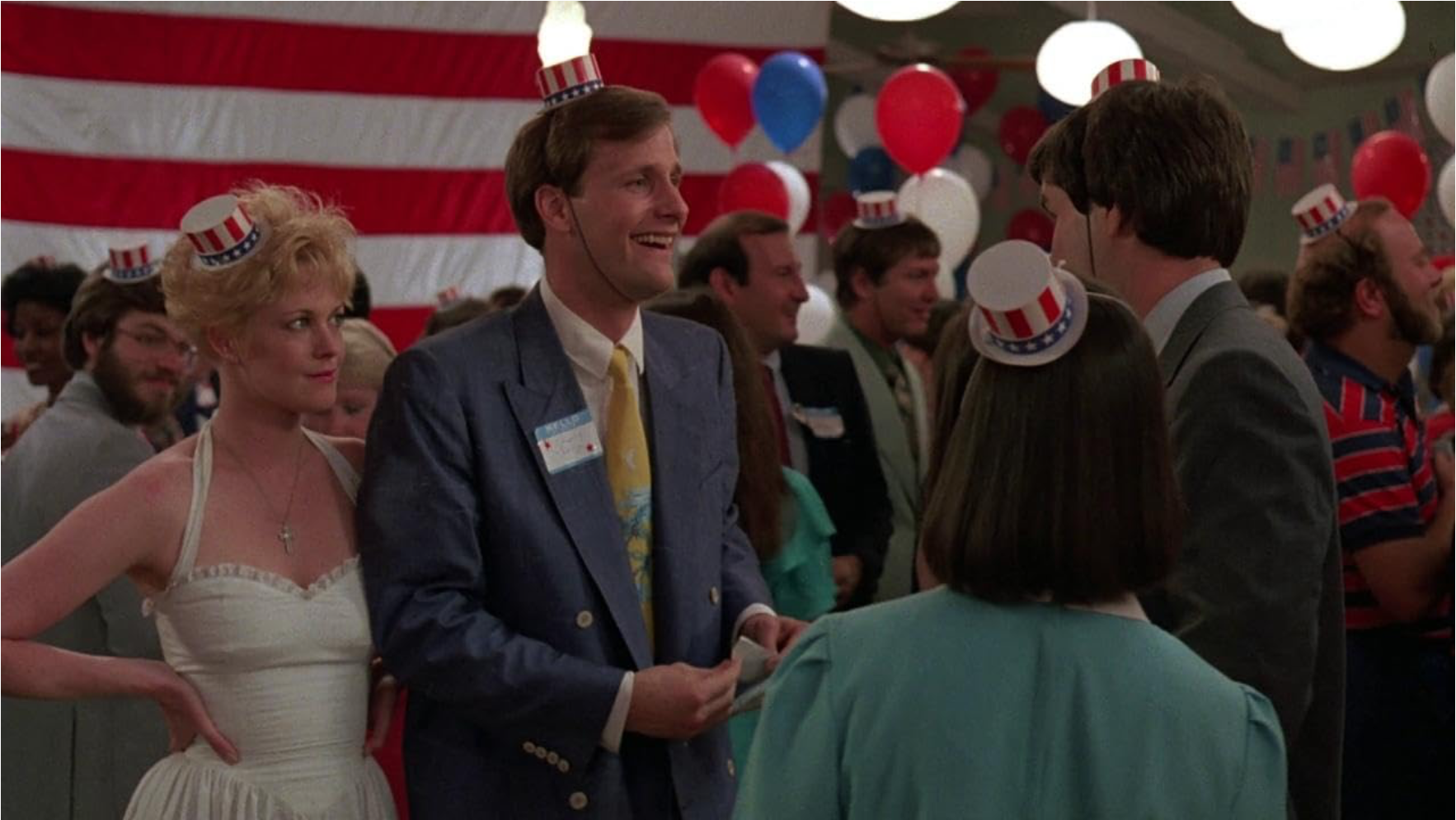
It gets more complicated when Audrey wants Charlie to pose as her husband at her high school reunion party, in her suburban Pennsylvanian hometown. This is where the pivot happens, with The Feelies commanding the stage of the high school gymnasium, playing for some appreciative Class of 1976 alumni. This finely-tuned fifteen-minute sequence is shot, at times, like a concert movie, with every square-foot of the gym decked out in American flags. It’s quickly apparent that this isn’t your typical post-production, multi-cam edit job. The Feelies are actually up there performing the songs live, and Demme is capturing the magic with orchestrated long takes. But it’s more than just showing off. The five songs they play — Neil Diamond’s “I’m a Believer,” Freddy Fender’s “Before the Next Teardrop Falls,” David Bowie’s “Fame,” and their own “Crazy Rhythms” and “Loveless Love” — do a fantastic job of scoring the emotional dynamics of the scene.
At first, it’s a lot of fun. Charlie’s down for some role-playing, stepping into the shoes of Audrey’s husband, but he soon has an anxiety attack upon seeing a coworker at the party. It turns out, however, that this fellow investment banker is happy to see Charlie with another woman. It’s an unexpected twist, and it’s like a weight has been lifted off Charlie’s shoulders, and his relief gets expressed on the dance floor as he’s finally able to get over his self-consciousness and cut loose to “Fame.” Then, Charlie and Audrey are able to settle down for a slow dance to the Freddy Fender cover.
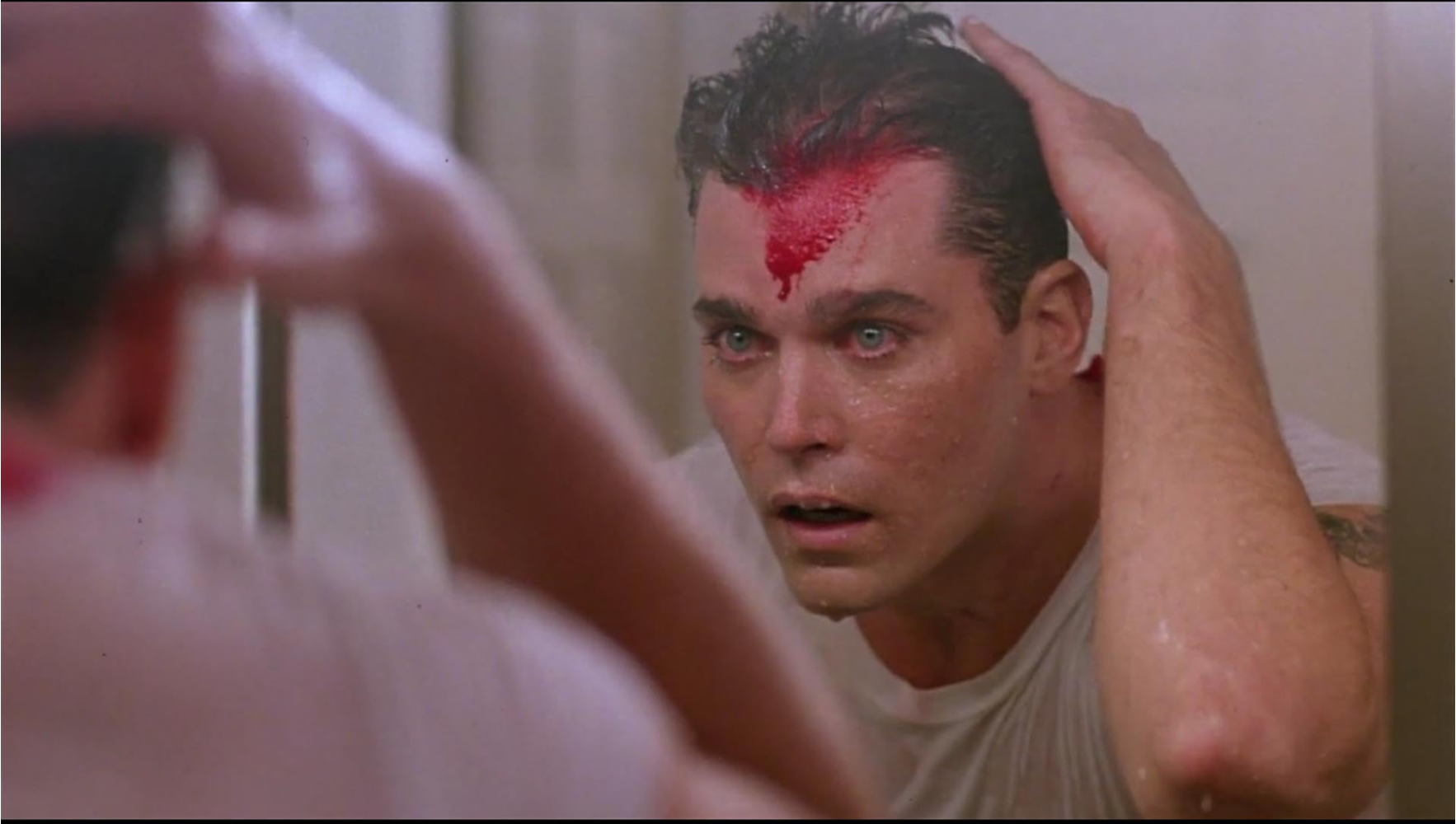
But the major twist is still to come, as the Feelies segue into the tense, atmospheric intro to “Loveless Love.” This song is the trigger for the rest of the movie as it accompanies the introduction of Ray Liotta’s character, Ray Sinclair, who just so happens to be Audrey’s not-quite-ex-husband, recently paroled from jail. The moment we see him on screen, everything about him screams bad news. We can tell at a glance that he is basically Charlie’s opposite. While Charlie is all nervous self-doubt and not even sure about what he wants or who he is, Ray is the rampaging id — the take-whatever-you-want primal monster.
This clip captures the turn. The Charlie-gets-his-groove-back moment is followed by a kiss. Then the lights are dramatically switched to a dark and moody hue just as “Loveless Love” warms up and Ray enters the picture. The comedy has become a thriller.
The pensive and nervous strains of “Loveless Love” continue to play in the background as Charlie’s coworker tells Ray what’s really going on with Audrey’s new guy. It turns out that Charlie’s wife took the kids and left him for the family dentist nine months ago and he’s been spiraling ever since. We watch Ray chew on this information for a moment, and we immediately know that our new couple is in for the worst kind of trouble. At the same time, we’re learning that even though Audrey isn’t exactly a divorcee — Ray is her estranged husband — it’s clear that there is no love lost between the two. Ray still wants to control her, to prove that he knows her better than anyone like Charlie ever could. A loveless love, indeed.
I don’t think Ray Liotta has ever been scarier than he is in Something Wild. His effectiveness has a lot to do with when his character appears and what he represents. You dread Ray because he is the other shoe that drops just when you think things are taking a turn for the better. He shows up the moment Charlie can see a future for himself apart from his wife and kids, and maybe even apart from his unfulfilling job as an investment banker. He also shows up right after Audrey begins to think, maybe this thing with Charlie isn’t just a fun, rebound fling.
More than anything else, however, Ray is the dark side of the Wild coin, the brutal consequence of all the sexy wish-fulfillment that characterized the first half of the film. He is the reckoning — the Catholic guilt consequences of trying to seek a licentious freedom. It was a liberating thrill for Charlie to live out a small-time Bonnie & Clyde fantasy, but Ray is the grinning nightmare, testosterone-driven version of their story. He is liberation pushed to its ugliest extreme, with a complete disregard for the morals and ethics that underpin society. He seems capable of anything at any moment. This monstrous character wastes no time in taking over the second half of the film and bringing it to a bloody finale that still retains some shock value to this day. It’s such a wild ending that, despite the movie being nearly 40 years old, I would feel bad spoiling it today.
If there’s a complaint to be made about the movie, it’s that the ultimate message isn’t very novel. There’s a long line of movies, especially in the 70s, 80s and 90s that question the trajectory of modern masculinity and pit nebbishy city slickers against alpha cowboys. Sometimes for laughs (City Slickers), other times for harrowing, violent drama (Straw Dogs). Even the premise of having a Wall Street square reconsider his life choices thanks to a free-spirited woman doesn’t sound all that new or interesting. But Something Wild makes it compelling, in part because of the strength of the cast, and in part because the movie is more about moving on after painful previous relationships and less about the soul-sucking conditions of late-period capitalism. And no matter how many times it’s been done, it’s still affecting when a movie forces the purely intellectual guy to defend himself against the purely physical guy.
It’s disingenuous to complain that they don’t make movies like Something Wild anymore, since Hollywood rarely made this kind of movie ever. Two exceptions come to mind, however: Scorsese’s After Hours and George Armitage’s Miami Blues (which was also directed by a Corman alumni and produced by Demme). While the ever-present off-kilter music, the tonal shifts and the structure of Something Wild remain remarkable today, I think the secret to Demme’s success, and why his movies remain so unique, lay in the margins of the film. He had a gift for stacking his cast so thoroughly and thoughtfully that even the most minor characters in the movie contribute to what makes it all so special. Just by looking at who’s in the movie you can get a sense of what the film is all about.
For example, the used car salesman, who has two lines and twenty seconds of screen time, is writer/director John Waters. The motorcycle cop who has one line and ten seconds of screen time is writer/director John Sayles. The two old ladies who sell Charlie a new suit are Demme’s mom and David Byrne’s mom. Other small roles are filled by the artist and costume designer Adelle Lutz (who was then David Byrne’s wife); Sue Tissue, the lead singer of Suburban Lawns; and the multimedia artist Jim Roche. None of these people are actors by trade and yet they naturally bring a varied life and backstory to their characters simply by being themselves. Everyone is someone, and it sets his movies apart in a deep and subtly profound way.
But the most informative cameo performance in Something Wild arrives at that central moment, during the high school reunion dance. The song “Before the Next Teardrop Falls” isn’t sung by any of the Feelies. That vocal performance belongs to Gary Goetzman, who is perhaps best known these days as the inspiration for the character of Gary Valentine in Paul Thomas Anderson’s Licorice Pizza. How did PTA come to be so attached to Gary Goetzman’s life story? Well, Anderson once cited three directors as being his biggest inspirations: Jonathan Demme, Jonathan Demme and Jonathan Demme.
Around 1974, just following the events depicted in Licorice Pizza, Goetzman got a gig as a production manager, as well as a small role, in Demme’s low-budget, Corman-produced debut film Caged Heat. The two must have hit it off because Goetzman continued to show up in nearly every Demme movie for the next fifteen years, often playing a character with the ridiculous name of Guido Paonessa. Not only that, for Swing Shift, Demme also hired Goetzman to work in the film’s music department, a role he would go on to play in other non-Demme films of the era, including Modern Girls, Point Break, and the Wim Wenders epic Until the End of the World. Gary being Gary, he also wrote songs for movies like the 1985 vampire classic Fright Night and the 1986 skateboard drama Thrashin’, all of which led to a side gig working with The Staple Singers and Smokey Robinson, among others. Who wouldn’t want to make a movie about this guy?
But it was Demme’s Stop Making Sense that earned Goetzman his first producing credit, which essentially set him up for the rest of his Hollywood career. He continued to produce many of Demme’s pictures afterward, including the Oscar-winning The Silence of the Lambs and the music documentaries Demme did for Robyn Hitchcock and Neil Young. But after working with Tom Hanks on Demme’s other Oscar juggernaut, Philadelphia, Goetzman and Hanks would go on to start their own production company, Playtone, which would see Garry enter the ranks of Hollywood royalty.
Casting people like Goetzman, who represent a deep personal connection, and leaning into the music and design elements of the cinematic toolkit, is a big reason why Demme is an auteur. Unlike most of the filmmakers who fit the auteur bill, Demme didn’t write his movies. He’d bring his sensibility to someone else’s script and thereby make it his own. With Something Wild, Demme took E. Max Frye’s script and for the first time made a movie that could never be mistaken for anything but a Jonathan Demme movie. If any other director used Frye’s script, it would be something completely different. Every bit player and every song is tied to the director in a personal way. It’s an intoxicating work of cinematic art.
It’s been eight years since Demme’s passing, and a lot longer since one of his movies broke into mainstream consciousness, but the re-release of Stop Making Sense, and rewatching Something Wild — which was such a formative movie in my teen years — has me really feeling his loss these days. While directors like Paul Thomas Anderson, the Coens and Chloé Zhao carry the torch for certain elements of Demme’s cinematic approach, his legacy is better felt in movies being made far from Hollywood, like those from the Italian filmmakers Paolo Sorrentino, Luca Guadagnino and, in particular, Alice Rohrwacher. If there’s a silver lining, it’s that his formative run with Orion is now widely accessible worldwide, since that studio’s library recently found a new home as part of Amazon’s MGM deal. It may not be an ideal scenario, but the current digital transfers are looking pretty good.
Of course, the best note to end on is a celebratory one, and nothing could be more appropriate than Demme’s video for The Feelies classic “Away.”
Discover more from Cineccentric
Subscribe to get the latest posts sent to your email.
 Cineccentric
I continue to appreciate your work. This Demme piece stands out. The added depth of the stories behind the stories is exceptionally insightful. Thank you.
LikeLike