
Like all of the major film festivals, Berlinale has its own peculiar vibe and reputation. It’s not as glamorous as Venice and Cannes, and it’s not as mainstream as Sundance and Toronto. There is no “midnight movies” section and there are no beaches or ski slopes in sight. Much of it takes place right in the heart of Berlin, in Potsdamer Platz, which is perpetually under construction and can come across as either starkly industrial or brightly modern depending on the angle and time of day you’re looking at it.

Apart from the grittier big city vibes, Berlinale often gets cited as being the “eat your vegetables” festival, the one where you get inundated with “important” movies from world cinema auteurs who might not get the same level of attention at Cannes or Venice. This is where serious and politically minded movies come to be heard.
There is an element of truth to this perception, while also being somewhat overstated. Berlinale has its own section, the Berlinale Special section, devoted to the more mainstream, star-studded movies. And there’s no mistaking the fact that the festival aims for glitz and glamor, with its red carpet photo shoots and high fashion sponsorships. It also has the Generations section, which is home to kids movies as well as coming-of-age films and stories that are aimed at teens and young adults.
But it is, perhaps more than anything else, a place where the art form of cinema thrives. The sections Forum and Forum Expanded are devoted to boundary-pushing and straight-up experimental films. Meanwhile, the main Competition and Panorama sections are indeed often filled with topical, prime cut international cinema. This often means you get a mix of dreamy fixed-shot slow cinema, intense hand-held vérité realism, absurdist satirical comedies, chilly dramas and thrillers, and a healthy dose of documentaries that tend to either break your heart or give you another year’s worth of soul-satisfying inspiration.
That said, the past five years have been anything but stable. The 2019 edition was wrapping up just as the pandemic was officially breaking out. That was also the final year of the longtime Berlinale director Dieter Kosslick. He was succeeded by Carlo Chatrian and Mariette Rissenbeek, who had the unfortunate task of scheduling two to three years of shifting COVID protocols along with the programming. As a result, over the last couple years, the festival’s been struggling more than ever to recoup its costs, and it all went a bit haywire leading into the 2024 edition.
Citing the budget issues, Chatrian was basically forced out, and Rissenbeek went with him. They saw last year’s festival through to the end, but that edition included rescinded invitations to alt-right politicians and some award speeches that were perceived by the press, as well as by those in the Ministry of Culture, as being anti-Israeli. Since Berlinale receives a lot of government funding, there was a lot of hand-wringing over the festival’s politics and whether the Ministry’s reactions would qualify as censorship.
Stepping into this quagmire for the 2025 Berlinale is the new festival director Tricia Tuttle, who is coming off a four-year tenure as the head of the BFI London Film Festival. Would Tuttle be trying to make the Berlinale more mainstream and more profitable, and less political and controversial? This may have been a genuine concern (as was the uncomfortable reality of a Brit taking over the festival), but as far as I can tell, the program gives off a strong sense of business as usual. In her director’s statement, Tuttle even makes a point of saying that the festival isn’t going to shy away from being political – that politics are baked into the Berlinale’s identity.
The only major change was the removal of the Encounters section of the program, which arrived during the short lived Rissenbeek-Chatrian era and never had a very strong sense of purpose. It has been replaced with Perspectives, a section devoted to debut feature films. While it’s never a bad idea for a festival to shine a light on debut filmmakers, I’m not sure giving these films their own section is necessarily the best way to go about it. With over half of the festival over, I’ve yet to be drawn to this section when it’s always competing against higher profile films.
So what have I seen? A lot of good-to-great movies. To be honest, it might be one of the more consistent editions in recent years. The highs may not be as high as other Berlinales, but I haven’t walked out of one screening, which is something I can’t say about last year’s fest. While I tend to focus my attention on the main Competition section every year, there’s usually one or two films that are so unwatchable that it boggles the mind. So far, that hasn’t been the case.

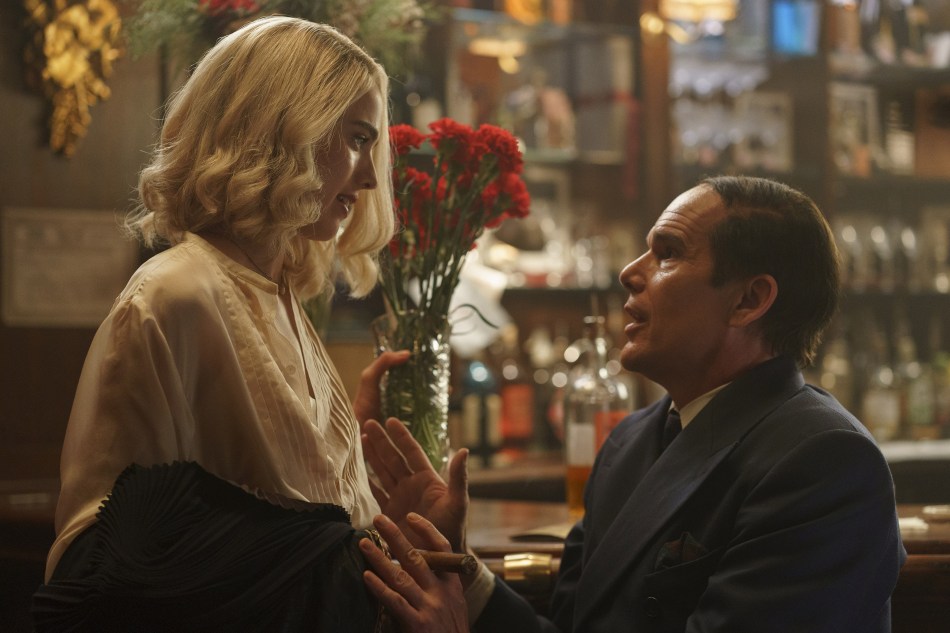
One of the Competition highlights is the new Richard Linklater movie, Blue Moon, a movie that reunited Linklater with his old collaborator Ethan Hawke, and is easily his best movie since the last time the two got together for Boyhood and Before Midnight. Blue Moon almost entirely takes place in Sardi’s, the classic Theater District restaurant, which is hosting an after-party for the premier of “Oklahoma!”, the new musical by Richard Rogers and Oscar Hammerstein.
But Blue Moon isn’t about either of those guys, it’s about Lorenz Hart (Ethan Hawke), the man who, up to that point, had been Richard Rogers’ writing partner for about twenty years. The movie starts with Hart realizing that “Oklahoma!” is going to be a massive success, even though he despises the sentimental, unsophisticated, populist entertainment that his former partner has turned out.
Hart is a complicated, verbose, and ingratiating guy, and Hawke makes a feast out of the colorful dialog that is constantly flowing like music from his mouth. He’s bitter and egotistical, but also clearly vulnerable and wounded by what’s happened to his career. He drinks too much and is self-sabotaging, but is also in desperate need of companionship and validation. Interestingly enough, he’s bisexual, attracted to beauty in whatever form it takes, but as a short, balding man in his late 40s, he’s become tragically obsessed with Elizabeth Weiland, the daughter of a Broadway bigwig, half his age and played with glowing charm by Margaret Qualley. Even the friendly bartender (a brilliantly funny Bobby Cannavale) knows that Hart is doomed in his pursuit of Elizabeth – even before she walks through the door.
Blue Moon is written by Robert Kaplow, the novelist who wrote the book Me and Orson Welles that Linklater and a couple of other screenwriters adapted in 2008. Here, Kaplow is writing directly for the screen, and he essentially constructs the movie as a series of conversations that build upon one another until you reach its heartbreaking climax. But not only that, each conversation is a little symphony upon itself, with a beginning, middle, and often tragic end. The stakes are perfectly set early on and you eagerly await the arrival of Rogers (played with aching perfection by Andrew Scott) and Hammerstein. Once the celebratory crowd shows up, there’s the constant suspense of how long Hart can hold his tongue and whether he can manage to be charmingly social rather than brutally honest.
One of the reasons I was so taken with Blue Moon is because it frequently raises the critical question of the emotional versus the intellectual. Can a work of art be truly great and important if it only aims to touch the audience on an emotional level, and not intellectually? In the world of criticism in all its various forms and mediums, it’s a question that has never really gone away – and of course there is no easy answer. But Blue Moon does accurately represent the loneliness of being firmly in the intellectual camp. Hart may be right that it’s too easy to only push emotional buttons, but Rogers is also right that sometimes audiences don’t want to be intellectually challenged.

This question certainly came up after the screening of Bong Joon-Ho’s Mickey 17, the long-awaited follow-up to his surprise, Oscar-winning hit Parasite. If you’re familiar with Bong’s 25-year career, you know he tends to alternate between a couple stylistic modes. One tends to be in a semi realistic vein – your Memories of Murder and Parasite, while the other tends to verge on the cartoonish – your Snowpiercer and Okja. Mickey 17 is firmly in the Okja vein, as it is filled with big, broad, colorful characters and has its satirical sights on some oversized targets.
It tells the tale of an expendable employee, Mickey (Robert Pattison), who’s working on a spaceship that is hoping to colonize a far off planet. Mickey took the job out of desperation, as he and his friend Timo (Steven Yeun) are trying to escape a deadly loan shark on Earth, but it means he must be the company’s guinea pig, testing the most extreme conditions and new medications, inevitably dying, but being “reprinted” so that he can do it all over again. Like Snowpiercer, much of the satire comes from the microcosmic class structure within the ship, and the fact that the leader of this expedition is a guy named Kenneth Marshall (a vamping Mark Ruffalo) who bears a striking resemblance to Donald Trump (if Trump were to share Elon Musk’s obsession with space colonization).

As is often the case with divisive movies, my reaction is somewhere in the middle. I like Mickey 17 more than some and less than others. One of my colleagues called the film’s attacks on Trumpism and a particular monologue against fascism to be “embarrassing.” Would Lorenz Hart agree and say these targets are too easy? I don’t know. We’re living in some pretty strange times right now and the bottom line is that Mickey 17 is a sci-fi blockbuster that actually has some things to say about the current state of the world and is taking some pretty big swings while saying them. I mostly find that pretty admirable, especially as most of our current sci-fi blockbusters are trying to top each other in being as inoffensive and generic as possible.
Ruffalo’s performance will surely generate a torrent of varying opinions, but Pattison is the star here and he’s giving an unimpeachable performance. Actually two performances – one as the sad sack Mickey 17, who’s also narrating the movie, and a completely different one as the angry, assertive alpha male, Mickey 18, who can’t stand how passive his predecessor is. While the special effects aren’t always flawless, the work done to put these two Pattinsons together is seamless, and a lot of fun to behold.
Like his Netflix effort Okja, Mickey 17 is continuing Bong’s animal rights campaign, subbing out giant pigs for alien creatures that look a lot like giant pill bugs. In one the weirder details in a movie full of weird details, Kenneth Marshall’s wife, Ylfa (the ever-reliable Toni Collette), has an obsession with sauces and is eager to use the aliens’ tails as the secret ingredient for her new special sauce.
Like a lot of the movie, when you take it at face value, the sauce detail is silly, absurd stuff. But on further inspection it also says a lot about how completely unprepared the human race is to ensure its own survival. In fact, all of the silly, absurd stuff in Mickey 17 turns out to be damningly poignant when you think about it for more than a minute. It’s a funny movie, but just about every joke is at our own expense – a commentary on how we’re killing ourselves and generally unwilling to learn from our mistakes or change our ways. How likely is it, and how funny would it be, if we escaped to another planet only to treat it the same way we treated Earth?
That’s the kind of dark, satirical humor that Mickey 17 is trafficking in, and it’s impressive that it also largely succeeds in being a crowd-pleasing action adventure film as well. It may not be as intellectually satisfying as some of Bong Joon-Ho’s more grounded films, but it’s got a big heart and it’s still exciting to see a director of his calibre getting to take a swing as big as this one. No one else could make a blockbuster as subversive like Mickey 17, and it just might be the perfectly weird movie for the imperfectly weird times we live in.
That’s it for now. I’ll be back in a few days to give a general wrap up of the festival, the awards and the highlights, which will definitely include some words on Bruno Forzani and Hélène Cattet‘s psychedelic masterpiece Reflection in a Dead Diamond, the latest from former Golden Bear winner Radu Jude, a triumphant Ben Whishaw in Peter Hujar’s Day, and much more.
Discover more from Cineccentric
Subscribe to get the latest posts sent to your email.
 Cineccentric
0 comments on “Berlinale 2025: “Blue Moon”, “Mickey 17””