
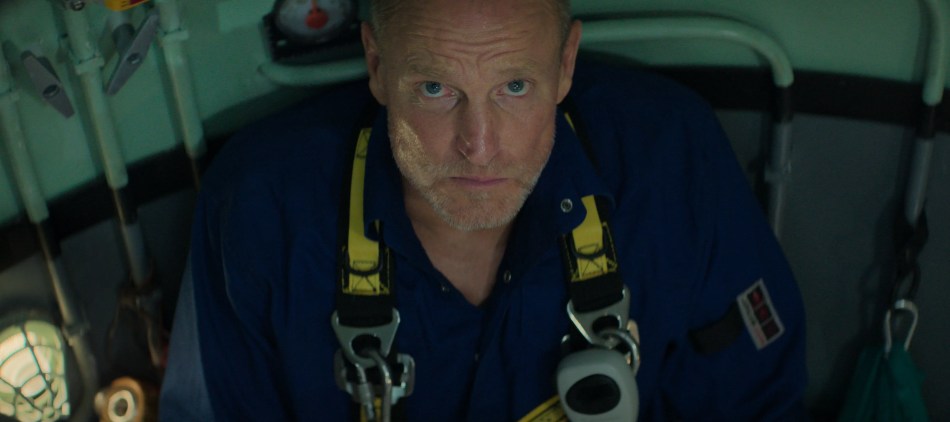
In 2012, a team of saturation divers went to the North Sea to fix an underwater gas pipeline. During the course of their work, a technical malfunction on the main ship caused it to drift and drag two submerged divers from the work site. David Yuasa (Simu Liu) managed to escape and climb back into the diving bell where colleague Duncan Allcock (Woody Harrelson) was waiting. However, the other diver, Chris Lemons (Finn Cole), became trapped as his umbilical cable (which was tied to the bell) became entangled and, under the weight of the ship’s drift, snapped. Chris was left stranded over 300 feet underwater with under 10 minutes of backup oxygen supply. Director Alex Parkinson’s Last Breath, a feature film adaptation of his prior documentary on the subject, recounts this harrowing ordeal and the incredible heroics in trying to save Chris.

Last Breath is a rousing and thrilling true story with plenty of natural suspense as Chris fights for his life at the bottom of the sea and everybody in this crew fights to save him. For much of the time, it is the action on the ship that is most crucial in the recovery efforts with the ship’s wayward trajectory delaying any rescue mission. Dive supervisor Craig (Mark Bonnar), Captain Andre Jenson (Cliff Curtis), and First Officer Hanna (MyAnna Buring), must take charge of the situation with the help of their support team to get the ship back to a place where it can rescue Chris. Fighting not only the failed technical systems but also a violent storm that throws the ship about in choppy waters, the team must dig deep within themselves to fight on Chris’s behalf, all while holding hope that he is even still alive. An effective score from Paul Leonard-Morgan and Parkinson’s direction help wring out every bit of emotion, suspense, and excitement in this story. It is hard not to get a bit teary eyed at moments with this group doing something miraculous in the name of rescuing this man.
This true story and Parkinson’s craftsmanship in staging all of the often claustrophobic, intense, and thrilling set-pieces of the event offers more than enough appeal to make Last Breath an exciting experience. Its middle section, entirely focused on Chris’s fight to put himself in position to be saved and the ship fighting everything to try, is Last Breath at its best with plenty of classic moviemaking appeal as one hangs on every moment, every detail and small victory in this larger battle, and the immensely moving nature of the human will to survive against all odds. It frequently has one on the edge of their seat and holding their breath waiting to see what happens next. The special effects, production design, and work of DP Nick Remy Matthews really shine when the film is focused on the action underwater and on the ship. Bringing to life the perilous world of the deep, the storm throwing everything into disarray, the stress of the ship’s crew watching everything through screens, and the limited vision created by the diver’s head gear and the blackness all around them, the film’s technical elements are some of its biggest strengths. However, the film struggles elsewhere.
In turning his documentary into a feature film, Parkinson follows conventional tropes at every point. The plot is flattened out into a conventional survival thriller. The characters are all familiar, even if based on real people. The one character who gets a back story (Chris) is the one who is imperiled. There is a hot shot (David) who is a bit emotionally distant. There is a grizzled veteran (Duncan) who just wants to get everyone home safe and who, in this case, is on his final mission before he is forced into retirement. The framing device of Chris bidding farewell to his fiance Morag (Bobby Rainsbury) before heading out on this job suffers from stiff writing, flat acting, and the lack of chemistry between Cole and Rainsbury. The same occurs during a closing scene between them in a moment that should be quite emotional, but never sparks to life due to the awkward writing that just spells out what they are thinking and is hampered by constant cuts that distract more than they enhance the feeling of the moment.

The film’s dialogue is a consistent problem. Duncan’s resistance to retire and his bittersweet feelings in exiting the vessel for the final time gives Harrelson a chance to showcase his quiet physicality, taking in all of the sights one more time and letting the emotion hit him. But, then he is tasked with basically spelling out everything he is feeling in a conversation with Craig that cuts into the quiet emotion of the moment. Even in more intense scenes, such as Duncan and David stuck in the bell together awaiting a chance to rescue Chris, both struggle to make the overwhelming emotion of the moment come to life. The more Hollywoodized attempts to turn these men into movie characters leave them feeling too one-dimensional and hollow, lacking the personality that can so easily be found in the archival footage of the real men that the film closes on. There are, nonetheless, some chuckle-worthy bits of camaraderie and some good banter between Duncan and Craig that add color, but it all generally lacks personality.
Impressive technical elements and action set-pieces, a rousing score, and plenty of natural drama and thrill help to bring Last Breath from documentary to feature film. However, in trying to shape this adaptation into a feature film, it falls into a reliance on derivative characterizations and struggles to find the humanity in its characters with stiff writing, performances, and dramatic direction. Nonetheless, it is a story built to inspire, to awe one with the lengths that these men go to in order to do their highly valuable job, and to impress upon one what can be done when a team works together to pull off something truly miraculous. It may falter, but it is to not get caught up in that emotion, making Last Breath into a satisfying and stirring experience.
Discover more from Cineccentric
Subscribe to get the latest posts sent to your email.
 Cineccentric
0 comments on “Last Breath ★★½”