
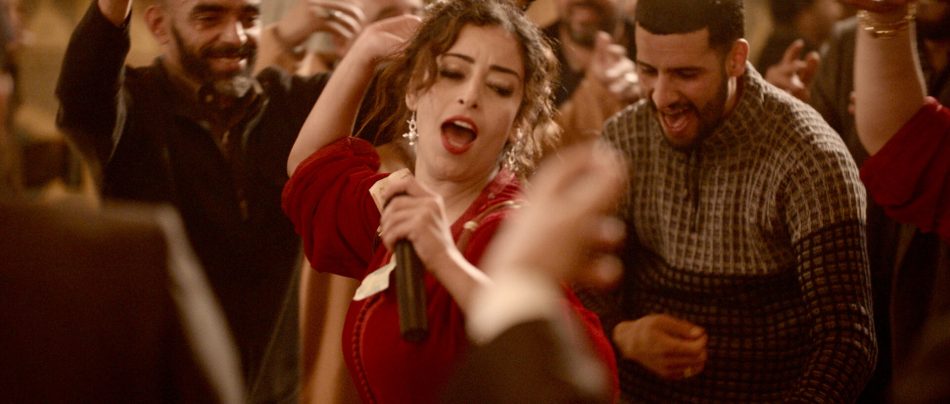
The first scenes of Nabil Ayouch’s defiant character drama show Touda (a captivating Nasrin Erradi) singing and dancing at a remote picnic spot. She’s entertaining a small group of male guests. Everything feels normal. Spirits are high. The later the hour, the more rowdy the revelers behave. The scenery gets darker and so does the mood. At nighttime, the situation feels threatening as the men start to grope Touda. There’s violence in the air. A sharp cut: Touda flees through the surrounding woods, perused by unseen assailants. The next day, the title heroine walks back home on a country road, shellshocked. It’s a magnificent opener for Ayouch’s story of the resilient Moroccan singer.

The prologue packs the essence of the protagonist’s life in a few intense moments. Touda dreams of becoming a celebrated ‘shaikha’, a dancer and singer of a traditional Moroccan musical style. To make it big, she has to get to Casablanca. But the path is thorny and dangerous. The brutal prologue makes this devastatingly clear. It highlights her great voice and love for Moroccan music, how she navigates a dangerous economic and moral liminal space, and her persistence within a climate of patriarchal aggression and sexist repression. Through this multilevelled marginalisation, any moment can turn into violence. The prologue also accumulates the film’s dramatic key elements: a strong focus on the main character, narrative gaps and radical shifts in atmosphere and mood.
Upbeat moments suddenly spiral into desperation, success turns sour. And a few times opportunity pops up out of nowhere. With Touda, nothing is ever certain. Unfortunately, that goes also for the film’s overall quality. The script by Ayouch and his wife Maryam Touzani never lives up to the promise of the prologue. This is already palpable when the story picks up after the title scene. Touda seems just mildly annoyed by the sexual assault. The tonal shift is so jarring one even wonders if the opening events happened years ago. Ayouch goes so far as to show Touda engaging in passionate sex shortly afterwards. This denies the physical and psychologically impact of sexual violence, diminishes the resonance of the opening scene and contradicts Touda’s overall characterization.
More than once, the story reproduces the misogynistic attitudes which it attempts to criticize. The image of the shaika that Touda glorifies unites passion, artistry, independence and sensuality. Touda has all of these qualities. Yet, she leads a harsh life as a single mother in a drab provincial town. She gets by with gigs in seedy bars where customers treat her as sexually available. Like its main character, the story shifts between stagnation and rushing forward. Ayouch and Touzani repeatedly emphasize Touda’s morality. Her disdain for lascivious colleagues and sex trade offers is presented as a positive quality. These double standards undermine the portrayal of a woman defying patriarchal expectations.
Erradi’s bristling performance keeps Touda interesting, both the film and its character. The moderate pace picks up each time she sings. Virginie Surdej‘s expressive camera is glued to Touda in these scenes. In less energetic moments, it keeps a careful distance. The audience only gets close to Touda when she dances. Flemming Nordkrog and Kristian Eidnes Andersen‘s music conveys Touda’s inner conflicts better than the plot. When the story finally moves to Casablanca, contrived tragic turns take overhand. The foreseeable challenges Touda encounters feel like stockbook conflicts. The stereotypical characters she meets don’t get enough space and time to properly develop. Touda seems to boycott herself for the sheer drama of it. Ayouch bends the protagonists to a questionable ideal of female modesty. An ideal that isn’t any more empowered, only slightly more Westernised than the traditionalist repression Touda fights against. Ultimately, Touda remains an object of male projections. In this case, those of the director.
Discover more from Cineccentric
Subscribe to get the latest posts sent to your email.
 Cineccentric
0 comments on “Everybody Loves Touda ★★½”