
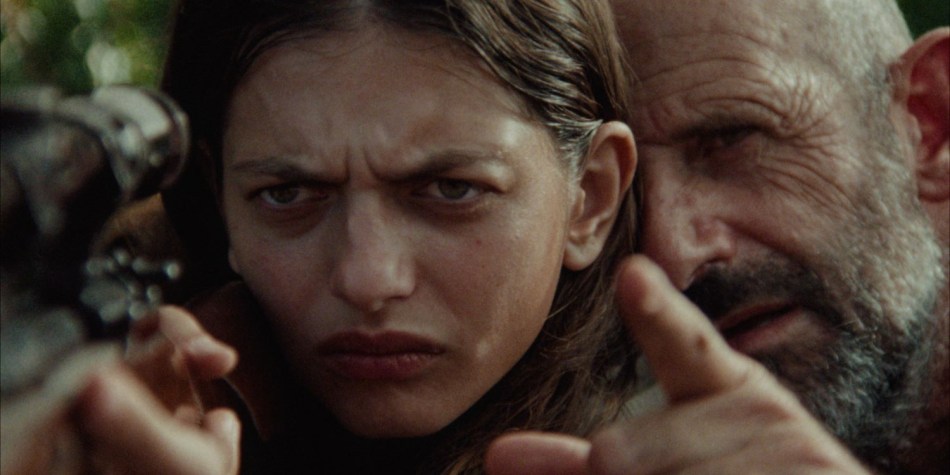
A closeup on a dead boar on the return drive from a hunting trip. News footage from crime scenes on the TV. Right from the beginning of his uneasy mix of crime saga and coming-of-age drama, Julien Colonna makes clear that the seemingly normal teenage world his young protagonist inhabits is a world of violence. At first, this violence plaguing the Corsican setting only lingers in the background, allowing 15-year-old Lesia (an convincing Ghjuvanna Benedetti) to disregard it. But when it finally jumps out at her, she is forced to look it straight in the face. That face belongs to her estranged father, Pierre-Paul (Saveriu Santucci).
He is a local mob boss on the island that saw a surge in organized crime in the early 90s when the story is set. Precocious Lesia has a good idea of what is going on around her as her aunt turns up one day and brings her to Pierre-Paul. The burly, bearded man is a fugitive at the moment and imposes a strict routine of hiding. It’s a strange, almost clinical ritual: no phone calls, no contact with the outside world, lest someone on the other end hear something they shouldn’t. One misstep or misplaced conversation would be enough and their lives would implode.
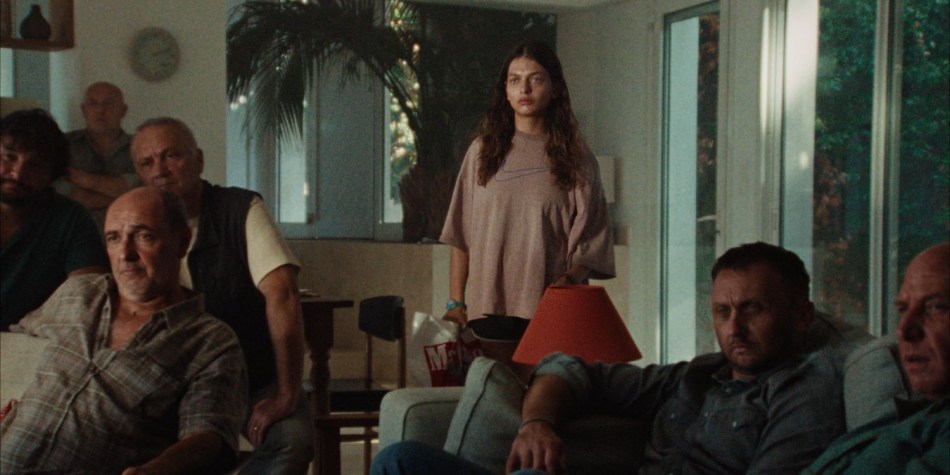
This visit feels different, as tension hangs in the air. The news is alive with the aftermath of an assassination attempt on a politician tied to Pierre-Paul’s shadowy dealings. Days later, her godfather is killed in broad daylight, signaling a shift in the local power dynamics. Pierre-Paul’s men start bracing themselves for an impending confrontation, preparing for what Lesia can only describe as a slow-motion car crash she has no control over. Soon enough, it is their faces that blur into TV reports, accompanied by grim images of bullet-riddled cars and wailing widows. The atmosphere on the island is increasingly uneasy, and Lesia senses that change is coming.
The Kingdom’s shady visuals attempt to immerse viewers in a decaying world, but lapse into self-indulgent languor. Sweeping landscapes, though undeniably striking, with vast shots of barren fields and empty halls, serve more to showcase their own grandeur than to move the story forward or deepen the emotional stakes. These lingering moments are exercises in aesthetic self-admiration by a scenario in awe of patriarchal power structures, toxic masculinity, and a cinematically coined fantasy of old-school crime. A muted color palette dominated by grays and browns reinforces the film’s somber tone as much as its monotonous rhythm of slowly escalating violence. Composed of sparse ambient music, the soundtrack mirrors the subdued pace.
The minimalist score’s repetitiveness sometimes becomes more of a backdrop than an emotional driver as the tension rises. It becomes glaringly evident that Lesia’s seemingly loving father is capable of chilling, cold-blooded acts. This doesn’t keep Colonna from romanticizing this vaguely threatening male protector figure supposed to embody a lost ideal of rough manliness. Relying on well-worn clichés of betrayal and vengeance, the formulaic plot fails to truly engage. Its endless cycle of men in power, family loyalty, and inevitable violence perpetuates outdated gender images, with female characters largely sidelined to passive roles. Lesia, the central female figure, is reduced to a mere observer in her own story, caught between male power struggles without much agency or an authentic voice. These reactionary gender dynamics only reinforce the archaic simplicity hiding beneath the smug surface of this equally routined and reactionary crime drama.
Discover more from Cineccentric
Subscribe to get the latest posts sent to your email.
 Cineccentric
0 comments on “The Kingdom ★★”