

Bogdan Puslenghea‘s A Rebel Edge wants very much to be a melancholic candle flickering in the wind of a vanishing poetic counterculture. It tells the tale of Doru Chirodea, a marginal Romanian poet who briefly dipped a toe into the choppy waters of the American underground scene in the late ’80s before washing up back in Timișoara, where he now self-publishes poetry and hosts book launches in bars that could be charitably described as dimly lit. It’s a concept full of bittersweet potential: one man clinging to his muse as the world drifts by with earbuds in. Sharing its subject’s self-effacing quietude, the result is more a cinematic sermon to untalented self-obsession than a homage to an overlooked artist.
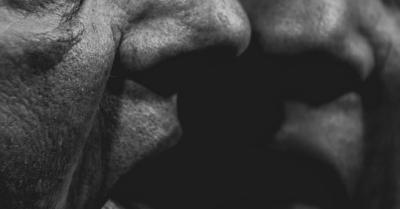
The unpolished observation opens in mid‑’80s New York, showing Doru devoting himself to English‑language poetry despite not being a native speaker, in what seems to have been either a fearless creative risk or a prolonged inside joke with himself. Then, somewhat inevitably, he returned home to publish his work on his own, undeterred by the total absence of commercial prospects or anyone asking him to do so. Grainy archival footage contrasts with contemporary, observational shots: Doru in dim cafés, seminarians, and bars, reciting lines from and ultimately publishing his volumes using his own money, addressing a dwindling, dedicated audience with steadfast sincerity. Puslenghea establishes an atmosphere thick with nostalgia: burnt-out candles, weathered hands turning brittle pages, dingy bars.
Chirodea’s sepia-toned routine consists of photocopying zines, reading to audiences that consist of a handful of people and moving manuscripts around. It’s a banal struggle with hardly any relevance. Though the protagonist regularly acts loud and smug, there is a severe lack of actual conflict, confrontation, or emotional turbulence. The visuals try to capture atmosphere but end up simply dwelling in the gray. Handheld shots, intended to give the film a raw feel, come across as disorganized, as if unsure of where to focus or even why it was bothering at all. A color palette dominated by dull browns and washed-out tones underlines that something vital has already decayed. Instead of heightening the emotional impact, it just reinforces the lack of energy.
The absence of contrasting voices from a contemporary world that has long moved on – critics, younger poets, skeptics – results in a monologue rather than a dialogue on relevance, failure, or even legacy. Thus, this steady patience, minimalistic framing, and intimate fascination with one man’s private calling fails to unearth any social-political, artistic, or at least personal insight. Apart from that trivial realization that the director and his subject share a sense of loyalty to a craft pursued without reward or recognition, A Rebel Edge seems to be groping for a deeper message about the artist’s struggle against societal indifference, but it never fully commits.
Discover more from Cineccentric
Subscribe to get the latest posts sent to your email.
 Cineccentric
0 comments on “A Rebel Edge (documentary) ★”