
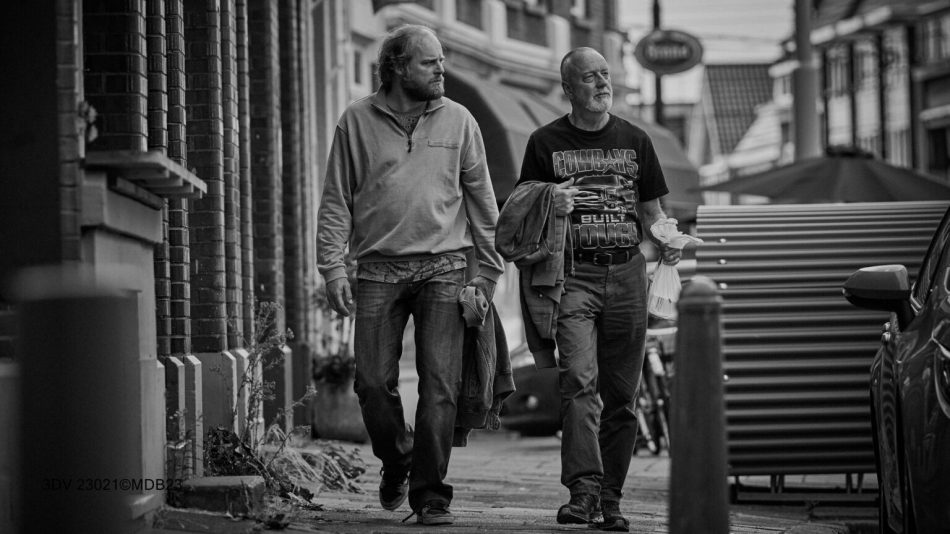
In a coincidental chat at TIFF Romania, where Peter Hoogendoorn‘s semi-biographical sketch Three Days of Fish runs almost a year after its premiere at Karlovy Vary, the director-writer explains the saying behind the curious title. The gist of it is that guests, like fish, should go after three days. True to the film’s deadpan, black-and-white tragicomic style, the protagonist Dick (Guido Pollemans) repeatedly finds himself staring down plates of fish – food he clearly dislikes. It’s an aphorism that suits the film’s stripped-down tragicomic tone. These small, seemingly throwaway moments gradually accumulate into a compact and textured portrait of familial estrangement.

As in his debut Between 10 and 12, Hoogendoorn draws from personal experience to craft an intimately scaled character study of a father and son awkwardly navigating a reunion that feels neither welcome nor entirely avoidable. Outwardly utterly unspectacular, the plot explores intergenerational misunderstanding and inherited silence. The film doesn’t spell out its emotional architecture right away; instead, it unfolds obliquely, often leaving things unsaid. At the story’s core are retired mechanic Gerrie (Ton Kas), his reserved son Dick, and the quietly observant presence of Gerrie’s second daughter, Nadia (Neidi Dos Santos Livramento). Hoogendoorn’s script is minimal to the point of near-opacity, avoiding expository dialogue and relying instead on weighted silences and lopsided emotional exchanges.
The opening scene, a stilted meeting between father and son at a Rotterdam bus stop, sets the tone. Gerrie, now living in Portugal with his Cape Verdean second wife, returns to the Netherlands for a short visit under the pretext of medical appointments and catching up with family. But the emotional terrain proves trickier. That he chooses to stay at Nadia’s rather than Dick’s quietly rankles his son, who oscillates between exasperation and a yearning for paternal recognition. His longing feels like a delayed symptom of a childhood largely spent in his grandmother’s care. Dick is defined by a kind of quiet disconnection—from his father, from others, and from himself.
He drifts through life salvaging second-hand furniture, creating a home from leftover scraps. His apartment exudes more warmth than any conversation he has with Gerrie. Yet his gentleness comes through in his relationship with Bianca (Line Pillet), whose calm acceptance of him offers a counterbalance to the unresolved tension with his father. Cinematographer Gregg Telussa‘s overcast black-and-white visuals mirror the film’s subdued emotional register. The grayscale turns Rotterdam into a landscape of unspoken distance, the lack of color echoing the emotional stasis between father and son. Christiaan Verbeek’s jazz-tinged score subtly underscores the emotional dissonance. There are no dramatic confrontations or cathartic reconciliations—only minor gestures: a look, a pause, shared silence.
Ultimately, the film is a modest collection of everyday moments that gently illuminate the invisible ties and gaps between its characters. It’s not quite drama, not quite comedy. It’s simply time spent with a group of surprisingly tangible people. A quietly amusing experience – but, as the saying about fish goes, the end credits are welcome as well.
Discover more from Cineccentric
Subscribe to get the latest posts sent to your email.
 Cineccentric
0 comments on “Three Days of Fish ★★★”