

On its slick surface, Eugene Jebeleanu‘s feature adaptation of Lavinia Braniște‘s eponymous novel is about a woman who desperately wants to be seen. Middle-aged Cristina navigates a lackluster life in an alienating and socially distanced Bucharest. Her unemotional relationship with her mother, who is working in Spain as a servant, is unraveling. Her domineering boss treats her with contempt. Her not-very-romantic relationships are reduced to digital trysts. This is obviously a filmic world of eroding human bonds, universal isolation, and interpersonal estrangement. Given the overarching theme of detachment, it’s ironic that the Romanian director-writer never manages to build a connection to his characters.
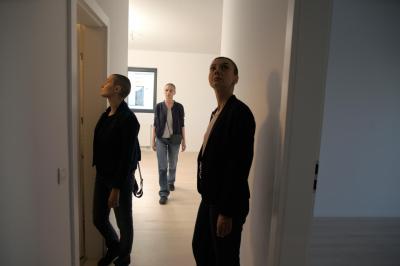
The reason for this is a palpable lack of engagement with Cristina’s story and personality. Her mundane problems and average persona are first and foremost a tool for meta-cinematic exercises. Three different actresses portray the protagonist in the film’s three chapters. Valentina Zaharia, Cristina Drăghici, and Cendana Trifan represent individual facets of Cristina’s identity: her career, family, and sex life. Such a choice might sound intriguing in theory but feels redundant and over-intellectualized in execution. The result is disjointed rather than layered. Each actress brings her own mannerisms and creative approach to the character. This gives the audience an uncommon insight into how acting shapes a fictional character.
On a narrative level, however, it’s a blunt metaphor for the ways in which Cristina hides parts of herself in specific contexts. As Cristina’s struggle to find belonging drags on, the lines between fiction and reality become porous. Behind‑the‑scenes rehearsals, director workshops, and interactive moments with the crew emphasize the constructed nature of cinema. These peeks behind the cinematic curtain are neither revelatory nor particularly interesting. In the context of today’s media-versed society, they lack both novelty value and relevance. What’s more problematic: the meta-aspects barely drive the plot forward or deepen it on a psychological, social, or emotional level.
Cristina’s trivial middle-class issues – distant relationships, work stress, mental fatigue – lack both urgency and complexity. There’s no humor, satire, or dynamic to make her dilemmas otherwise worthwhile. Her main issue is the sheer emptiness of her existence. However, this void is actually thinly disguised privilege. The main character has the comfort, time, and leisure to entertain unsatisfying long-distance affairs, and be annoyed by a parent’s lack of attention and their boring work routine. If there is some profound drama in her vague discontent, the film fails to reveal it. Its visual weaving between the on-set reality and the fictional situations asks the viewers to question where authenticity ends and performance begins.
Yet, everything, including the rehearsal and workshop scenes, feels inauthentic and staged. Maybe that is because the whole concept is so pretentious. Stale academic exercises undermine cinematic immersion. The self-conscious, meta-cinematic contraption becomes more about itself than the character it’s supposed to examine. Instead of deepening our understanding, the device prevents emotional investment. If Internal Zero has a defining feature, it’s its obsessive self-awareness. Rehearsal scenes, camera cues, production meetings, and actors discussing their roles constantly remind the audience that this is a film about making a film. What begins as an ambitious play with form quickly spirals into a cinematic echo chamber. The film becomes so preoccupied with deconstructing itself that it forgets to construct anything worth deconstructing in the first place.
Visually, the film leans heavily on stripped-down, aseptic compositions. A static, cold camera reflects Cristina’s emotional distance. The pale color palette matches the drained, numbed protagonist, creating a visually monotonous experience. Slow pacing and long, uneventful takes linger on silence and routine. No doubt, Internal Zero is intellectually ambitious. It wants to interrogate identity, work pressure, mental exhaustion, as well as the aesthetics of storytelling itself. But those ambitions are buried under layers of self-reference and abstraction. This would make a great thesis project. As a film, it is technically overcomplicated, narratively brittle, and dramatically inert.
Discover more from Cineccentric
Subscribe to get the latest posts sent to your email.
 Cineccentric
0 comments on “Internal Zero ★½”