
“A story of oppression that forces individuals into roles – be it borrowed masculinity or forced femininity – that they would never accept in a free country,” reads the official synopsis of Gözde Kural‘s sophomore feature. Its bleak and highly allegorical story is set in Afghanistan during the gruesome rule of the Taliban. They presumably murdered the family of the young mother Leila (Fereshteh Hosseini) who sets out to seek her little son Omid, convinced he might still be alive. But just venturing outside as a woman without a male chaperone is potentially lethal under the Taliban’s regime. So the fragile protagonist cuts off her hair and glues it to her face to look for Omid in male disguise.

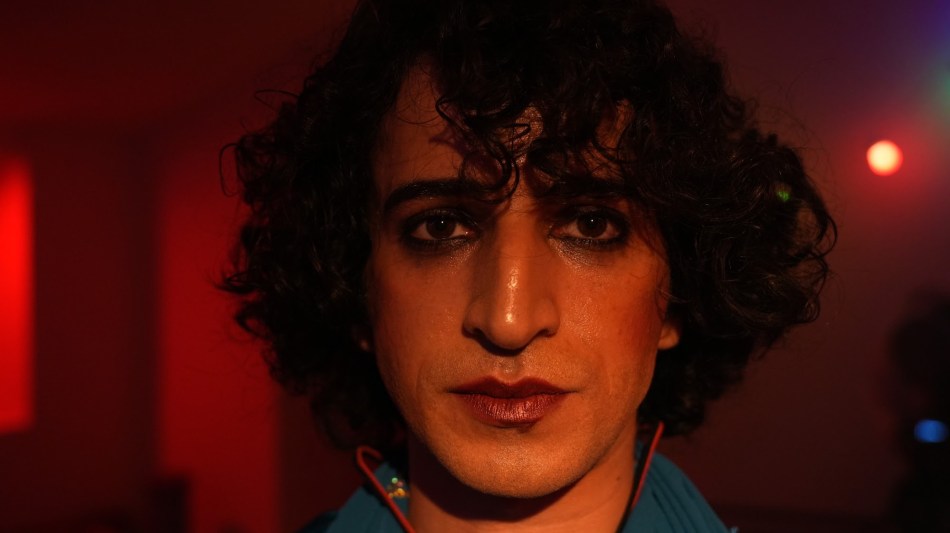
Was the Turkish director aware of the text description of her drama, which premiered in Karlovy Vary’s Crystal Globe Competition? It’s hard not to think so. For Leila’s cross-dressing is not the only gender impersonation fraught with repression, violence, and a desperate lack of alternatives within her story. Allegedly “based on true events,” it mirrors Leila’s gender enactment with that of Sanjar (Reza Akhlagirad). He lives at the titular venue, a pitiful amusement place featuring such breathtaking attractions as a tube TV playing old Hollywood movies on VHS, a vintage Gameboy, and a dance act from Sanjar. He embodies a repulsively reactionary idea of an effeminate gay man whom he seemingly became because the Taliban pushed him into that role.
Why on earth religious extremists who enforce a rigid gender binary and have plenty of cis women in their power would do such a thing remains one of many inconsistencies of the inherently offensive plot. Its basic narrative is effusively meager. Leila inevitably encounters Sanjar on her search, without him recognizing her as a woman. She frees a boy Omar’s age from the venue where he is kept with other boys, likely to be pushed into gender-bending sexwork like Sanjar. Then Leila continues looking for Omar, whose name means “hope”. A metaphor hitting the audience over the head so hard it’s painful. Not as painful, though, as the grotesquely backward, twisted representation of gender non-conformity and queerness.
Both are depicted just as crudely and absurdly unrealistically as the film’s written synopsis suggests. Anything not straight and binary here appears as a literal perversion: something people are not simply by nature but because horrible, cruel circumstances forced them into it. Kural’s film supports the idea that people could be “turned”; seduced or pushed into this bizarre concept of queerness. It is solely presented as a harmful aberration linked to child abuse. Since this narrative arc is essential to the story, it is nearly impossible to separate any of the film’s aspects from it. Not that it would make this psychologically flat and dramatically unrealistic story any better.
Apart from a decent turn by Hosseini, the acting is shallow and clunky. The child actors often just sit or stand around as if not knowing what to do. The dialogue comes off as weirdly constructed and more than once doesn’t correspond to what’s going on. At least Adib Sobhani’s desaturated cinematography, depicting the war-torn country as dust-colored wasteland, has a certain moody grace. However, any atmosphere is undermined by the cruel irony that the director-writer decries the Taliban’s brutality, yet her film inadvertently conveys ideas in common with their dehumanizing beliefs.
Discover more from Cineccentric
Subscribe to get the latest posts sent to your email.
 Cineccentric
0 comments on “Cinema Jazireh ★”