
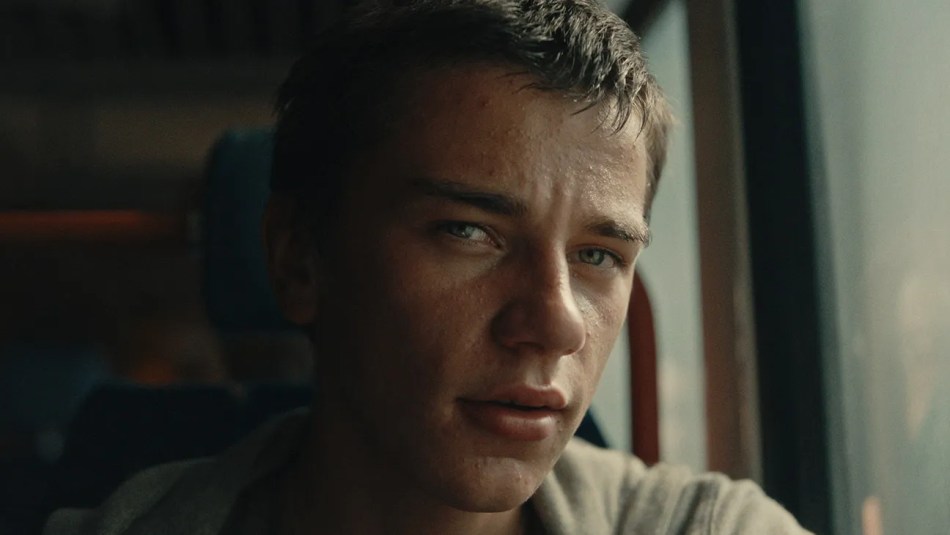
A seemingly small but significant detail of Katarína Gramatová‘s feature film debut, screening at Karlovy Vary after its Tokyo premiere, is its original title “Utekáč”. It’s the name of the remote village in Slovakia’s so-called “Hunger Valley” in which the aching coming-of-age story plays out, underlining the setting’s narrative significance. The natural beauty of the surrounding landscape contrasts sharply with the economic hardship which its inhabitants experience. One of them is Eňo (non-professional actor Michal Záchenský) who is forced to make uncomfortable decisions when he gets word of his young mother’s shady business. Single mother Martina (Eva Mores) has a well-paying job abroad, leaving her 15‑year‑old son under the care of his weary grandmother.

He kills time riding mopeds with his friends and doing odd jobs, all in the vague hope that money could one day mend his fractured family. But that hope, like many in this desaturated world of tarnished rural innocence, morphs into something more complicated. From the beginning, there are rumors about his mother’s job, off-handed comments from his pals, and his grandmother, who seems to think he is too young to know. As Eno starts to search for the truth, he is not only driven by a need to understand but to be close to his mother – if not personally, then at least through a shared secret.
A muted symphony of disillusionment unfolds in the forgotten corners of Slovakia, where the dream of post-socialist prosperity has long given way to resignation and frustration. With a calm, observational eye, shaped by her documentary sensibilities, the director-writer resists melodramatic outbursts in favor of psychological exploration. Eňo’s search for clarity mirrors a childlike desire for ethical simplicity and social permanence. This emotional undercurrent does not bring revelation, but erosion: of childhood fantasies, of familial myths, and idealistic naïveté. The two narrative strands – the listless routines of village life and the slow-burning investigation into Martina’s truth – occasionally fray at their edges. Yet the tonal divergence speaks to the protagonist’s inner schism, stuck between hoping and knowing.
Záchenský, like most of the remarkably convincing cast, is a non-professional actor and lends his character a quiet, understated anger. Cinematographer Tomáš Kotas shoots on film, giving the Slovak countryside a subtle warmth and tactile roughness. Wide shots stretch over decaying farmland and skeletal forests, evoking a quiet vastness that contrasts the intimate crises unfolding within. Natural light, handheld framing, and a silence heavy with unspoken truths radiate a self-effacing tenderness. The rugged landscape becomes a discrete marker of the uneven emotional terrain. Adults who are not so much villains as survivalists in a collapsing economy anchor the ambiguous integrity. One essential flaw to Gramatová’s teenage tale is a notion of ethical superiority closely tied to male privilege.
Martina is judged for something most men would be applauded for. Thanks to her earnings, Eno is in a far better place than she was at his age: a teenage mother left behind in a rural dump. While these double standards feel true to life, presenting them as acceptable comes with its own ambivalent implications.
Discover more from Cineccentric
Subscribe to get the latest posts sent to your email.
 Cineccentric
0 comments on “Promise, I’ll Be Fine ★★½”