

Sydney Sweeney recently featured in an ill-fated American Eagle ad campaign that faced accusations of advancing fascism and eugenics. It is, thus, perhaps poor timing that Americana with Sweeney as one of the headlining stars would come out now. A small film that was shot in 2022 and premiered at SXSW in 2023, it is not one that would ever be expected to light up the box office and yet, it has found itself as a lightning rod for jokes and cheap shots because of Sweeney’s presence in the film and the current firestorm against her. No matter how one feels about Sweeney, it is a shame to see writer and director Tony Tost’s directorial debut turned into something it is not. This is a small comedy Western set in South Dakota with an oddball set of characters all in pursuit of a stolen Lakota ghost shirt, a driving force for the plot and the film’s central thesis.

Americana is about the blood spilt in the name of White-led Western expansion. Characters frequently mention how this land that is now the film’s setting of Buffalo Falls, South Dakota, is stolen land. The ghost shirt is a crucial part of Lakota culture that has not only been stolen from them, but is being fought over by White men and women to either turn a profit or, in the case of local museum owner Roy Lee Dean (Simon Rex), further their exploitation of Native American culture. Throughout, Tost – who is likely best known now as the showrunner for the second season of Poker Face – centers Native Americans. Life on the reservation, showcasing what has become of the modern Native American tribes of the West, and the leadership of men like Ghost Eye (Zahn McClarnon), afford the film a chance to follow in the footprints of numerous classic revisionist Westerns. It is a reversal of the “cowboys and Indians” archetype with wannabe modern cowboys like Dean facing off with Ghost Eye in Americana’s bloody climax and it is not the heroic “ride off into the sunset” finale many a classic Western movie cowboy would get after a showdown with a Native American. For many in the film, the pursuit of the ghost shirt takes on a Coen brothers-esque goofiness, but for Ghost Eye and his fellow tribe members, this is a personal battle to restore at least something of cultural value to their people that has been stolen.
Americana is not perfect. It feels like a directorial debut. Tost clearly came in with something he wanted to say and while often able to distill it shrewdly and smartly, at other times the dialogue can be a bit too on-the-nose with little trust afforded the viewers’ ability to interpret. The influence of filmmakers like the Coens, Quentin Tarantino, and Rian Johnson is all over Americana with Tost still hashing out what his own identity will look like as a filmmaker. For now, it is somewhat of an amalgamation of these influences with the film lacking the auteurist polish that could make it into something really special. As Americana sets itself up with a chapter structure, showcasing the life of young Cal (Gavin Maddox Bergman) with his mother Mandy (Halsey) and Mandy’s domineering boyfriend Dillon MacIntosh (Eric Dane), then turning its focus to dinner waitress Penny Jo (Sweeney) and regular customer Lefty Ledbetter (Paul Walter Hauser), it can take some time to come together. This is a story with a lot of moving parts that will eventually collide in that bloody finale, but can be too unwieldy for its own good.
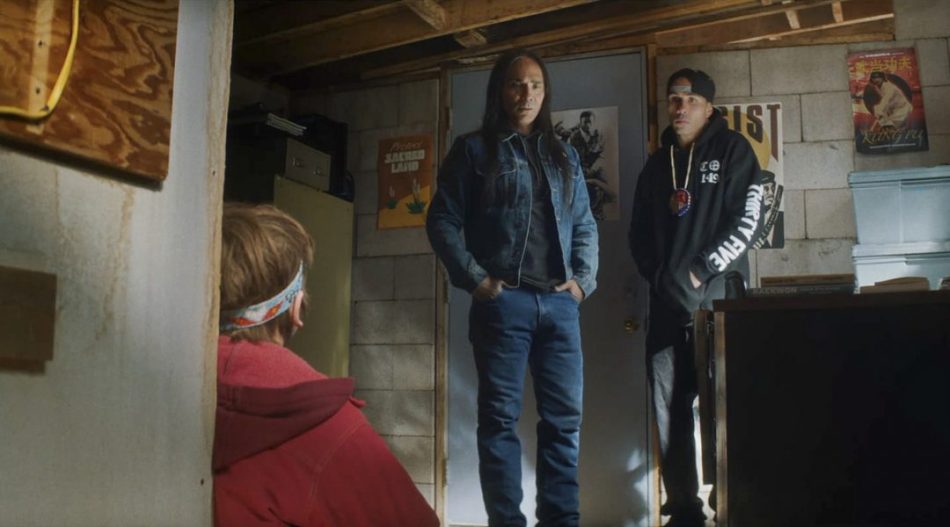
Fortunately, when Americana is good, it borders on being great. There are two scenes in particular that show the spark of Tost’s comedic writing and benefit from the incredible cast. A running element throughout is Cal’s belief that he is the “reincarnation of Sitting Bull.” Whether this is somewhat true or not is left as a mystery but, naturally, nobody around him believes this to be true. As Cal tracks down Ghost Eye and alerts him that “the White woman” (aka his mother Mandy) has the ghost shirt, Ghost Eye has a heart-to-heart with the young boy that is hysterical. McClarnon’s delivery in the conversation is fantastic and Bergman himself shows great timing and delivery of his own lines. The pair throughout have a wonderful dynamic that enriches the film each time they appear.
The film’s bloody climax is set in Wyoming at Mandy’s family home, also the setting of the second stand-out scene in Americana. The film perhaps bites off more than it can chew in this introduction with Mandy’s roots being in a patriarchal and regressive remote society run by her father. Mandy, her sisters, and mother, existed solely to serve the men in their lives and to be pimped out to local men of influence. It is a heavy element to introduce – though, together with the examination of modern Native American culture, firmly establishes Americana as a film highlighting the dark underbelly of the so-called “religious Right” and trad movement that dominate this region politically – but one that yields great comedy when the action in the home turns into chaos. The climax with every character in the film coming together in Wyoming is crazy enough, but with these women seeing an opportunity to free themselves from bondage and taking it, even more blood is spilt in this scene. The dialogue and chemistry amongst Mandy’s female family members is terrific, oscillating between dissociation from what is happening and their own shock at how much they enjoy taking revenge on these men who have oppressed them for so long. August Allen-Jones who plays Mandy’s mother Grace has perhaps the best line in the film, an off-hand, blink-and-you-miss-it line with delivery so good and timing so unexpected that it had me in stitches.
Whatever one feels about the current political firestorm surrounding Sydney Sweeney, it is a shame to see a film like Americana caught in the crossfire. It is not a great film, but it is an interesting debut. It is a small and typical indie picture, a hodgepodge of its influences and its own ideas that could use fine tuning to be even better but is plenty enjoyable as it stands. It has a strong cast. Zahn McClarnon and Gavin Maddox Bergman impress, while Halsey is terrific as the rebellious Mandy. She wears her heart on her sleeve in every scene, capturing the rough and rugged energy as well as the vulnerability needed to establish Mandy as Americana’s heart-and-soul. Simon Rex’s seedy small-town museum curator, Paul Walter Hauser’s bumbling yet earnest buffoon, and even Sweeney’s stuttering small-town diner waitress all add beneficially to Americana’s fascinating collection of oddball characters, making for a fitting portrayal of this quintessential small-town American locale. It may not last long in theaters, but Americana is a film worth watching with an open mind and one that I found to be quite entertaining in spite of its flaws.
Discover more from Cineccentric
Subscribe to get the latest posts sent to your email.
 Cineccentric
0 comments on “Americana ★★½”