
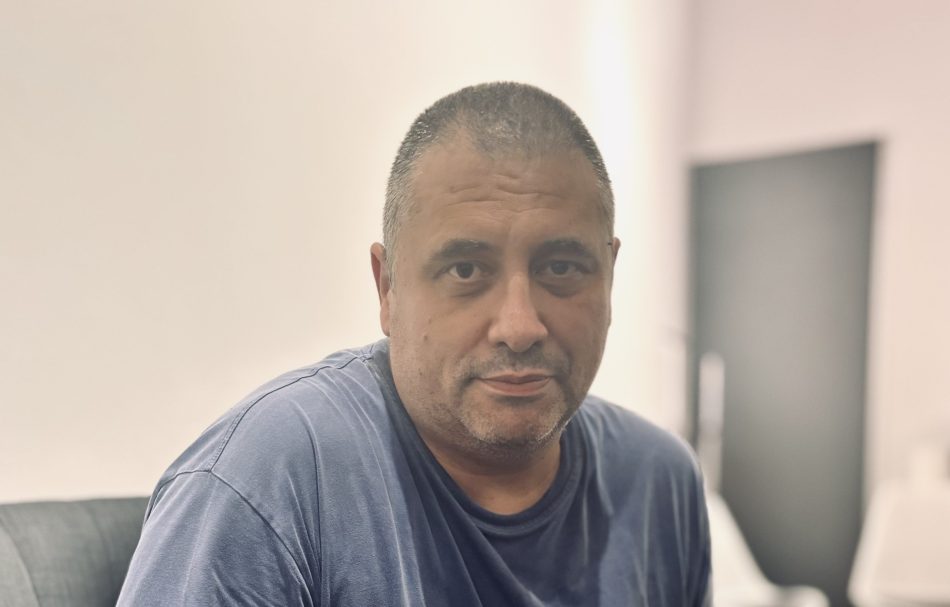
As one of contemporary cinema’s most incisive auteurs, Radu Jude returns to the competition of the Locarno Film Festival with Dracula, a crass caricature of power, mythology, and the ghosts of history. The film dismantles the familiar vampire narrative with the Romanian director’s signature blend of irony, formal audacity, and social satire. Lida Bach spoke with Jude about confronting national myths, cinematic language, and embracing commercialism.
Lida Bach: So, what does Dracula represent to you? From a Western point of view, this figure is a Hollywood fixation. But in Romania it seems like this icon has been reclaimed by nationalism.
Radu Jude: It’s a complicated answer because, during the Ceaușescu dictatorship, the Dracula myth barely existed. I don’t know if it was formally forbidden by the regime. There were no translations of the “Dracula” books, no films with vampires in Romanian cinema or on television.
After the revolution, tourists started to come to Romania and say: ‘we are here for Dracula’. People were kind of very bewildered by that. And then of course, we hit another kind of myth: Vlad the Impaler, Vlad Dracul, the origin of this vampire myth.
So we have this myth of Vladimir, which was framed by nationalists. The fascist regime in the forties and the communist regime used it also as a nationalist device. In the last year it was the extreme right-wing party that used it as an icon for their political campaign.
How?
The face and the idea because he was cruel, but just, punishing the people who were lazy. So people say we need someone like him.
Also because of the Islamophobic aspect? Since Vlad fought against the Ottoman Empire.
I don’t think so, since we don’t have [much] immigration. Islamophobia is not as big as in other societies. The wars with the Ottomans were considered like the national wars and not religious wars. It is used as an icon for Christianity, but less, as an anti-Muslim icon.
You mentioned that you cut a lot of things out of the film. Was there originally more politics in it?
No. I think I had two more smaller stories which were not very well made.
You shot the movie with an iPhone, like you did Kontinental ’25…
I needed both films to be made in the same time because this film is a bit too trashy and too much about cinema itself. That’s why I needed to make another more down-to-earth film to not lose focus.
A political dimension of the film is the use of amateur tools, something that professional cinema and the industry want to keep away. Some years ago I had a film for which I wanted to shoot something on eight millimeter. And they said, well, if you have money from our film fund, then you cannot shoot on eight millimeter because that’s considered amateur format. To shoot in amateur format, pretend you’re a tourist. Then nobody pays attention.
So are the tourists in your film aware they’re gonna be in a cinematic movie?
Probably not. I was in the Rotterdam Film Festival’s film market with another project. 20 producers and distributors every day. But they were not interested in that project. At some point, I made a joke and said: I have a Dracula film as well. And they said: Oh, in this we are interested! So I thought, why not make it? It’s a joke. Dracula is the film itself, since it sucked in other stories. The AI images are also related to the sucking concept. AI is sucking information from the whole Internet.
Do you figure AI can be used creatively to make cinema?
Absolutely! I think it’s a tool like all the others. I strongly believe that any tool can be used to make cinema. Cinema was from the beginning in strong connection with old technologies and sometimes resists technological developments.
How did you create these specific images? Were you looking forward to the worst ones?
Yes. We chose these machines to generate such things. And sometimes, it all looked too good. So we would put it in another software to destroy it.
How important was the influence of other Dracula adaptations? You have scenes from Murnau‘s famous Nosferatu in the film. Were there more influences than this one?
Oh, yes, but not as much from vampire films, which I don’t like that much. It’s more, connected to avant-garde films like the mocking films of the Fluxus movement in America. What I’m passionate about is literature, Balzac, Rabelais, and authors that had a certain freedom of composition, a freedom of narration, a freedom of digressions, which I try to achieve here. At some point, I wanted to use more from this TikTok kind of culture or Instagram.
Do you remember when you as a child first time heard about Dracula?
I found out about Dracula as a character after the 1998 revolution, like many from my generation.
You also have a lot of sex and flying dicks in your film. Was the sex there from the beginning, or did it become more and more?
I was so many times accused of not doing commercial films. So I said, okay, I’m doing a commercial [film]. What is a commercial film for you, I asked some people during a Q&A. They said commercial film means action scenes, cheap humor, nudity, sex, vampires, supernatural. I do my best to offer that and do the most commercial film. That’s why there’s a lot of flying dicks.
Was there at any point pressure to be conventional, family-friendly? To make it more tame, more accessible?
I think it’s accessible. I consider it to be very family-friendly… Of course, we don’t have a rating for the film, yet. I hope it’s not going to be 18 or something. Otherwise, it’s family-friendly because it’s very superficial and has all these pop and pulp elements.
Your son is in the film. How does he feel about it?
He understands it very well. We use him because it was cheap. He was with me and his mother in Transylvania. So I said, well, we don’t have money for actors, so you should come.
When the zombies arrive in the movie, it feels like it’s becoming a video game.
Because cinema can incorporate all these aesthetics and transform it into something else.
Would you say that as your career progresses …
Regresses!
… Or regresses, that you get more interested in the visual aspect of cinema than in the narrative aspects?
The visual aspect was always very important, but in different ways than for instance, in Kontinental ’25, which is very down to earth and realistic and based on dialogue. The visual side, which is the basic element of cinema, was always very important, always.
I’ve heard that you’re thinking about making a Frankenstein movie.
We’re still at the stage of writing. It’s for the American actor Sebastian Stan, who actually has Romanian origins. He’s Romanian. I didn’t have any idea to offer him something, he asked me. So I said, Sebastian, let’s make a Frankenstein in Romania, because if you make a kind of Frankenstein in Romania, it will [be different].
Funny, Sebastian Stan will also play Dracula in an upcoming Chloé Zhao movie.
He’s also playing the creator of Frankenstein. He will have a double role. But this movie won’t be shot anytime soon, because I’m working on three other films now. So in two years from now.
Do you always work on several things at once?
That’s the lesson of Fassbinder, who’s my hero. I find it easier because while working on one project, you can find ideas for another.
So your films kind of intermix?
Sometimes. Ideas you’re testing in one project don’t work, so you move them into another one.
Do you remember why you wanted to become a filmmaker?
Oh, it’s such a long story. You can find it on the internet. It started with going to the cinema, discovering this place when I was 15 years old, watching films and starting to think about them. I applied to film university for many years and was never accepted. Then I started to work in film studios for foreign films. I started as a casting assistant, director assistant, production assistant. Then I started to direct soap operas, teleshopping, commercials, TV shows.
Do you ever get tired of making films?
Yes. Always. I get tired and lose my interest for a while. But when I start working, the enthusiasm appears again.
Do you always need something new to challenge you or to evoke your interest?
It’s an interesting perspective. I didn’t think of that in this way, but maybe. We have to see something that [is refreshing].
How do you work with the actors? Is there a lot of improvisation?
I don’t have a method. In this film, there’s a lot of improvisation by some actors and none by others because some can improvise better, some not.
Why did you decide to use this specific ending following your everyday man?
It was a way of getting back to reality. It’s a small story about how after all these things, you get back to a reality of discrimination, of day to day problems.
So would you say the first major part is more cinematic escapism?
I don’t like the word escapism. I prefer to say it’s about the pleasure of cinema, the pleasure of storytelling. It’s about the pleasure of bad stories. It’s difficult to define. So I was just thinking if you’re right.
When you work at three films at once, do you have anything that occupies you apart from film?
Well, it’s a very important part of my life, true. But I have a family life. I have kids. I don’t have other hobbies. I’m reading, but less.
How do you feel about being at festivals? Enjoyable, exhausting, a bit of both?
It’s a mix of feelings. It’s pleasurable, but in the same time, it’s exhausting. It’s frustrating because I would like to see some of the films and I never have time to watch anything! It’s a place where there’s so much superficiality, but at the same time so much passion for cinema. A bit like a bubble. So I have a mixed opinion. At least I can appreciate that festivals are promoting other kinds of films. I see it as a resistance to the pressure of the market. This resistance is maybe not very well done, but still it is a resistance.
Thank you so much for this interview!
Discover more from Cineccentric
Subscribe to get the latest posts sent to your email.
 Cineccentric
0 comments on “‘Dracula’ Radu Jude Interview”