

If someone asked if Steven Kostanski’s retro-romancing reboot of Roger Corman’s eponymous sword-and-sorcery film series is strictly speaking a good film, the answer would be: no. But neither is Corman’s 1983 cult favorite. So a lack of conventional cinematic merit seems paradoxically appropriate for the Canadian director-writer’s celebration of 80s pulp glory. It’s practical-effects driven tone, nostalgia-tinged aesthetic and self-aware humor give this mix of reinvention, remake and reverence, premiering Out of Competition at the Locarno Film Festival, an off-beat charm and old school appeal. The latter is enhanced by the nonchalant exposition of conceptual contradictions, not only within the original film but the genre itself.
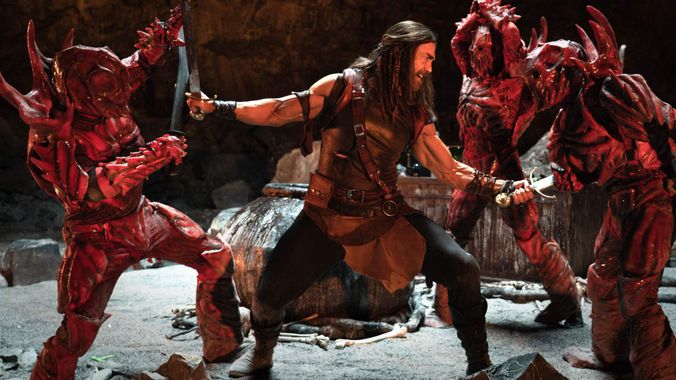
Dangling between parody and pop-cultural enshrinement, the new Deathstalker interrogates the campy cocktail of fake grandeur, hyper-masculinity and cartoonish gore that back in the day were often taken seriously. While the original series excelled in cheap spectacle and exploitation, it isn’t interested in resuscitating the sword-and-sorcery genre. Rather than faithfully reconstructing Corman’s film, it lets its textures speak for themselves. The ancient kingdom of Abraxeon is overrun by hordes of Dreadites, demonic warriors sent by the evil sorcerer Nekromemnon intend to throw the world into everlasting darkness. A grizzled barbarian scavenging the scorched battlefields retrieves an old Amulette. This magical item holds the secret to ending Nekromemnon‘s reign.
Marked by ancient magick and pursued by assassins, Deathstalker (Daniel Bernhardt) sets out on a quest to break the curse and save the realm. The search unfolds like an archeological dig through fantasy clichés, tropes and purposefully familiar twists. The mighty warrior is joined, aided, and occasionally sabotaged by the wizard Doodad (Patton Oswalt) whose malfunctioning magic functions as an ironic chorus, and the musically attuned, shifty thief Brisbayne (Christina Orjalo). While the ragtag trio represents prototypes straight from a role player game, their character dynamic and personalities reflect contemporary sensibilities and are surprisingly heartwarming. This goes especially for the relationship between Deathstalker and Brisbayne.
She is not an object of sexual conquest as so many brass-bikini wearing warrior queens in the sword and sorcery world, but rather a clever little sister to his burly older brother. Together with Doodad they form an alternative family of misfits who all left behind more assimilative alliances to do their own thing. Violent sex, voyeuristic body display and a superlative gender binary become the sole set of motives which the ironic plot doesn’t invoke or iconize. It’s this unpretentious awareness of the problematic aspects of Corman’s Deathstalker and numerous other works of its era that makes its modern riff enjoyable despite its predictable plot and punch lines.
Narrative invention is deliberately discarded in the blunt – or, let’s say, barbarian – story. Its prime qualities are on the outside: visual excess, atmospheric artifice, and hand-made effects, unmasking the genre’s masquerade of grandeur. Likewise, the scenery’s dusty taverns, stone corridors, and battlefield wastelands suggest studio worlds built for temporary inhabitation. These sets revel in their own artifice rather than in illusionistic completeness, thereby highlighting the childish absurdity of expectation fantasy film. Through his Action Pants FX studio, the film teems with creature suits, prosthetic makeup, and delightfully kinetic stop-motion animation. As a tactile contrast to the smooth omnipotence of CGI, such rough physicality becomes both statement and satire.
Bernhardt’s performance carries the requisite stoic bravado, rendering him comic in context, while Oswalt’s Doodad adds dry wit. Together they expose the theatrics of the heroic quest as they enact it. The low budget production aligns itself with traditions of ironic pastiche while still preserving a core of affection for its source. An anarchic attitude and studio scenery are part of that exploration, as is the dialogue, which alternates between solemnity and self-parodist banter. Deathstalker treats its roots not as a lost tradition but a cultural artifact, its polarizing aspects are laid bare through amplification. Acknowledgment of the genre’s absurdities comes with a refusal to relinquish its pleasures.
Discover more from Cineccentric
Subscribe to get the latest posts sent to your email.
 Cineccentric
0 comments on “Deathstalker ★★½”