
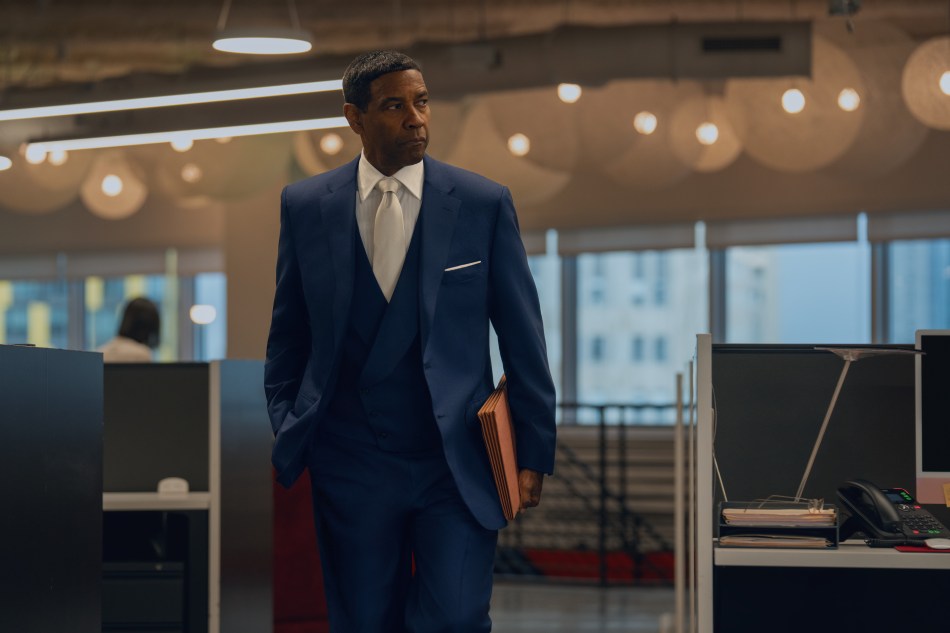
The New York City skyline is beautiful. Cinematographer Matthew Libatique’s camera conveys this at the start of Highest 2 Lowest, Spike Lee’s latest film and remake of the Akira Kurosawa classic High and Low. Norm Lewis serenades the scene with a rendition of ‘Oh What A Beautiful Mornin’’ that leads to a zoom onto music mogul David King’s (Denzel Washington) penthouse, the King himself arranging an offer to buy back majority ownership of Stackin’ Hit Records, the record company he had founded. King’s label had achieved great success in the early 2000s, though in 2025 the company is at risk of a buyout from a larger competitor. King regards his label and the music it puts out as authentic while judging the music from the competing label as overcommercialized and lacking integrity. He believes that the heyday of Stackin’ Hit Records has not passed, and has a strong conviction of the label’s integrity and continued relevance to the music industry.
The start of Highest 2 Lowest finds King at his most optimistic, an upbeat orchestral score filling each scene. King has a loving family, a wife and a son, and he looks forward to reclaiming his record label and continuing his work in the music industry. He does well navigating his family life, his business, and the demands for his attention, and it is rare when his ear isn’t solicited by budding musicians eager for him to hear their music and sign them. King, simply put, is rich in every sense of the word. Most importantly, he lives a fulfilled life. A lush score reinforces the scale of his success, and it is chilling when the music stops once he receives a call on the same balcony he had celebrated his offer coming together earlier that morning. King is told that his son had been kidnapped and that he must pay a hefty ransom for his son to be returned.
King knows that paying the ransom money endangers his offer to buy back majority ownership of Stackin’ Hits, but his son’s life is unquestionably more important. He is faced with a moral dilemma, however, when his son is found safe yet his close friend and chauffeur’s son Kyle (Elijah Wright) had been kidnapped instead mistakenly. Even so, the kidnapper demands the ransom, believing that King would not let harm come to Kyle.
Those familiar with Kurosawa’s High and Low will find much familiarity in Highest 2 Lowest; however, a key difference between the two films is the time period they take place. In 2025, Highest 2 Lowest is immersed in an era of social media and short-form video content. The speed at which information spreads and is misconstrued is immeasurably faster today than through the newspapers of the 1960s. King, and especially his son Trey (Aubrey Joseph) who was raised in this generation, is keenly aware of this and King’s decision about the ransom not only has moral implications, but also implications for his public-facing persona. Maintaining positive optics & attention (particularly where the music business is concerned) is supreme. Facts and context – which can’t be properly developed in a social media post or short-form video – be damned.
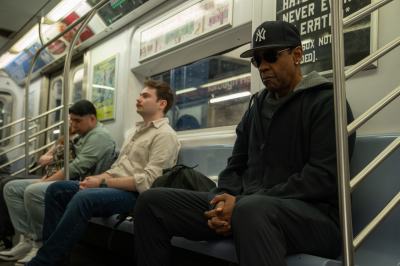
In Highest 2 Lowest, Spike Lee is critical of our contemporary preferences for communication, and argues that their imposed shortmindedness ultimately has consequences, especially when it comes to authenticity. He attributes the differences between King and the kidnapper (who also has a background in music) to greed and a focus on money rather than music. “All money ain’t good money”, spoken by King, becomes a refrain within the movie’s dialogue, and it’s no wonder. King is not willing to make a quick buck at the expense of his music or his label. If his profits are at risk because of this, it’s of minimal concern to him. Unlike him, the kidnapper, portrayed by A$AP Rocky, is primarily motivated by money. His frantic negotiations with King, as well as a fated confrontation between the two, illustrate that the two have substantial differences in their means of rationalization and communication, and Lee attributes this to generational differences between the two men in part caused by the present’s pervasive shortmindedness.
Lee also emphasizes the short-term memory of the public consciousness through recurring imagery of the Jordan brand. While the legend of Michael Jordan and knowledge of his greatness is very alive and well today, the effort and unfettered determination that was required to achieve that greatness hasn’t maintained the same relevance as the Jumpman logo. Kyle even asks “who’s Michael?”, seemingly not in jest, after his basketball coach references Jordan by his first name. In the Jordan brand, King sees a reminder of the grit and obsession needed to achieve greatness, not unlike his own in starting Stackin’ Hits Records. Trey and Kyle, on the other hand, see the Jordan brand as a status symbol.
Spike Lee’s modernized take on High and Low has definitive commentary on artistry and integrity. Highest 2 Lowest will likely resonate with artists or anyone who has held immense passion for their career. It’s when the film isn’t focused on these areas that it falters and appears undisciplined, even akin to a parody of Lee’s films and persona. A sports fan screaming “Boston sucks” directly at the camera echoes Lee’s sports fandom for New York, the title of the film being dropped in two separate scenes, and an apartment number of “A24”, the film’s production company and distributor, attempt to be tongue in cheek, but these instances become more and more noticeable in the second half of the film and detract from the experience of watching the movie. As a result, while Highest 2 Lowest exhibits a strong directorial statement for Spike Lee, his film has notably less composure than the Kurosawa classic it adapts.
Discover more from Cineccentric
Subscribe to get the latest posts sent to your email.
 Cineccentric
0 comments on “Highest 2 Lowest ★★½”