
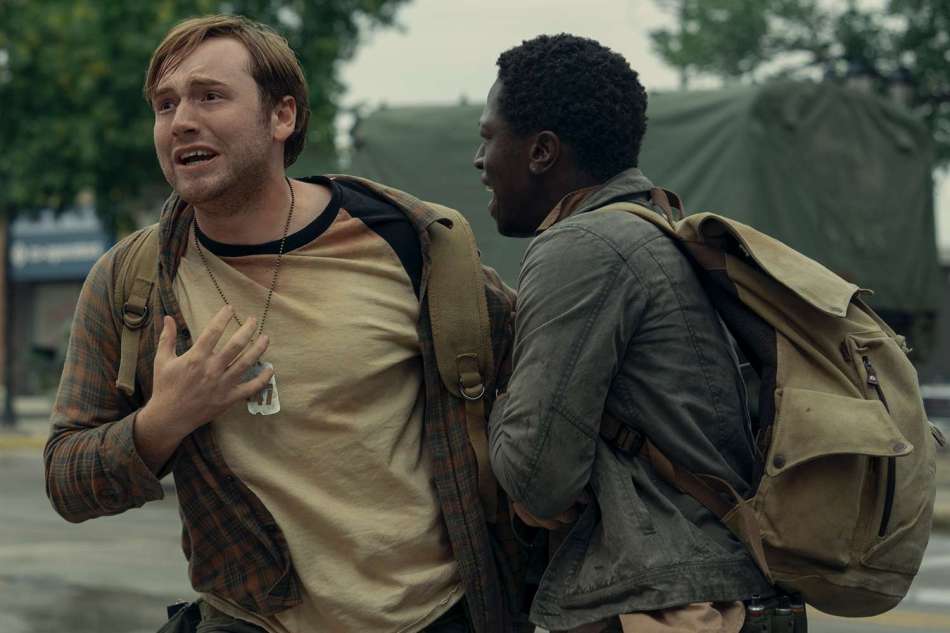
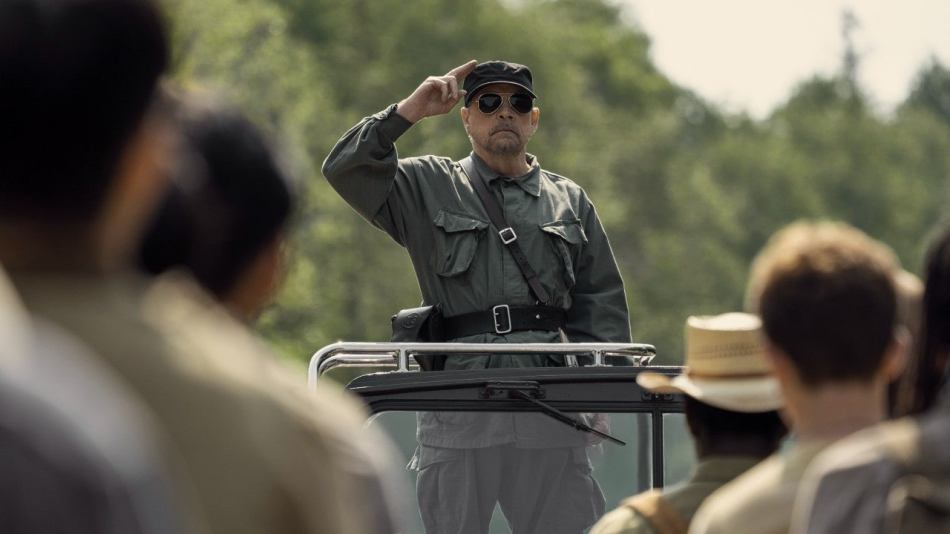
The Long Walk is a film about brotherhood and friendship. It is a story about the good, the sliver of light and its power amidst the dark oppressive forces threatening to snuff it out. The very first novel written by Stephen King (though not the first to be published), The Long Walk is set in a totalitarian America, 19 years after a war that forever changed the country. Young men from across the country volunteer every year to participate in “The Long Walk”, an endurance challenge to walk at least 3 MPH and stay on course until they cannot walk any longer. One individual is chosen from every state and promised bountiful riches and one wish if they win. The other 49 are killed after three warnings if they fail to maintain the 3 MPH pace or are killed the moment they step off-course. It is, as the vicious Major (Mark Hamill) – the man who organizes and leads the troops that enforce the rules of the walk – contends, a symbol of hope for every state and a way for the nation to come together every year to watch these young men push themselves well past any normal human limits.

Of course, “The Long Walk” is anything but a symbol of hope. The Long Walk is a clearly pointed critique of fascism and a totalitarian government with this walk the epitome of their cruelty. Pitting young men against one another, turning their deaths into sport and entertainment, and offering this walk as an allegedly voluntary endeavor that brutalizes them in the name of self-advancement. This walk is the only way out. It is, as participants Ray Garraty (Cooper Hoffman) and Peter McVries (David Jonsson) discuss, an “escape hatch” from poverty and toil, but it is the only one offered. For the non-participants, it is a spectacle. Locals gather along the road to watch, while fans watch on television and others gather around the predicted finish line to witness the final kill live. It is bloodsport and inhumane. Participants must defecate and urinate in the streets while still walking. They are given meager rations of food. One slip, one cramp, or one piece of faulty footwear could spell the end for them. It is a debasing of the individual that yearns for more in a society held hostage by the rich and the powerful. It is the epitome of life in fascism, an endless and monotonous walk punctuated by those nearest to you being horrifically killed (or being disappeared) for breaking the rules. Either walk or die. Either volunteer (comply) or die. There is a carrot dangled, but no escape hatch. The road does not stop just because the walk ends, nor do the winnings allow one to escape from the government’s grip. It is a poisoned chalice, propaganda for future generations to keep signing up and a guarantee that the fascist rule progresses unchallenged.
Yet, amidst this bloodshed and toil, these young men find something that the rest of society has lost: unity and brotherhood. As they die one-by-one, they recoil and try to fight their emotions. They want to win. They have ideas on how they will spend the money and their one wish. But, they do not want to watch the men they have walked so many miles with die. They are powerless to resist, as any attempts are quickly snuffed out by the armed guards around them. They must simply walk and wait, either for themselves to break and submit to death or to watch one of their brothers succumb. The Long Walk is brutal and unrelenting. Director Francis Lawrence shows the men looking away, but the audience is not afforded the same luxury. We see their heads blown through with bullets or watch them wail as they clutch their stomach after a gutshot. One moment, they are alive and trying to gather themselves. The next, they pay the price for their humanity and for having a physical and, especially, mental limit. Ray, Peter, Art (Tut Nyuot), and Hank (Ben Wang) make up the “musketeers” and though they are in competition with one another, they help each other survive. They hold one another up as they trade walking naps. They share rations if one of them drops theirs. If somebody thinks they are at their limit, they talk them up and help them push through the mental barriers and physical pain. It is fatalistic knowing what awaits at least all but one of them (or perhaps all of them), but as Ray and Peter agree, these “moments matter.” It may be brief and destined to end brutally, but it is no different than any other in life where “death is the only guarantee.” The only catch here is that death will come on this road and before a national television audience. It is tragic and stirring, a heartbreaking endeavor built on raw, human performances. It is also inspiring and life affirming. It is not hopeful in the ways the Major believes, but hopeful in the sense that even amidst this horror, souls can connect and friendships can form. These young men live decades in hours and days with the memories and “moments” to match. In these moments of crisis, as a government pits them against one another for limited resources and opportunities, they know they are strongest working together. They are, in their own way, a resistance movement.
Lawrence’s unflinching direction is crucial to The Long Walk success, as is the cinematography of Jo Willems. Washed out colors offer a bleak and downcast look while these boys trudge through familiar looking small-towns, open spaces, and eventually a downtown area as they move across America. It is suffocating at times in its tight framing, while often striking in its beauty amidst the horror. Willems’s use of silhouettes in the night sequences is brilliant, offering a poetic and stirring image of them walking united through such arduous conditions. The shots of the men walking in the foreground while a fallen brother is shot in the distance, the soon-to-be deceased’s voice amplified, and the pained reactions and flinches of those still alive, make for haunting and heartwrenching imagery. This is a story of humanity amidst such oppression and Willems’s work keeps it centered, bringing the audience into this intimate space with the men and allowing us to feel the exhaustion, love, and pain alongside them.
Also crucial to this is the remarkable cast. Cooper Hoffman and David Jonsson carry The Long Walk on their shoulders. They have so much charisma and heart. Their camaraderie is remarkable and their chemistry contagious. Hoffman’s scenes, too, with his mother (Judy Greer) are so affecting that one has their heart in their throat from the very first scene. The bond between “the Musketeers” is also deeply touching. The final scene between Tut Nyuot, Hoffman, and Jonsson is packed with emotion and a scene that Nyuot steals. Mark Hamill’s performance as the Major is properly domineering, looming tall with a brooding presence that captures his at-first intimidating nature. Hamill’s chilling delivery of his line in a flashback scene stands out, while Hamill plays this as a man who feels empowered by his station, the fact people fear him, and the weapons he arms himself with. Once stripped of this, he has just false bravado and is just as vulnerable as anybody else.
Engrossing and exhausting, The Long Walk is as much a journey into what it means to live under a totalitarian regime – perhaps there will not be a “long walk”, but the conditions that it exploits exist – as it is an examination of the brotherhood that is possible in spite of such antagonistic conditions. The young men on this walk may be desperate, but together, they are capable of possibly enacting change. They must walk, but they do not need to capitulate to the forces that put them on this road. Powerful and stirring with great direction, cinematography, and performances, The Long Walk is another great Stephen King cinematic adaptation.
Discover more from Cineccentric
Subscribe to get the latest posts sent to your email.
 Cineccentric
0 comments on “The Long Walk ★★★½”