
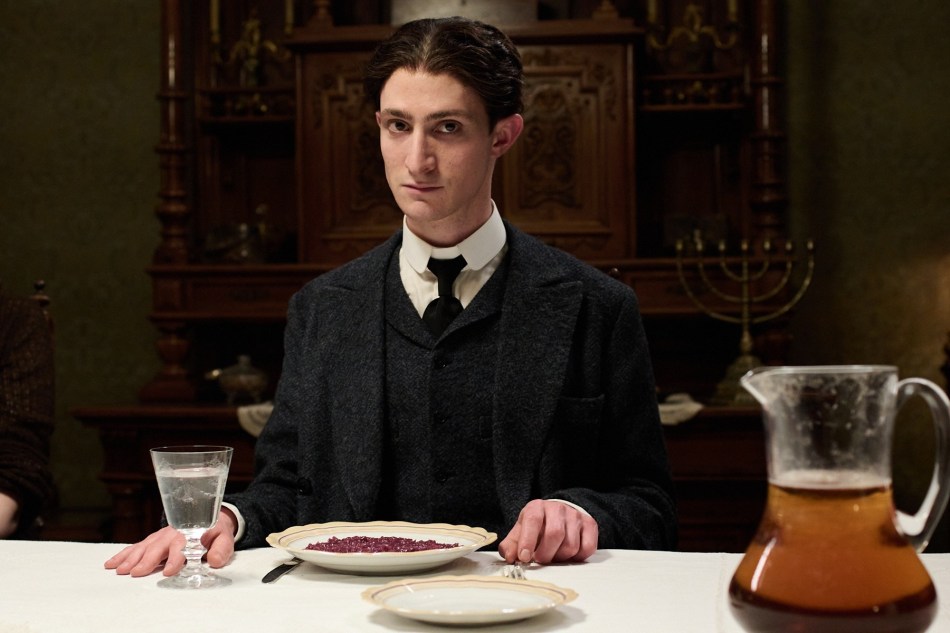
Having been to Prague, where the troubled title character of Agnieszka Holland‘s erratic biopic spent most of his life, significantly helps with connecting its recurring references to local sights, memorizing and monetizing his persona. One of these prominent tourist attractions – Czech artist David Černý’s colossal Kafka head with constantly shifting features, supposedly symbolizing his unstable mental state and volatile psyche, is actually cited on the film’s poster. There, it becomes an involuntary signifier of the Polish director’s own failure to grasp her subject’s tangled mind. The latter is the only potentially interesting aspect of Kafka’s (Idan Weiss) utterly unremarkable – or bluntly speaking: outright boring – life.
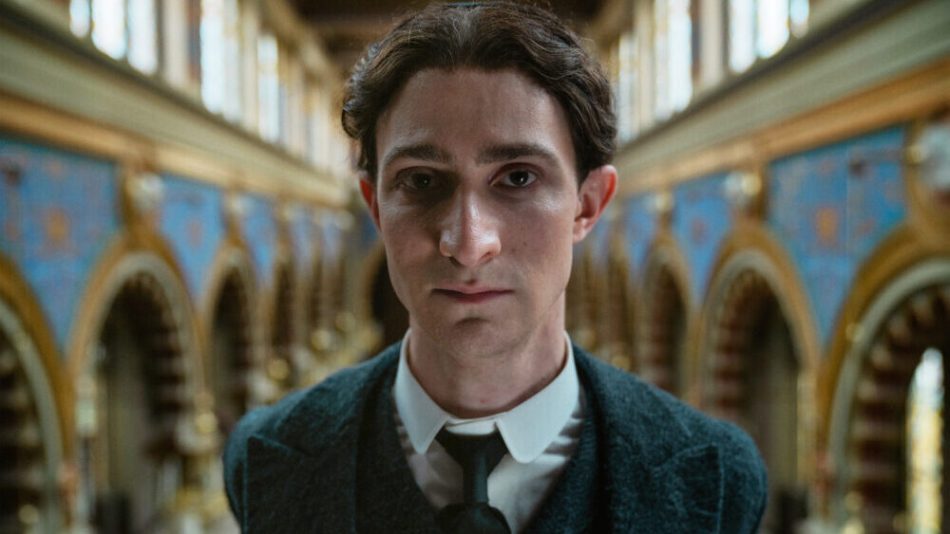
Marek Epstein‘s disjointed screenplay regularly tries to escape the dull drudgery of Kafka’s office into the surreal scenarios of his stories. The irony that many of them were inspired by the insurance clerk’s first-hand experience of bureaucratic brutality and administrative absurdism largely escapes the blunt biography. It starts out with Franz as a boy getting an unflattering haircut by his father (Peter Kurth). Cut to about a decade later as the now adult protagonist undergoes the same procedure. Such blatant signposting of his subservient nature, social awkwardness, and nervous ticks plagues the anecdotal account. Despite overt attempts at postmodern progressiveness, narrative tropes and aesthetic conformity root the scenario firmly in the period it depicts.
As far as costumes and settings go, this early 20th century Bohemia looks pleasant enough, though depressingly conventional. Tomasz Naumiuk‘s brash cinematography eagerly tries to convey a sense of action when not much is happening. Kafka has his first public readings of what his father calls silly writing, and falls first for German lower-middle-class Felice Bauer (Carol Schuler), then for her friend Grete Bloch (Gesa Schermuly). He’s refused by the army due to his declining health and – after surviving the two deadliest episodes of his time, the Spanish flu and the First World War – dies of tuberculosis at the relatively early age of 40.
Holland switches between distant historic melodrama and breaking the fourth wall by having characters like his longtime friend and supporter Max Brod (Sebastian Schwarz) speak directly to the theater audience. However, such quirks come off as more gimmicky than groundbreaking. Especially since character portrayal and literary interpretation remain frustratingly conventional, bordering on conservative. The shrewdly scattered plot reveals uncomfortable patriarchal undertones that feel all the more misplaced given Kafka’s own lifelong struggle with the traditional image of brutish masculine force represented by his imposing father. Their uneasy relationship was a constant and much theorized upon source of insecurity for Kafka.
Apparently, he found even the most banal exchange deeply traumatizing. Why that was, however, never becomes clear. With all its pretentiously progressive visuals and experimental eccentricities, neither the disjointed dramaturgy nor the tense acting can get to the core of his angsty antics. The same goes for his curiously parenthetical romantic flings. Throughout his short life, Kafka seemed more enamored with an abstract construct of love than any actual person. He would sublimate his love interests to idealized hypothetical figures but seemed only able to engage with them formally but never emotionally, intellectually, or physically. On a dramatic level, the same goes for Holland. She seems to have some theoretical ideas about Kafka but no fleshed out image.
Discover more from Cineccentric
Subscribe to get the latest posts sent to your email.
 Cineccentric
0 comments on “Franz ★★”