

“The revolution will not be televised.” It’s the title of the classic Gil Scott-Heron song, a defining, poetic ode to Black Liberation that continues to have a driving urgency despite being written 55 years ago. In Paul Thomas Anderson’s One Battle After Another, it’s also part of the codespeak used by revolutionary activists who’ve been forced into hiding after one of their members was captured by the authorities and named names. Then again, it also serves as a nod to the source material for Anderson’s new film, Thomas Pynchon’s 1990 novel Vineland, which takes place on the verge of Ronald Reagan’s reelection in 1984, a time when television has become so insidious that “Tube addiction” is a widespread, mind warping affliction. In Pynchonland, Tube addiction isn’t just happenstance, it’s purposeful. Not only is the revolution not going to be televised, television will be one of the main tools in preventing the revolution from ever happening.
These days, you could extend the invasive, sedating effects of mass media to include social and streaming media, but, remarkably, Paul Thomas Anderson is making a case for cinema’s present-day vitality – as a means to provide an authentic voice for the counterculture, to reflect their concerns in a way that might actually inspire someone to do more than just sink deeper into the couch as the next episode autoplays.
One of the most remarkable things about One Battle After Another is that it achieves the not-so-easy feat of being seriously political while also being ridiculously entertaining. Since Boogie Nights, Anderson’s best films have often arrived with a kinetic charge – they’re alive and kicking in a way that can give a viewer goosebumps. This has especially been the case since the auteur has hooked up with Jonny Greenwood, whose scores often have the magical ability to be both propulsive and nerve-jangling. And it’s certainly the case again, as Anderson, Greenwood, and an incredible cast of actors, rise to the challenge and put in the kind of next level work that raises questions about career best.
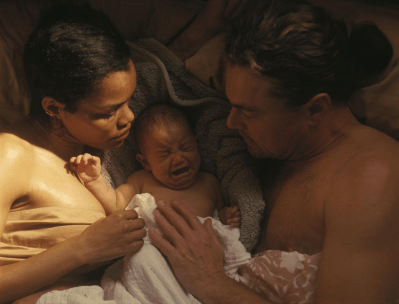
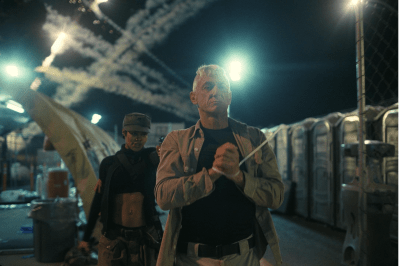
This time around, the ensemble story is loosely centered around “Ghetto” Pat Calhoon, aka “the Rocketman”, aka Bob Ferguson (Leonardo DiCaprio), a member of the French 75, an activist group that we first meet during their liberation of an immigration detention center located on the U.S./Mexico border. “Ghetto” Pat is the group’s demolitions expert, and as they detonate bombs in banks and courthouses, Pat falls in love with the beautifully Black Perfidia Beverly Hills (Teyana Taylor), one of the French 75’s more militant members.
But Pat and Perfidia’s blossoming romance is complicated by Col. Steven J. Lockjaw (Sean Penn, who may be earning himself another Oscar nom here) who received a dose of psycho-sexual torture from Perfidia during the aforementioned takeover of his immigration center and has been obsessed with her ever since. And that obsession isn’t exactly rebuffed by Perfidia. She’s kinda into it, and her growing recklessness ultimately leads to the law, and Lockjaw, catching up with the French 75 and arresting Perfidia, who then gives up the names of her informants, sending the members of the group scattering to the wind.
There is however, one more detail that makes all the difference. Before she was arrested, Perfidia gave birth to Charlene. However, during her pregnancy, Perfidia didn’t act pregnant, and after Charlene is born, she still wants to be a badass activist first and a mom maybe second or third, leaving Pat with the job of raising the child. He doesn’t know that Chalene may be Lockjaw’s kid, and Lockjaw doesn’t really care about Charlene until, sixteen years later, it becomes an issue with his getting membership in a powerful white supremecist group named the Christmas Adventurers Club. Lockjaw’s desperation to erase his own history, the proof of his relationship with a Black woman, is what sends him after Pat and Charlene – who are now living a quiet, small-town life as Bob and Willa Ferguson.
It’s at this point that the movie really settles into its primary tone, which is that of a nervous, giddy chase film. After getting to know the new Bob and Willa (Chase Infiniti) – Bob having fallen into the role of a dope-smoking burnout, and Willa rising to the role of Bob’s responsible caretaker and ninja-in-training. Willa leaves for a school dance just before the alarms go off as Lockjaw and his immigration enforcement goons descend upon their town with extreme blunt force, all under the pretense of breaking up a phony heroin-smuggling ring that’s being pinned on the town’s service industry employees.
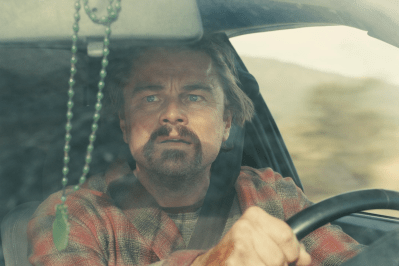
For much of the remaining film, Bob is on the run, trying to track down Willa, who’s been picked up and carried to a safehouse by another former French 75 member Deandra (Regina Hall). Fortunately, the pot-addled Bob, who can’t remember any of the codespeak that would make his escape much easier, is assisted by Sergio St. Carlos (Benicio del Toro), Willa’s calm and methodical ninja instructor. The last piece of this knotty puzzle belongs to the Christmas Adventurers Club, who end up sending their own assassin to try and clean up the mess that Lockjaw is making.
There is a lot going on in One Battle After Another, but unlike Anderson’s previous take on Pynchon material, Inherent Vice, the colorful details never threaten to overwhelm. For better or worse, this time he’s taking a very loose approach in his adaptation. There’s a reason why it says the movie is “inspired by” Vineland and not “based on” the book. He’s plucked out four characters and turned their story into a linear, straightforward narrative.
When Anderson was on Marc Maron’s WTF podcast back in 2015, he talked about his obsession with Vineland, and how rereading the book was practically an annual ritual. One Battle After Another is essentially the result of having internalized the text, updated it, and made it his own. Other Pynchon obsessives, like myself, can’t really complain about your typical adaptation issues of “faithfulness” because a text like Vineland, which includes aliens, Godzilla, and a significant subplot involving hippie ghosts, defies adaptation to begin with.
But even with the looseness of this translation, there’s no escaping the Pynchonian thematic concerns that are at the heart of both Vineland and Inherent Vice. Despite being published years before Inherent Vice, Vineland acts as a kind of sequel to that story, moving a step forward in history, from Reagan’s California to Reagan’s America. Where “Doc” Sportello was investigating the first disappearances and commodification of America’s liberal values, the first signs of the encroaching darkness, in “Vineland” we see only that only ghostly remnants of those values remain. The suppression has evolved from a shady operation to a full out assault.
More specifically, you’ll remember that Coy Harligen, Owen Wilson’s character in Inherent Vice, is believed to be dead, but actually got turned into a government informant, snitching on members of the counterculture. It’s eating away at his soul, and perhaps the only happy ending Inherent Vice has to offer is Coy being able to return home to his family – back to the land of the living. Coy’s tale is echoed in Vineland, and represented in One Battle After Another in the character of Perfidia. But whereas in Vineland that storyline was expanded and deepened to become the heart of the matter, in Anderson’s version, it’s more or less relegated to Act One.
That might be my only complaint, that the movie is less interested in Pynchon’s main concern, about how America’s liberal trajectory got co-opted and corrupted. This is the corruption that is represented in the central relationship of Vineland, but it doesn’t quite mirror the one we see between Perfidia and Lockjaw. Anderson’s take on that relationship, and those characters in general, is a lot less complex, but at the same time it’s all pretty forgivable due to what Anderson does deliver on.
In updating the story, One Battle After Another absorbs the politics that have further crystalized since 1990. Instead of looking at the coordinated efforts that went into co-opting and commercializing the counterculture, it focuses on the more recent coordinated efforts to erase history altogether. There’s a hilarious scene early on, when a stoned Bob goes to a parent-teacher meeting and his first question is, what kind of American history are you teaching? The right history? In everything that follows that scene, we can see the trouble, the futile panic and ugly desperation of what happens when you believe you can escape the truth and rewrite what’s already happened. While Lockjaw’s exploitation of Perfidia may speak to a certain original sin in America’s past, Anderson’s film is pointedly including the history of Native Americans and Mexican-Americans as part of the endangered narrative.
It might deserve repeating that One Battle After Another is a hugely entertaining crowd-pleaser. And among the movie’s many unexpected pleasures is watching, alongside our bewildered Bob, just how thoroughly entrenched and well-prepared the Mexican-American community is. When Bob goes running to Sergio St. Carlos, he has no idea that he’s basically turning to one of the leaders in the modern resistance movement. Watching the frazzled and bedraggled DiCapprio get paired with the calm, cool and collected Del Torro is witnessing a comedy duo for the ages.

There isn’t a hint of a bad performance in the film, but the biggest star may be Chase Infiniti (which sounds so much like a Pynchon character name that it boggles the mind). I haven’t watched Apple TV+’s version of Presumed Innocent, so this really struck me as one of the most impressive debuts I’ve seen in some time. From the first moment you see her on screen, practicing some karate moves, Infiniti’s delivering a fully-formed, lived-in performance, and she’s never not captivating. Her chemistry with DiCaprio is the warm, beating heart of the film. And, as in the book, she’s the all-American kid that represents the future, the hope that maybe the next generation can get the country back on track. If they were all kickass warriors like Willa Ferguson, I’d sleep a lot better at night.
But Anderson’s movie gives us more hope than just pointing to the kids. It shows that there are perhaps more people keeping the flame alive than there were in the 1980s. Certainly, they’re more visible, and therefore more frightening, to those who like to live in the dream world of white supremacy and a fabricated history. That’s what makes One Battle After Another feel like such a wake-up call and such a perfect movie for our moment in history. See this movie in a theater. It’s like turning off the Tube, looking around, and being rest assured that the resistance is in fact alive and well. What a gift.
Discover more from Cineccentric
Subscribe to get the latest posts sent to your email.
 Cineccentric
0 comments on “One Battle After Another ★★★★”